Actual Real Bitcoins Explained and How to Verify Them
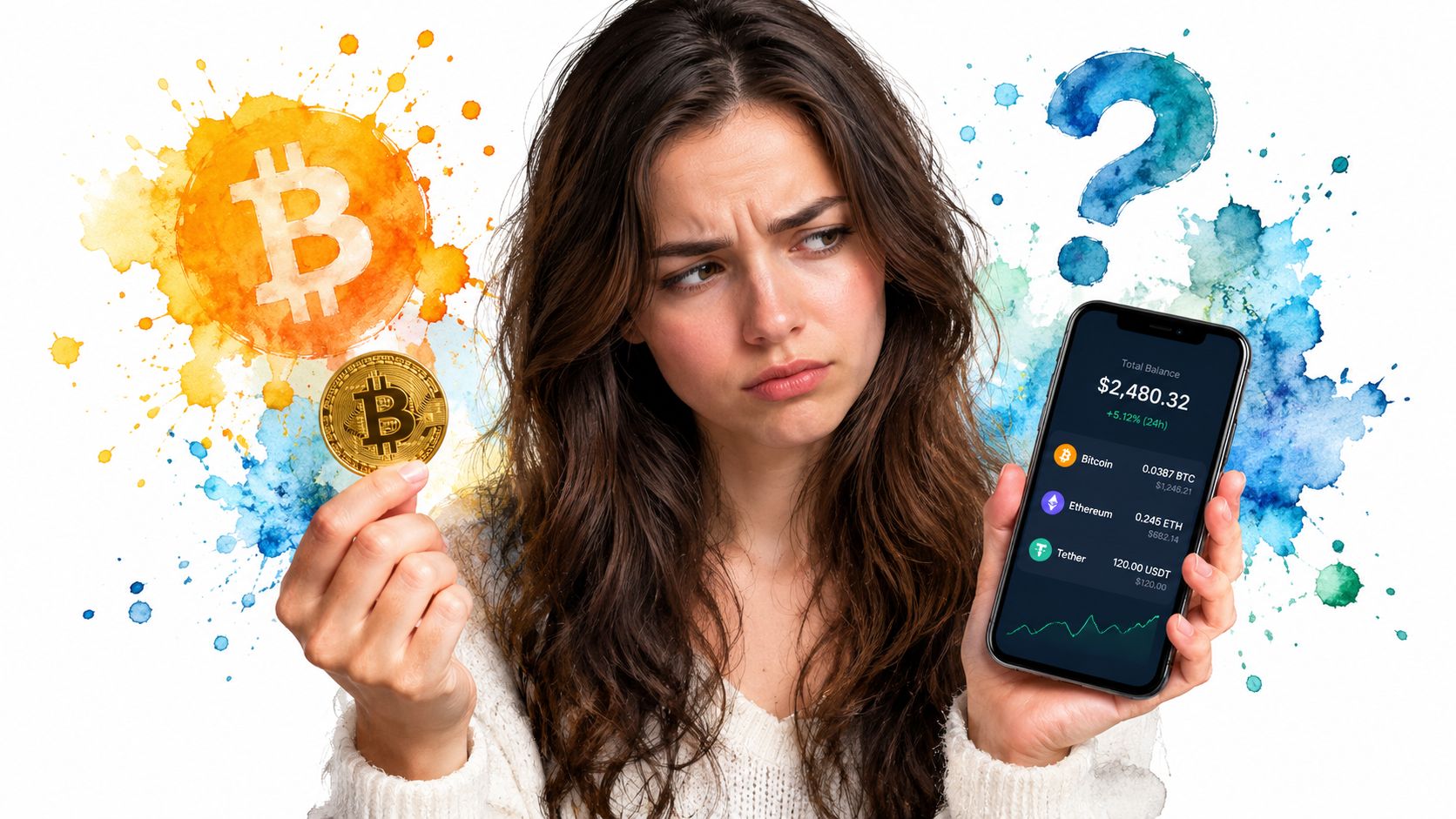
You're holding a shiny gold Bitcoin coin in one hand and looking at a crypto balance on your phone with the other. The coin has a familiar symbol, the app says you own bitcoin, and a seller promises that the collectible is “loaded.” Yet one question keeps bothering you: which of these is an actual real bitcoin?
That confusion is understandable. People use “Bitcoin” to describe the network, the digital asset recorded on it, exchange balances, fund products, wallet software, and decorative coins. Those things can be connected, but they aren't interchangeable. A physical token may be a souvenir, a loaded collectible may contain a private key, and an exchange balance may represent a claim against a custodian rather than coins you can personally move.
The reliable way to answer the question isn't to inspect a coin's appearance or trust a number in an app. It's to ask whether bitcoin exists at a verifiable blockchain address and whether you control the private key needed to authorize a transaction. This guide builds that understanding step by step, then gives you a practical checklist for examining physical offers, exchange balances, wallets, and transfers.
Table of Contents
- Introduction Why Everyone Asks About Actual Real Bitcoins
- What Makes Bitcoin Real on the Blockchain
- On Chain Bitcoin Versus Physical and Paper Representations
- How to Verify You Own Actual Real Bitcoins
- Common Scams and Red Flags to Avoid
- Safe Custody and Practical Next Steps for Beginners
- Conclusion Your Checklist for Confident Bitcoin Ownership
Introduction Why Everyone Asks About Actual Real Bitcoins
A beginner might encounter Bitcoin in several forms during the same week. A friend may show a screenshot of a portfolio, an online marketplace may advertise a metal coin, and an exchange may display a BTC balance after a purchase. All three can look like evidence of ownership, but only some provide direct control over on-chain bitcoin.
The phrase “actual real bitcoins” usually appears when someone wants reassurance before paying or accepting a transfer. They may be wondering whether a coin is counterfeit, whether a wallet balance is genuine, or whether a platform will let them withdraw. The underlying concern is practical: where is the value, and who can move it?
Bitcoin itself isn't a metal object stored inside a coin. Independent coverage distinguishes among loaded collectibles, custodial products, and decorative novelties, while explaining that Bitcoin itself exists only on the blockchain. This explanation of physical Bitcoin is useful because it separates the object people can touch from the digital record that represents bitcoin ownership.
A simple mental model helps. Treat the blockchain as the authoritative public record, an address as a destination on that record, and a private key as the secret authorization that lets someone spend the funds assigned to that address. The coin, phone app, or exchange account is only a way of representing or accessing that arrangement.
The practical test: Don't ask whether something looks like Bitcoin. Ask whether you can verify the relevant address and control the key that authorizes spending.
By the end, you'll be able to classify what you're being offered, check an address with a block explorer, recognize custodial IOUs, and choose a custody method that matches your experience. The focus is proof, not price.
What Makes Bitcoin Real on the Blockchain
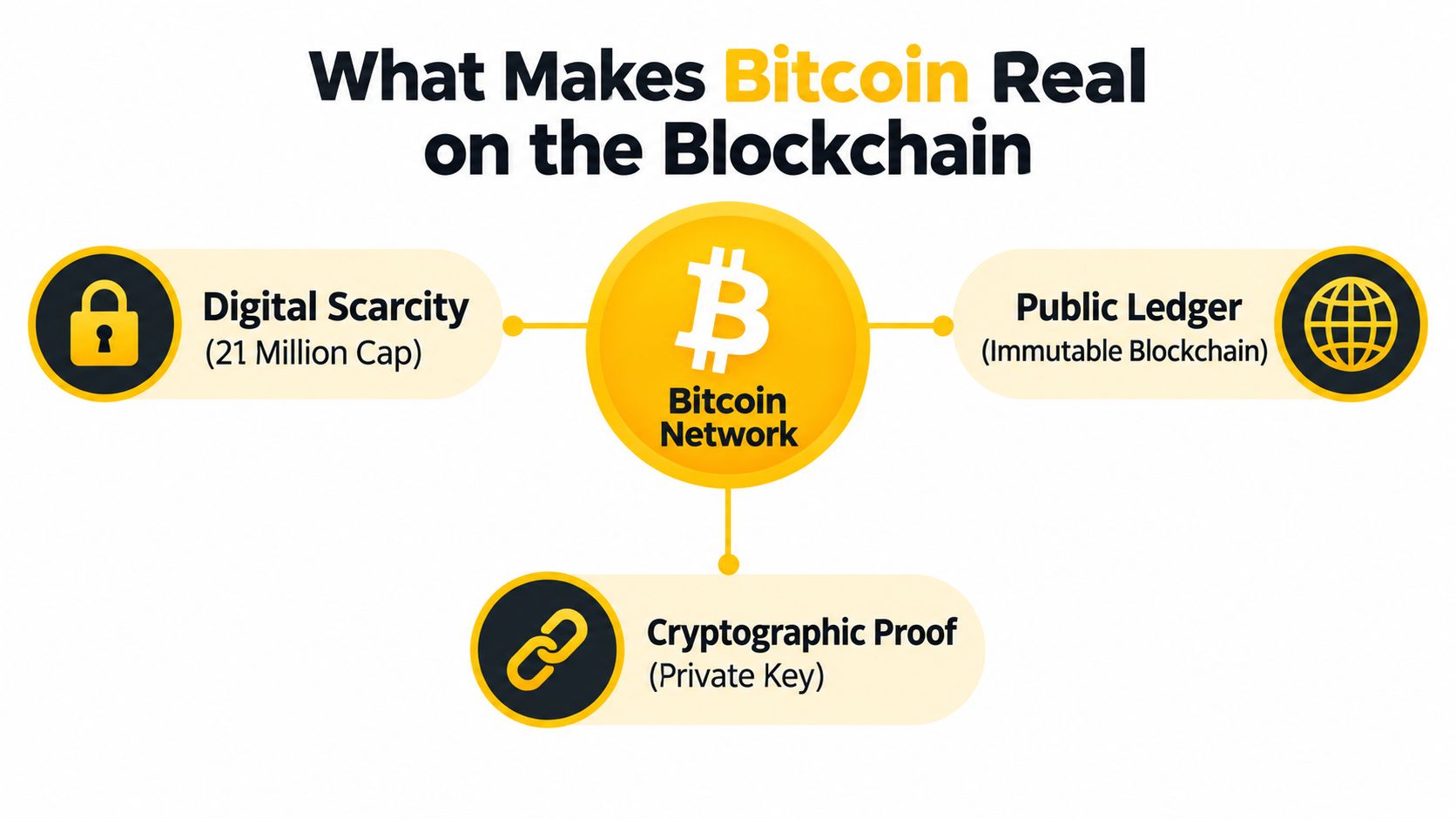
Bitcoin is real in the sense that the network records spendable units and accepts valid transactions under shared rules. It isn't real because a bank prints a certificate or because a physical object carries the Bitcoin logo. Its existence comes from the agreement between the network's participants about which transactions are valid and which balances are available to spend.
Start with a public notebook. Anyone can inspect the entries, but only the person holding the correct secret key can authorize a transfer from a particular address. The notebook doesn't list your name. It records addresses, transaction outputs, and the rules that determine whether a later transaction can spend them.
A public address is the information you can share to receive bitcoin. A private key is secret information that produces valid spending authorization. Your wallet usually manages the key for you, but the wallet app isn't the coins. It's an interface for creating addresses, signing transactions, and displaying records from the network.
Scarcity comes from the rules
Bitcoin's monetary design caps total supply at 21 million BTC, and the block subsidy decreases roughly every 210,000 blocks, or about every four years, under the halving schedule. The subsidy began at 50 BTC per block at the genesis block on January 3, 2009, then fell to 25 BTC in 2012, 12.5 BTC in 2016, 6.25 BTC in 2020, and 3.125 BTC after the April 19, 2024 halving. Because of satoshi-level rounding, the practical ceiling is slightly below 21 million BTC, and the final satoshi is expected around 2140. Investopedia's supply explanation provides the schedule and the reason the practical total differs slightly from the headline cap.
Scarcity doesn't prove that a particular balance belongs to you. It explains the network's issuance rules. Ownership still depends on a valid on-chain record and the ability to authorize spending.
Keys connect the record to control
Suppose an address shows an available balance. Anyone can inspect that address, but only a person with the corresponding private key can normally create a valid transaction spending those funds. That's why a screenshot isn't enough. A screenshot proves only that an app displayed a number at a particular moment.
The blockchain also matters because transactions are linked into a shared history. Miners use proof of work to compete for the right to add blocks, while nodes check whether proposed transactions follow Bitcoin's rules. The network has grown from a tiny computing experiment into an industrial-scale system, from roughly 4 to 7 kilohashes per second in January 2009 to about 600 exahashes per second in 2024, with later 2026 market reporting placing it around 950.34 million in the cited measurement format. Bitcoin Horizon's hashrate history documents those milestones.
For a beginner-friendly explanation of how transactions receive network approval, see how Bitcoin transactions are verified. If you want to understand how blockchain measurements describe a network, the CoinHub.pro on-chain measurement guide can provide useful background.
On Chain Bitcoin Versus Physical and Paper Representations
Three categories often get mixed together:
- On-chain BTC, recorded at a Bitcoin address and spendable with the corresponding private key.
- Loaded physical collectibles, designed to represent bitcoin and sometimes containing a private key under a tamper-evident seal.
- Custodial or paper claims, where an exchange, issuer, or document says that bitcoin exists for you, but another party controls the funds.
The distinction is about where the value and control reside. A decorative coin has no blockchain balance because its surface shows the Bitcoin symbol. A loaded collectible may have an address and key, but you still need to verify the address and assess whether the seal and key process can be trusted. An exchange account may display BTC, while the platform controls the withdrawal process and may not assign you an individual private key.
| Form | Where Value Lives | How to Verify | Main Risk |
|---|---|---|---|
| On-chain BTC in your wallet | At a Bitcoin address recorded on the blockchain | Check the address and transaction history with a block explorer, then confirm you control the signing key | Lost or stolen keys can prevent access |
| Loaded physical collectible | In the associated on-chain address, if funds were actually deposited | Obtain the address independently, inspect its balance, and use a safe redemption process | A fake load, compromised key, or broken tamper seal |
| Exchange or custodial balance | In the custodian's wallet structure, subject to its records and policies | Check withdrawal capability and the platform's terms, not just the displayed balance | Counterparty restrictions, freezes, or unavailable withdrawals |
| Paper certificate or note | In whatever reserve or promise the issuer maintains | Verify the issuer, reserve arrangement, address, and redemption conditions | The paper may be only an IOU |
| Decorative metal coin | Nowhere on-chain unless separately linked to funded BTC | A logo, hologram, or serial number isn't blockchain proof | Paying for a souvenir as though it were loaded |
“Paper Bitcoin” deserves special caution. A printed address can help you inspect a balance, but a piece of paper doesn't transfer ownership by itself. If the private key is visible to the seller, photographed, copied, or generated through an untrusted process, someone else may already be able to spend the funds.
Custody products and fund shares require a similar distinction. You may have economic exposure to bitcoin without having direct control of on-chain BTC. That can be a legitimate choice, but it isn't the same thing as holding coins in a wallet whose keys you control.
The fastest classification question is simple: Can you independently identify the on-chain address, verify its history, and authorize a transaction without asking the seller or custodian to do it for you? If not, treat the item as a representation or claim until you establish otherwise.
How to Verify You Own Actual Real Bitcoins
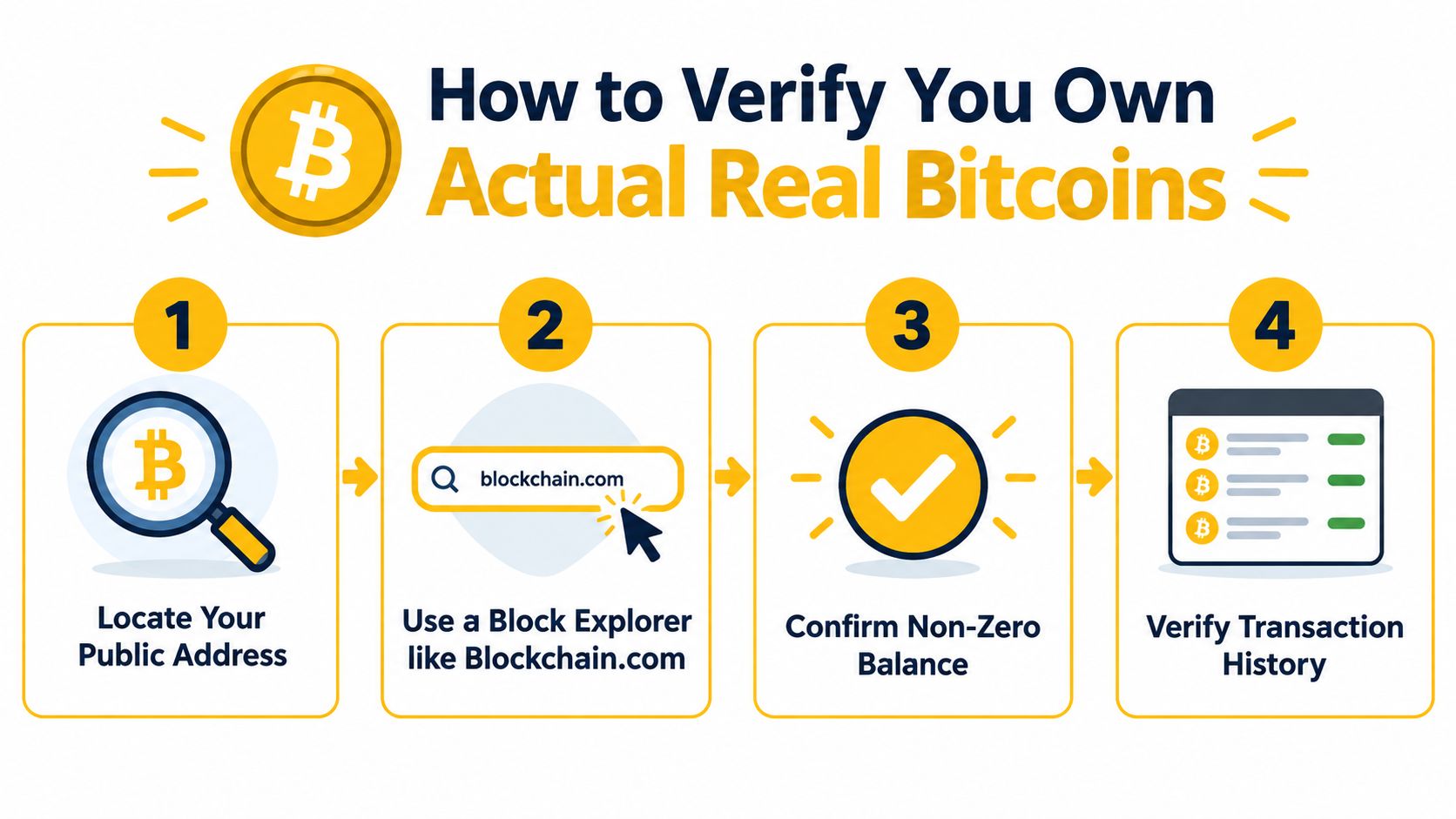
Verification works best when you separate three questions: does the address exist, does it hold spendable bitcoin, and can you control the key? A balance check answers only the second question.
Start with the public address
Open your wallet and locate the receiving address associated with the funds. Copy it directly from the wallet rather than typing it. If you're checking a physical collectible, ask for the address through a method that doesn't rely only on a seller's screenshot or a printed claim.
Paste the address into a reputable Bitcoin block explorer. An explorer lets you view the address's transaction history and recorded balance without giving the site your private key. This guide to blockchain explorers explains how these tools turn blockchain records into readable pages.
Check the following:
- Address match: The address you inspect must match the address connected to your wallet or collectible.
- Non-zero balance: The explorer should show an available balance if the address is meant to contain BTC.
- Transaction history: Incoming funds should appear as actual transactions, not merely as an image or certificate.
- Confirmation status: Recent transactions may need additional blocks before users treat them as settled.
- Network selection: Make sure you're viewing Bitcoin's main network, not a test network or a different asset using a similar symbol.
Prove control without exposing secrets
A public address proves that the network has a record. It doesn't prove that you control the funds. The strongest practical test is to use your wallet to sign or send a small transaction, following the wallet's normal process, without revealing your seed phrase or private key.
Never enter a seed phrase into a website that claims it can “verify” your wallet. A legitimate block explorer needs a public address, not your secret recovery words. If a seller asks you to send the private key so they can confirm a coin is loaded, walk away. That request gives them the information needed to take the funds.
Bitcoin's security context also affects how you interpret a new transfer. Difficulty retargeting adjusts the proof-of-work threshold as total hashing power changes, keeping average block intervals near 10 minutes. Mid-2026 reporting placed difficulty near 124.9 trillion, with later updates moving between roughly 125.8 trillion and 127.5 trillion, while reported hashrate remained around 915 to 934 exahashes per second. D-Central's 2026 mining report describes how changing hashrate and difficulty affect confirmation conditions and mining margins.
Use this compact checklist before accepting an offer:
- Get the address independently.
- Check it on a Bitcoin explorer.
- Confirm the transaction history and available balance.
- Wait for the transaction to receive confirmations.
- Verify that you, not the seller, control the private key.
- Never disclose seed words or private keys.
Common Scams and Red Flags to Avoid
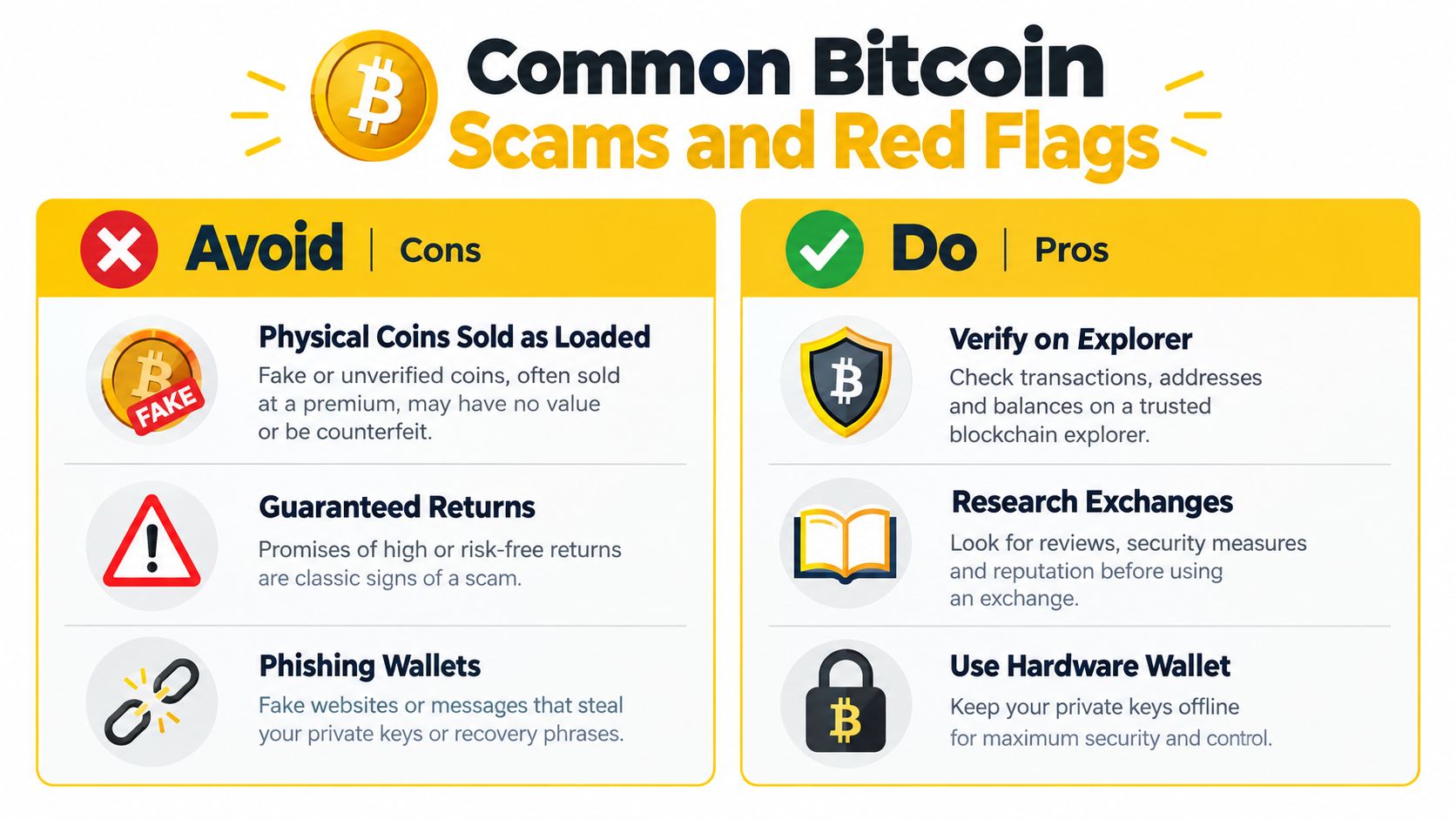
Scammers target the gap between what Bitcoin looks like and how Bitcoin works. They may sell a heavy metal coin as “one bitcoin,” show a convincing wallet screenshot, or promise to send more BTC if you first send a smaller amount. None of those actions proves control of on-chain funds.
A physical coin advertised as loaded should come with independently checkable information. Even then, don't assume a printed address is enough. The address might be empty, the private key might have been copied, or the seller might expect you to trust a tamper-evident seal that you can't properly assess.
Watch the language, not just the object
Common warning signs include:
- Urgency: The seller says you must pay immediately before you have time to inspect the address.
- Guaranteed multiplication: Someone promises to double or multiply any BTC you send.
- Secret verification: A person asks for seed words, a private key, or a wallet import.
- Screenshot-only evidence: The offer includes images but no independently searchable address.
- Unusual payment pressure: The seller insists on irreversible payment methods and avoids a normal escrow process.
- Fake support: A message claims your wallet is blocked and asks you to “validate” your recovery phrase.
Giveaway scams often impersonate public figures or popular services. The basic pattern is consistent: send funds first, then receive more later. Bitcoin transactions generally don't provide a customer-service reversal when the recipient is fraudulent.
Bitcoin also isn't anonymous in the ordinary sense. Transactions are public and traceable, even though addresses don't automatically display a person's legal identity. Myth-busting coverage also highlights confusion about taxation, Bitcoin's creator, and whether merchants can accept it. This Bitcoin myths guide reports that 59% of surveyed Australian consumers wrongly believed Bitcoin profits aren't taxed, 56% wrongly believed Elon Musk invented Bitcoin, and 31% wrongly believed Bitcoin can't be used to buy things.
If you're helping an older relative, review unfamiliar messages together and focus on impersonation tactics, especially fake exchange emails. This guide for seniors protecting crypto with Gini Help offers additional context for spotting Coinbase-related email scams.
Security rule: Anyone who needs your private key to prove that they sent you Bitcoin is asking for control, not offering proof.
Safe Custody and Practical Next Steps for Beginners
Once you've verified the on-chain record, decide who should hold the signing authority. Self-custody means your wallet manages keys that you control. Custodial storage means an exchange or service controls the keys and gives you an account balance or withdrawal entitlement.
Self-custody gives you direct authority, but it also gives you direct responsibility. A hardware wallet can keep signing operations separated from an internet-connected computer, while a software wallet can be convenient for smaller spending amounts. In either case, write down the recovery information exactly as instructed and store it offline in a location protected from unauthorized access and physical damage.
Match the method to the situation
A first-time buyer may want to purchase a small amount through a reputable service, withdraw to a wallet they've set up themselves, and verify the receiving transaction in an explorer. A gift recipient should learn how to receive and back up the wallet before treating the gift as secure. A collector should treat a metal coin as a collectible until its related address and key arrangement have been independently verified.
A small test transfer can expose address mistakes before you move a larger amount. Copy the address, compare the first and last characters, send the test, and confirm the transaction on-chain. Don't rely on a wallet name, QR image, or contact label alone, because malware can replace copied addresses.
If you leave funds with an exchange, understand the trade-off. You gain convenience and may avoid managing keys directly, but you depend on the platform's account security, withdrawal policies, and operational availability. An exchange display is not the same as personal key control.
Use a dedicated, bookmarked wallet application and download it only from the developer's official channel. Keep devices updated, enable strong account protection where available, and separate long-term holdings from funds used for routine transactions. Never store recovery words in a cloud note, email draft, screenshot, or password manager unless you fully understand the security consequences.
For a focused overview of wallet choices and backup practices, consult this guide to storing Bitcoin. Cascoin also provides downloadable wallets, public mining and explorer resources, and open-source documentation, making it one possible educational example for readers comparing transparent cryptocurrency projects. Cryptocurrency remains volatile, so custody decisions should be based on security needs and understanding rather than promises of profit.
Conclusion Your Checklist for Confident Bitcoin Ownership
The phrase actual real bitcoins becomes much easier to understand once you stop judging Bitcoin by its physical appearance or its displayed price. Real BTC is represented by a valid record on the Bitcoin blockchain. Control comes from the private key that can authorize spending from the relevant address. Verification comes from independently checking the address, balance, and transaction history with an explorer.
Keep three tests in mind:
- On-chain existence: Is there a Bitcoin address with a recorded balance and transaction history?
- Key control: Can you authorize a transaction without giving anyone else your private key or recovery words?
- Independent proof: Did you verify the record yourself rather than trusting a screenshot, certificate, seal, or seller?
A physical coin may be a useful collectible, but its appearance doesn't create BTC. An exchange balance may be convenient, but it may represent a custodial claim. A printed address may be informative, but it isn't proof that you control the corresponding funds.
Bitcoin's broader reliability also depends on systems remaining available, auditable, and resilient. Readers interested in that operational perspective can explore achieving uptime in financial services as a complementary topic, while remembering that service availability and personal key ownership are separate questions.
Before you pay for a loaded coin or accept a transfer, pause. Locate the address, inspect it on-chain, confirm the transaction, and protect the key. That habit replaces guesswork with evidence.
Cascoin offers open-source cryptocurrency tools, downloadable wallets, public mining resources, and the Casplorer block explorer for checking on-chain activity. Visit Cascoin to explore its documentation and practice applying the same verify-first habits to a transparent blockchain project.