Solo Pool Mining Explained and How to Set It Up Right

You've got a miner running, a wallet ready, and a choice to make. A standard pool can send smaller, regular payouts based on your contributed work. Solo mining offers the opposite promise, one rare chance to keep an entire block reward. Solo pool mining sits between those two experiences, but many guides blur the distinction and make the choice sound easier than it is.
The practical question isn't whether a solo pool can magically improve your odds. It can't. The question is whether you want winner-takes-all variance while outsourcing some of the technical infrastructure, or whether steady payouts, full node control, or lower-power mining better match your goals. This guide explains the difference in plain language, then connects it to Cascoin's Labyrinth Mining, MinotaurX, and SHA-256 paths.
Table of Contents
- Introduction to Solo Pool Mining and Why It Matters Now
- What Solo Pool Mining Really Means
- Solo Pool Mining Versus Standard Pools and Pure Solo
- Cascoin Mining Options and Where Solo Pool Fits
- How to Configure and Verify a Solo Pool Setup
- Performance Power and Economic Trade Offs to Weigh
- Security Troubleshooting and Community Resources for Long Term Success
Introduction to Solo Pool Mining and Why It Matters Now
A miner comparing payout screens may see two very different outcomes. A conventional pool credits smaller amounts as the miner submits valid shares. A solo pool can show accepted shares for a long time while paying nothing, because the miner must find a valid block to receive the reward. The appeal is the chance to keep the full reward rather than receive a proportional share.
The probability is equally important. Tracked data cited in 2026 reports shows solo miners found only 20 to 22 Bitcoin blocks over the previous 12 months, approximately 0.04% of roughly 52,000 blocks mined in that period, according to reported solo-mining results. Those wins produced about 62.96 BTC to 69.35 BTC in total rewards, but the distribution was highly uneven. Solo mining is possible, yet it resembles a long-odds attempt rather than dependable income.
Practical rule: Treat solo pool mining as a variance decision first and a hardware decision second.
The word solo can describe two operating models. Pure solo mining means you run the node and mining software yourself. Solo pool mining uses an operator to route work and handle parts of the block-template process, while preserving the all-or-nothing reward structure. That service can simplify setup and connection management, but it does not improve the underlying chance that your hardware finds a block.
The distinction matters when choosing among Cascoin's mining paths. Labyrinth Mining, MinotaurX, and SHA-256 may suit different hardware, algorithms, or operating goals, while solo-pool mining describes a reward and infrastructure arrangement rather than a separate guarantee of profitability.
Choose standard pooled mining if predictable credits matter most. Choose a solo pool when learning, experimenting, or pursuing a full-reward attempt matters more, and you can tolerate long periods without income. The following sections clarify the models, compare their trade-offs, and explain how to verify that a setup is working.
What Solo Pool Mining Really Means
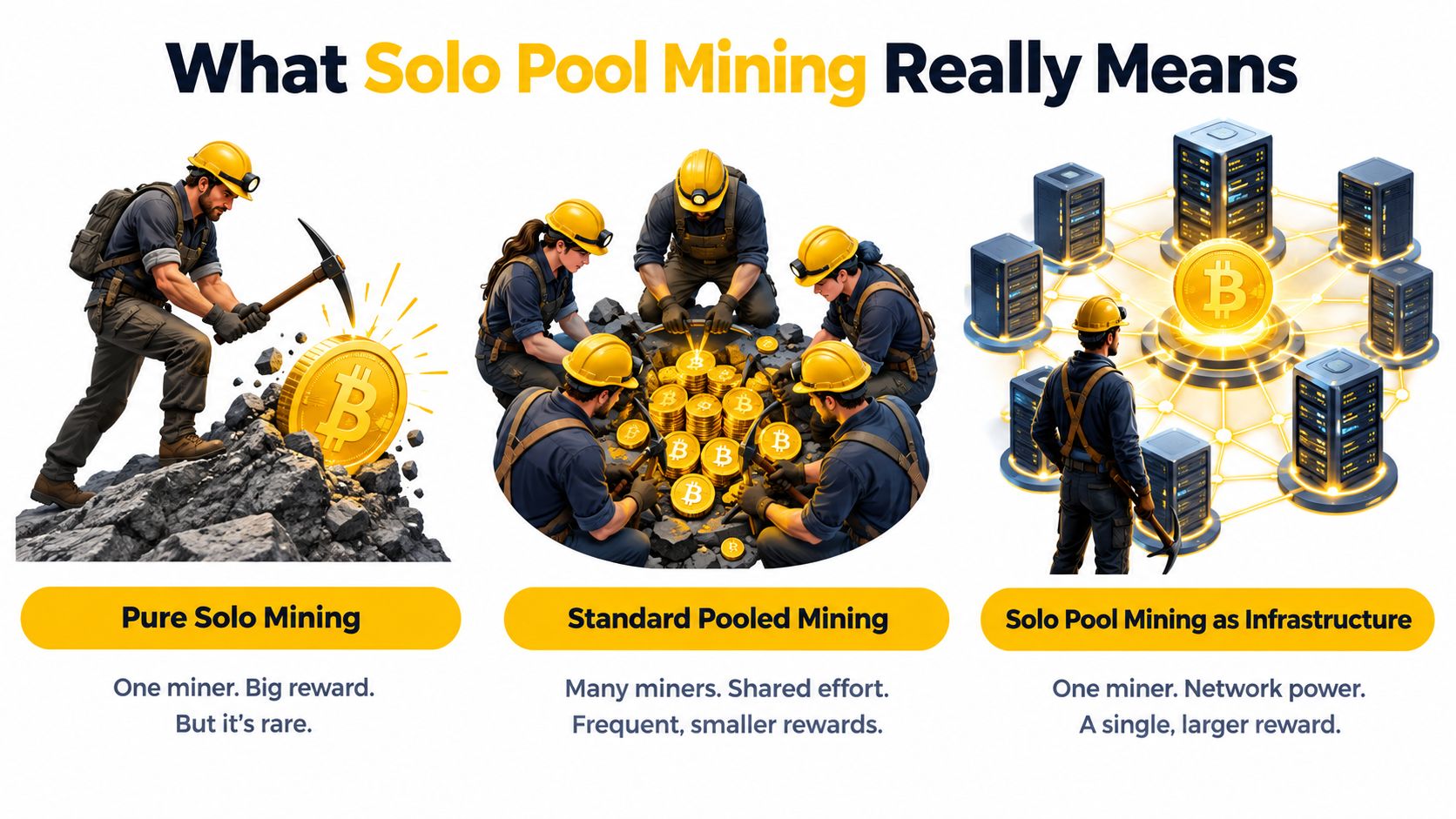
Start with the reward model, not the software. Pure solo mining means your miner sends work to infrastructure you operate, commonly including your own full node. If your hardware finds a valid block, you receive the reward. If it doesn't, your mining activity produces no block payout.
Standard pooled mining changes the payout pattern. Many miners contribute hashrate to one pool, and the pool distributes rewards according to its accounting method. Your machine still performs the same fundamental search, but the pool turns many individual attempts into a more regular stream of smaller credits.
Solo pool mining keeps the pure solo reward rule while using a pool operator's infrastructure. The operator routes work, supplies block-template plumbing, and often provides dashboards, connection management, and server availability. The miner still receives the full block reward only if that miner finds the block.
A lottery analogy that stays accurate
Think of each hash as a lottery ticket, but remember that the ticket is also useful work for the network. In pure solo mining, you print the tickets, manage the draw connection, and submit a winning ticket yourself. In standard pooled mining, a group combines its tickets and shares prizes according to contributed work.
A solo pool gives you access to the drawing infrastructure without putting your tickets into a shared prize pot. You connect your miner, receive work, submit shares that prove activity, and wait for your hardware to produce a network-valid block. Accepted shares demonstrate participation, not a payout entitlement.
The key variables are straightforward:
- Hashrate measures how much computational work your miner performs.
- Network difficulty describes how hard it is to find a valid block at a given time.
- A block template contains the transaction and consensus details your miner works against.
- A share is a lower-difficulty proof used by the pool to track your miner's work. It isn't the same as a valid network block.
A solo pool doesn't alter the relationship between your hashrate and the network's hashrate. As Cascoin's mining explanation makes clear, understanding the underlying mining process matters more than the label attached to the endpoint. The pool mainly removes operational friction, especially the need to maintain your own node and manage template generation.
That distinction prevents the most expensive misunderstanding. Solo pool mining can make solo mining easier to run, but it doesn't make the outcome easier to achieve.
Solo Pool Mining Versus Standard Pools and Pure Solo
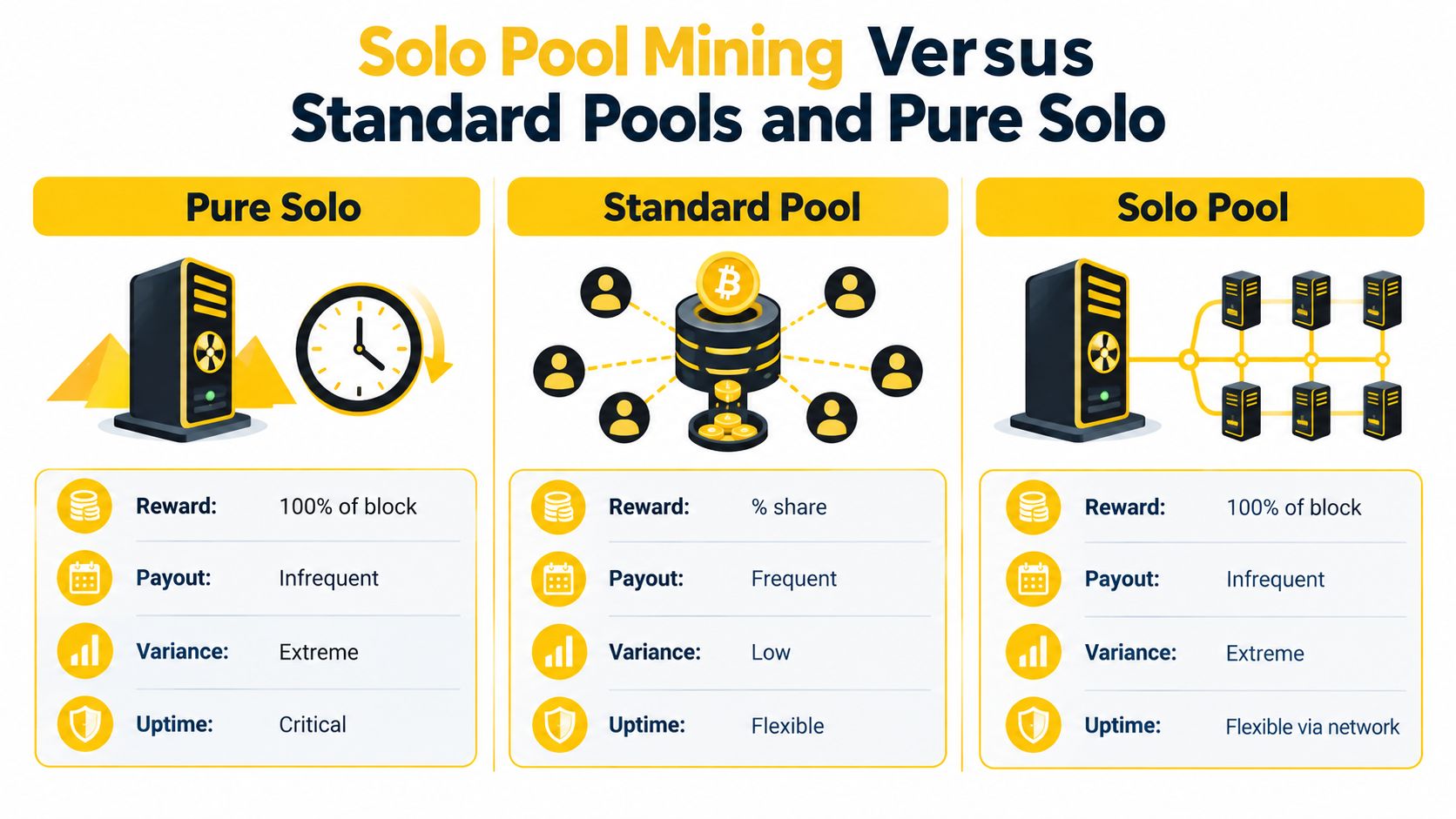
The three models differ less in the hashing performed than in who manages infrastructure and how rewards reach the miner. Pure solo gives you the most direct control, standard pools give you the smoothest payout experience, and solo pools provide a middle route for miners who want full-reward upside without maintaining every component themselves.
Reward timing changes the whole experience
A standard pool pays according to contributed work and its published payout method. That makes revenue easier to monitor, although fees and the pool's rules affect the final amount. Pure solo and solo pool mining keep the block reward concentrated in one miner, so the payout is rare and binary.
| Criteria | Solo Pool Mining | Standard Pool | Pure Solo |
|---|---|---|---|
| Reward structure | Full block reward if your miner finds the block | Shared reward based on contributed work | Full block reward if your miner finds the block |
| Payout frequency | Infrequent and unpredictable | More regular | Infrequent and unpredictable |
| Variance | Extreme | Lower | Extreme |
| Node responsibility | Usually handled by the pool infrastructure | Handled by the pool | Managed by the miner |
| Operational complexity | Moderate | Lower | Highest |
| Best fit | Risk-tolerant miners wanting simpler solo access | Miners who value steady accounting | Operators wanting maximum independence |
The pool itself doesn't improve probability. SoloPool's documentation explains that odds still depend on your hashrate compared with the network. A solo pool replaces much of the node and block-template work, not the mathematics of block discovery.
Match the model to your circumstances
| Situation | More suitable approach | Reason |
|---|---|---|
| You need mining income to arrive regularly | Standard pool | Shared accounting reduces payout variance |
| You want to learn node operation and validate work yourself | Pure solo | You control the complete stack |
| You want full-reward exposure but less infrastructure maintenance | Solo pool | The operator supplies the endpoint and related services |
| You can't tolerate a long period with no payout | Standard pool | Solo outcomes can remain silent for extended periods |
| You're experimenting with modest hardware | Solo pool or standard pool | The setup can be simpler than a self-hosted node |
A solo pool can also make uptime management more forgiving at the connection layer, because the operator may provide resilient servers and monitoring. Your miner still needs power, cooling, and a stable connection. Convenience doesn't remove the need to keep hardware working.
For a broader explanation of shared mining economics, see what a mining pool is. The important decision is not which model sounds more exciting. It's whether the payout pattern matches your budget, patience, and reason for mining.
Cascoin Mining Options and Where Solo Pool Fits
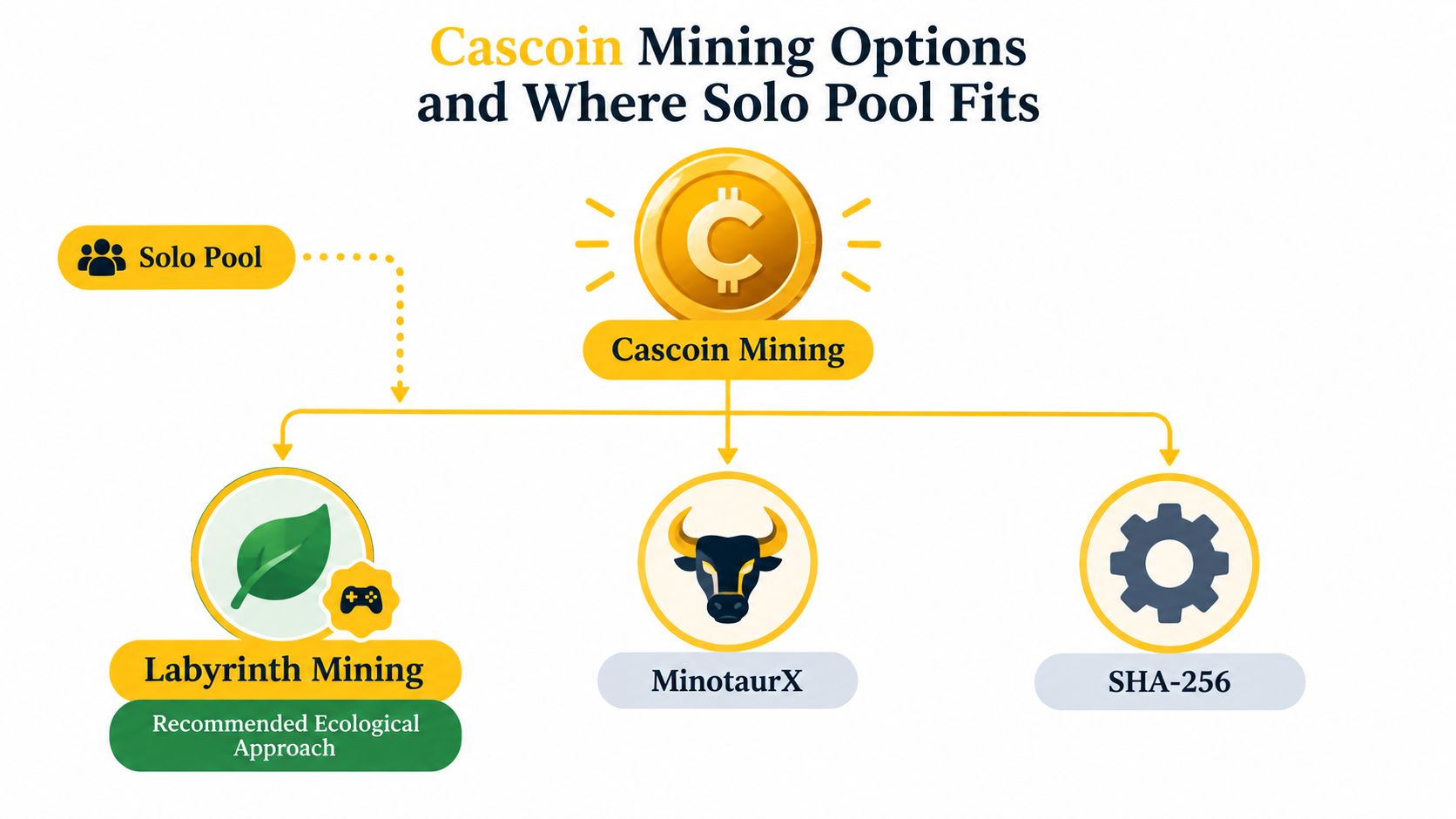
Algorithm choice changes the practical meaning of solo pool mining. A high-power ASIC path, a CPU-oriented algorithm, and a lower-power gamified approach don't create the same operating costs, noise profile, or hardware requirements.
Cascoin offers three mining paths: Labyrinth Mining, MinotaurX, and SHA-256. Labyrinth Mining uses a virtual maze in which mice collect cheese, presenting an ecological and gamified alternative with rewards described as reaching up to 3x higher than traditional approaches while consuming less power, as stated in the publisher information. MinotaurX is positioned for CPU-friendly, lower-power participation. SHA-256 is the familiar route for experienced ASIC operators.
Labyrinth Mining
Labyrinth Mining may appeal to miners who care about lower energy use and a more interactive experience. The mining process isn't framed only as a race for raw hashes. Instead, lightweight client software simulates movement through a maze, giving the activity a game-like layer.
The solo-pool concept can fit here when the pool provides the routing and accounting needed to let an individual miner pursue a full reward. The fit depends on the available endpoint and the exact reward rules, so verify those details in current documentation before committing hardware or funds.
MinotaurX
MinotaurX offers a lower-barrier route for people who want to mine with compatible CPUs rather than specialized ASIC equipment. That can make experimentation easier, but lower hardware intensity doesn't remove variance. A miner still needs to understand whether the selected pool pays for ordinary shares or only for a block found by that miner.
SHA-256
SHA-256 is the clearest match for established ASIC operators. It's built around specialized mining hardware, and a solo pool can reduce the administrative burden of running a node-backed operation. The trade-off remains unchanged: the miner keeps the full reward only after finding a valid block.
Cascoin's open code repositories on Codeberg and GitHub, its Casplorer block explorer, downloadable wallets, documentation, public pool, and Discord community give miners several ways to inspect and verify the ecosystem. Those resources matter because solo mining requires trust in the endpoint, payout rules, and software you're using. Choose the algorithm that matches your equipment and power constraints first, then decide whether solo-pool variance is acceptable.
How to Configure and Verify a Solo Pool Setup
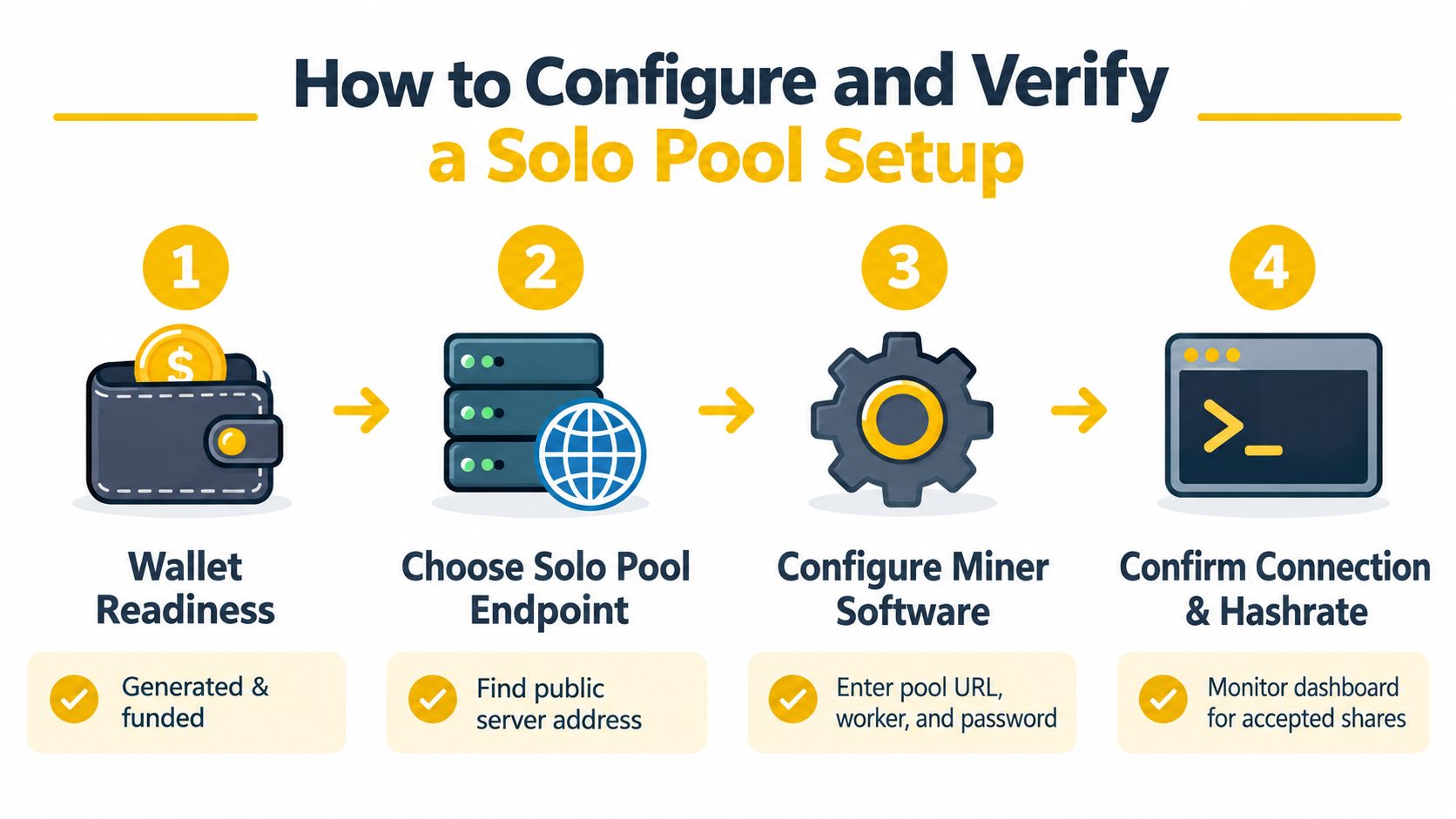
A reliable setup starts with preparation, not with pasting a pool address into mining software. You need a wallet you control, a compatible miner, the correct algorithm, and a verified endpoint from the pool's official documentation.
Prepare the wallet and endpoint
Create or open the wallet before starting the miner. Copy the receiving address carefully, confirm that it belongs to the correct network, and keep the recovery phrase offline. Don't use an address you can't access later just because it's convenient.
Next, select the solo pool endpoint from official documentation. Check the supported algorithm, connection method, payout condition, server location options, and fee policy. Avoid relying on a pool address copied from an unverified social post or an unsolicited message.
Configure the miner
Open the miner's settings and enter the pool URL, worker name, and password exactly as required. The worker name helps identify the device, while the password is often only a connection field. Follow the endpoint's own instructions rather than assuming every pool uses the same format.
For software selection and compatibility checks, consult mining programs for different hardware. Choose software that supports the algorithm and device, then confirm that the miner reports the expected algorithm after launch.
Confirm activity instead of assuming success
A connected dashboard should show a worker, reported hashrate, and accepted shares. Allow enough time for the dashboard to populate, because a new connection may not display immediately. Rejected shares, repeated reconnects, or a hashrate reading that remains absent indicate a configuration or connectivity issue.
Use this verification sequence:
- Wallet check: Confirm the payout address in the miner configuration matches your intended wallet.
- Endpoint check: Compare the entered address with the pool's official documentation.
- Algorithm check: Verify that the miner is performing the intended algorithm rather than falling back to an unsupported mode.
- Share check: Look for accepted shares and a worker entry on the pool dashboard.
- Explorer check: If a block is ever found, verify it independently through Casplorer before treating the reward as settled.
- Log check: Review miner logs for rejected work, stale jobs, authentication errors, and repeated connection drops.
Verification rule: An accepted share proves that the pool received valid work from your miner. It doesn't prove that you've found a block or earned a payout.
The main usability benefit of a solo pool is that you can avoid maintaining the full node and block-template pipeline yourself. You still need to verify the service, protect the wallet, and monitor the miner. Convenience should reduce setup friction, not reduce your attention to evidence.
Performance Power and Economic Trade Offs to Weigh
A solo-pool decision starts with a practical scenario. You have a miner running, electricity being consumed, and no guaranteed payout on the next day. The reward may be substantial if your work contributes to a block, yet the timing is governed by probability rather than a schedule. Separate three questions: how much hashrate you can provide, what the hardware costs to operate, and how long you can accept waiting.
Hashrate works like buying more lottery tickets, but every ticket still has an uncertain result. A larger miner improves the chance of finding a block, while a smaller one may wait far longer. Network difficulty changes those odds, so an average interval cannot promise an individual result. Coverage of solo mining in 2026 shows that rare wins can occur, but the broader lesson is variance, not a predictable income pattern. The 2026 report on rare solo Bitcoin wins provides that context.
A solo pool does not remove this uncertainty. It changes the operating arrangement by letting the pool provide work while your miner competes for a block under the solo-payout model. Standard pool mining smooths results by sharing rewards across contributors. Pure solo mining gives you direct control but requires you to manage more infrastructure. For Cascoin, compare that high-variance path with Labyrinth Mining, MinotaurX, or SHA-256. The right choice depends on algorithm compatibility, available hardware, power limits, and whether you prefer steadier shared rewards or a rarer full-block outcome.
Power changes the decision
Electricity is charged during unsuccessful attempts as well as successful ones. A power-efficient Cascoin path may suit a home participant better than equipment built for a more demanding algorithm, but lower consumption does not guarantee profit. Include cooling, repairs, connectivity, hardware depreciation, and downtime in the operating-cost model.
Hashprice can tighten the margin for hardware-heavy mining. Bitcoin.com's 2026 solo-mining coverage cites CoinShares' report of Bitcoin hashprice reaching an all-time low of US$27.7 per PH/s/day in June 2026. That environment makes cash reserves and realistic electricity assumptions more important than headline hashrate.
For hardware context, the Nvidia RTX 5090 monster graphics card shows why specifications alone cannot answer a mining question. Check purchase cost, energy draw, heat, and compatibility with the chosen algorithm before connecting it.
Set a maximum monthly power budget and a waiting period you can tolerate without a payout. If you need regular returns, a standard pool may fit better. If you accept lottery-like variance and want hands-on technical experience, solo-pool mining can be a controlled experiment.
Security Troubleshooting and Community Resources for Long Term Success
Solo pool mining adds convenience, but it also creates a trust boundary. You're relying on an external endpoint to deliver work and report activity, so protect the wallet and verify every connection detail independently.
Keep private keys and recovery phrases offline. A pool should need a payout address, not your seed phrase or private key. Use bookmarked official documentation, inspect domain spelling carefully, and treat urgent requests for wallet credentials as phishing attempts.
Diagnose the common failures
- Rejected shares: Check the algorithm, miner version, wallet format, and worker credentials.
- Stale work: Look for latency, unstable connectivity, or a pool endpoint that's too distant.
- No dashboard worker: Confirm the endpoint, port, firewall permissions, and whether the miner is submitting shares.
- Hashrate drop: Review temperature, fan behavior, power delivery, throttling, and background software.
- Repeated reconnects: Test the network connection and compare the miner's logs with the pool's status information.
An accepted share is useful evidence because it confirms that the pool received valid work. It isn't evidence of a block win, so use the block explorer to verify any claimed discovery and check the wallet independently.
Cascoin's open-source code, public documentation, downloadable wallets, public mining pool, and Discord community can help miners audit software, compare configuration experiences, and ask for troubleshooting support. The project also presents Labyrinth Mining, MinotaurX, and SHA-256 as different participation routes, so community guidance can help match an algorithm to your hardware rather than pushing every miner toward one setup.
Cryptocurrency outcomes remain volatile, and no mining configuration guarantees a return or a future coin price. A responsible operator treats power spending as an expense, keeps records, tests with hardware already available, and changes strategy when the numbers no longer fit.
Cascoin offers several mining paths, including lower-power Labyrinth Mining, CPU-friendly MinotaurX, and SHA-256 for ASIC operators, with public tools and community resources for verification. Review the available options at Cascoin, choose the algorithm that matches your equipment, and only then decide whether solo-pool variance fits your budget and patience.