Code Review Process Guide for Secure Crypto Projects
A pull request arrives with a harmless-looking change to block validation. The diff is small, the tests pass, and the contributor has explained the change clearly. Then someone notices that a boundary condition accepts a block a different node rejects. The network doesn't need a dramatic exploit to split. One inconsistent rule in consensus code can be enough.
That risk changes the meaning of a code review process for an open-source cryptocurrency. A web application can often roll back a deployment or repair corrupted records. A blockchain may have already accepted blocks, processed transactions, or exposed private keys before maintainers understand what happened. Reviewers therefore need a system that protects consensus, wallet security, mining behavior, and long-term maintainability without turning every documentation update into a security ceremony.
The practical answer is not to make every pull request equally heavy. It's to make the review depth match the blast radius. Small changesets, context before judgment, and risk-based escalation give solo maintainers and volunteer contributors a workable standard.
Table of Contents
- Why Your Crypto Project Needs a Disciplined Review Process
- Setting Clear Objectives and Review Roles for Open Source Teams
- Designing a Branch and Pull Request Workflow That Scales
- Security Performance and Mining Algorithm Checklist for Reviewers
- Templates Etiquette and Sample Comments That Improve Reviews
- Measuring Success and Continuously Improving Your Process
Why Your Crypto Project Needs a Disciplined Review Process
Three pull requests land in one afternoon: a typo fix in a wallet message, a mining path update, and a transaction-serialization refactor that includes unrelated cleanup. They may share a queue, but they do not deserve equal review depth. The wallet text needs a quick functional check. The mining change needs focused analysis of work validation and algorithm behavior. The serialization refactor may require protocol-level testing because a small encoding difference can change transaction interpretation across nodes.
The consequence determines the process. A faulty user-facing string is inconvenient. A defect in transaction validation, signature handling, replay protection, difficulty adjustment, or reward calculation can affect funds or network agreement. Passing tests provides evidence, not a final safety judgment.
Structured review has older roots. Michael Fagan's formal inspection method, introduced in 1976, established a role-based and systematic approach. Later historical summaries describe the 1970s through the 1990s as the formal inspection era that influenced modern peer review. The historical review of code inspection links those practices to deliberate defect detection. Checklists and assigned responsibilities exist because consistent inspection catches problems that an informal glance can miss.
What disciplined review protects
For an open-source cryptocurrency, review protects several parts of the system:
- Consensus agreement: Every node must interpret blocks and transactions consistently.
- Wallet safety: Key generation, signing, storage, and address handling need careful scrutiny.
- Mining integrity: Work validation, rewards, difficulty, and algorithm-specific behavior must remain coherent.
- Operational trust: Contributors and users need a verifiable record of why changes were made.
- Maintainability: Future maintainers must understand code they did not author.
A Microsoft study of modern code review found that only about 15% of review comments identified a possible defect, while at least 50% addressed long-term maintainability. The study is a useful reminder for crypto maintainers. Review must look for exploitable behavior, but it also needs to preserve the shared understanding required to operate a protocol safely over time.
Practical rule: If a change can alter what nodes accept, what wallets sign, or what miners earn, treat it as a protocol change even when the diff looks small.
Cascoin's public development model makes this discipline visible. A solo-stewarded, MIT-licensed project with public repositories and community discussion depends on contributors making their reasoning easy to inspect. New contributors should not need private context to submit useful work, and maintainers should not have to reconstruct intent from a large, mixed-purpose diff.
Keep changesets small, establish context before commenting, and increase review depth as risk rises. These rules preserve velocity by directing scarce expertise toward code that can affect consensus, funds, or mining behavior.
Setting Clear Objectives and Review Roles for Open Source Teams
A consensus patch can look harmless until two nodes accept different blocks. A wallet change can pass unit tests while signing the wrong transaction fields. A mining update can preserve performance but change reward or difficulty behavior. Review roles must expose those risks before approval, especially when a small maintainer group is handling more pull requests than it can inspect thoroughly.
Assign responsibility before the PR opens
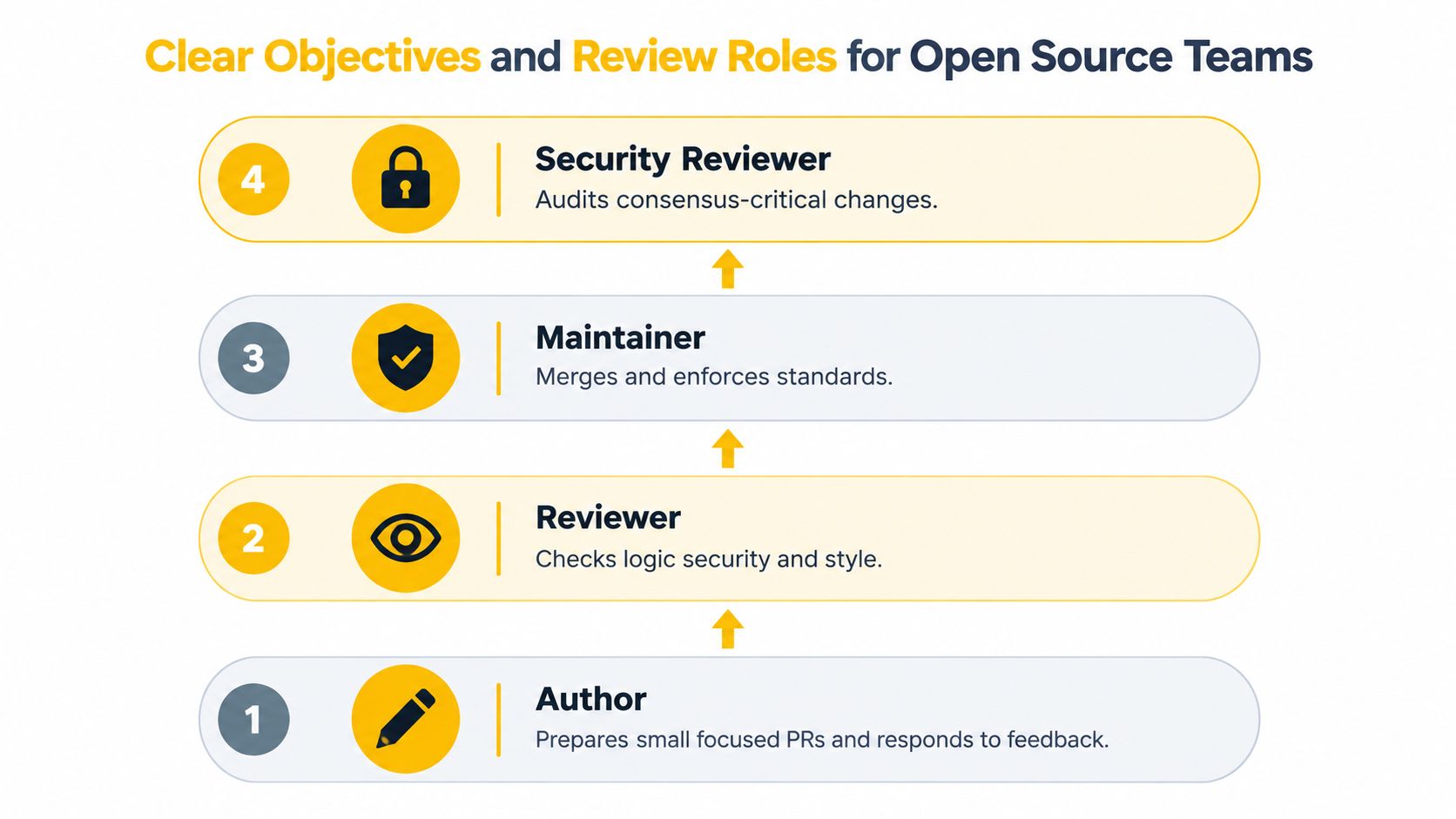
The author owns the problem statement, scope, and evidence. They should describe intended behavior, identify affected subsystems, list tests run, and name unresolved questions. A consensus correction, wallet change, or mining adjustment should not be hidden inside a broad refactor. Separating those concerns gives reviewers a clear basis for approval and makes later debugging possible.
The reviewer challenges the author's assumptions. They read surrounding code, trace failure paths, test edge cases, and distinguish blocking defects from style preferences. A reviewer without subsystem context should state that limitation rather than provide false confidence. Reusing reviewers for high-risk areas is practical because usefulness rises sharply once someone has inspected the same subsystem more than once. Keep that reviewer involved while adding a second person for independent scrutiny when the stakes justify it.
The maintainer owns the merge decision. They confirm that the scope is still appropriate, required approvals are present, tests support the claimed behavior, and unresolved objections have been addressed. A maintainer can follow a reviewer's technical recommendation without transferring accountability for what enters the repository.
A security reviewer joins when a change affects private keys, signing, serialization, authentication, dependencies, consensus rules, or mining economics. That person does not need to review every documentation edit. They do need a visible escalation route for code that could expose funds, split the network, weaken replay protection, or alter miner incentives.
Make approval proportional to risk
Use one informed reviewer for isolated documentation or test changes. Require maintainer approval for changes entering the main branch. Add independent review for consensus, wallet, cryptographic, or mining-algorithm code. The second reviewer should examine the diff independently, not approve after reading the first comment.
A small project can make this rule concrete with a CODEOWNERS-style file:
/consensus/  @consensus-maintainer
/wallet/     @wallet-maintainer
/mining/     @mining-maintainer
The exact mechanism may vary, but the artifact should show contributors who owns each risk area and whom to contact. Ownership records decision authority. It does not imply that a large team exists.
Keep the contributor path accessible. Cascoin's open-source contribution guidance gives contributors a direct route for proposing changes, answering questions, and supplying review evidence. On GitHub or Discord, discuss the code rather than the person, explain why a concern matters, and avoid making a personal preference a blocking requirement.
Rotate reviewers without discarding expertise. Pair a subsystem owner with a newer reviewer, let the newer reviewer handle tests and documentation first, then increase responsibility as their context grows. Record architectural decisions in the pull request, where future maintainers can inspect them instead of reconstructing a disappearing chat conversation.
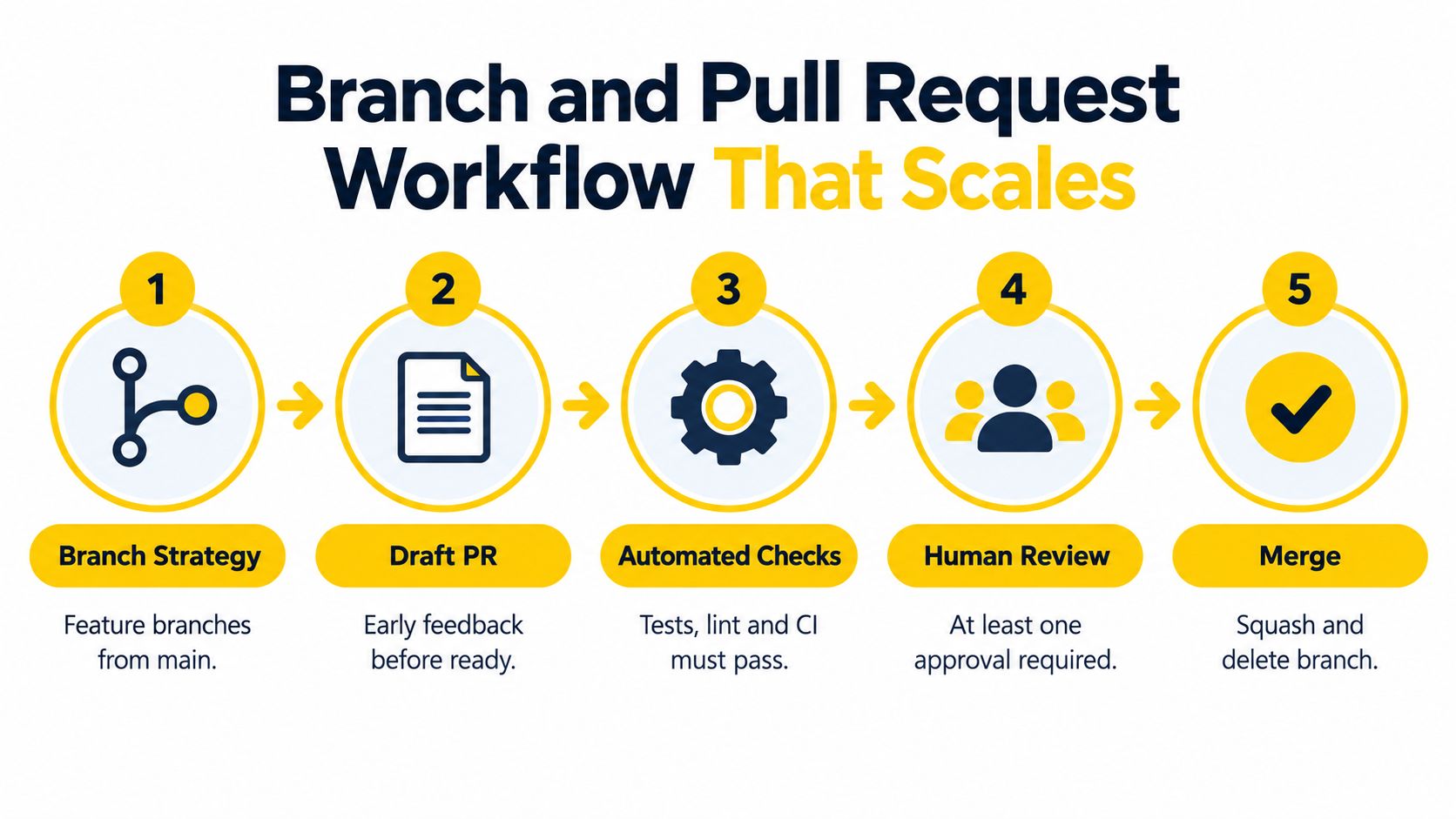
Designing a Branch and Pull Request Workflow That Scales
A scalable workflow removes avoidable decisions from the review queue. Contributors should know where to branch, what a ready PR contains, which checks run automatically, and who can merge it. The repository should make the safe path easier than the improvised one.
Start with a focused branch
Create a feature or fix branch from the current main branch. Give it one purpose. A consensus correction, a wallet error-message update, and a mining performance refactor should be separate branches, even if one contributor is working on all three.
Open a draft pull request early when the design needs feedback. A draft lets maintainers challenge the approach before the author spends time polishing implementation details. It also gives reviewers context while the change is still cheap to reshape.
The PR description should answer five questions:
- What problem does this solve?
- What behavior changes?
- Which files or subsystems carry risk?
- What tests and manual checks were run?
- What remains uncertain?
Cascoin's pull request guidelines provide a useful project-specific baseline. A reviewer should be able to compare the stated problem with the actual diff and quickly see whether the change stayed focused.
Let automation clear the routine work
Before asking a human to review, require the available deterministic checks:
- Build checks: Confirm supported targets compile cleanly.
- Unit and integration tests: Exercise both normal and failure paths.
- Linting and formatting: Keep style disputes out of the human review.
- Static analysis: Flag unsafe patterns, unreachable branches, and suspicious data flow.
- Dependency checks: Identify changes in third-party code and lockfile behavior.
- Fuzzing where appropriate: Exercise parsers, serializers, transaction handling, and boundary-heavy consensus code.
Automation doesn't prove correctness. It creates a common floor so reviewers can spend time on intent, invariants, and interactions instead of whitespace.
Control size and review speed
A widely cited industrial study analyzed 2,500 reviews covering 3.2 million lines of code. Its findings helped popularize smaller reviews, while SmartBear recommendations commonly used in practice suggest reviewing fewer than 200 to 400 lines at a time and spending 60 to 90 minutes per review, associated with about 70% to 90% defect discovery in those benchmarks. The code review statistics summary documents those figures and their practical context.
Treat those numbers as operating signals, not a universal law. A 300-line consensus change may deserve more scrutiny than a much larger generated fixture. If a PR is too large to understand, split it into preparatory refactors, behavior changes, and follow-up cleanup. Don't approve a risky bundle just because splitting it is inconvenient.
The University of Pittsburgh study found that a review rate of 200 lines of code per hour or less was an effective threshold, identifying nearly two-thirds of defects in design reviews and more than half in code reviews. The empirical review-rate research supports limiting inspection speed as an operational control. Ask reviewers to pause or divide the work when the diff becomes a scanning exercise.
A practical merge flow looks like this:
- An issue defines the intended behavior and risk.
- The author creates a focused branch and draft PR.
- Automated checks run before human review.
- The author supplies test evidence and explains affected invariants.
- A reviewer examines the diff in context.
- Higher-risk changes receive specialist review or deeper testing.
- The maintainer confirms approvals, resolves outstanding conversations, and merges with a traceable strategy.
- The branch is removed and the post-merge result is monitored.
When PR volume exceeds reviewer capacity, triage first. Low-risk documentation and isolated tooling changes can use a lighter path. Consensus, wallet, and mining changes go to the front of the specialist queue, even if their diffs are short.
An AI reviewer can summarize a diff or flag routine concerns, but it shouldn't approve a consensus change by itself. Recent discussion of AI-assisted code review highlights the continuing difficulty of project-specific context, organizational rules, and deeper logic correctness. Configure automation around repository policies, then keep a human responsible for the merge.
The following video can help contributors visualize the mechanics of branches and pull requests before they work on a public repository.
Security Performance and Mining Algorithm Checklist for Reviewers
Crypto review needs three separate lenses. Security asks whether an attacker can steal, forge, replay, or manipulate. Consensus correctness asks whether honest nodes reach the same result. Performance asks whether the implementation behaves acceptably under real workload and mining conditions.
Don't collapse those questions into one “LGTM.” A change can be secure against key theft and still split consensus. It can preserve consensus and still create a denial-of-service path. It can pass correctness tests and still make mining or wallet operation impractical.
Security checks
For wallet and transaction code, inspect:
- Key boundaries: Private keys should remain inside the intended storage and signing boundaries. Check logging, error messages, serialization, backups, and temporary objects.
- Signing behavior: Verify domain separation, input construction, signature validation, and rejection of malformed data.
- Transaction validation: Confirm that amounts, scripts, inputs, outputs, and authorization rules are checked consistently.
- Replay protection: Ask whether a transaction or signed message can be reused in an unintended network or state.
- Dependency supply chain: Review new dependencies, version changes, build scripts, generated artifacts, and source provenance.
- Failure handling: Ensure invalid input fails closed and doesn't leave partially updated wallet or node state.
For consensus code, compare the implementation with the protocol rule, not only with nearby code. Test boundary values, malformed encodings, time and height transitions, duplicate data, and disagreement between independently implemented paths. A reviewer should be able to state the invariant in plain language before approving the code.
Mining and performance checks
Mining-algorithm changes require their own questions. For Labyrinth Mining, inspect maze generation, deterministic inputs, path validation, reward calculation, difficulty behavior, and whether clients can disagree about a valid result. For MinotaurX and SHA-256, verify that algorithm selection, work verification, target comparison, and reward accounting remain isolated and consistent.
Be cautious with energy-efficiency claims. Measure behavior under comparable workloads and hardware rather than inferring efficiency from a faster benchmark on one machine. Check whether an optimization changes accepted work, gives a client an unintended advantage, or creates a denial-of-service opportunity through expensive validation.
Cascoin's open-source software audit guidance is a useful reference when a change needs a more formal examination. The audit path should supplement, not replace, ordinary review and automated testing.
Apply a risk-based matrix
| Change Area | Risk Level | Required Review Depth | Extra Checks |
|---|---|---|---|
| Documentation, comments, isolated user-interface text | Low | One focused review and automated checks | Link checks, build verification |
| Developer tooling, test fixtures, non-consensus refactor | Moderate | Context review, test review, maintainer approval | Static analysis, regression tests |
| Wallet storage, signing, serialization, dependency updates | High | Maintainer plus security-aware reviewer | Negative tests, dependency review, targeted fuzzing |
| Consensus validation, block rules, replay protection | Critical | Independent reviewers with subsystem context | Cross-implementation tests, fuzzing, explicit invariant review |
| Mining algorithms, difficulty, rewards, work validation | Critical | Maintainer plus mining or protocol specialist | Deterministic vectors, performance tests, economic and edge-case analysis |
Escalate when the author can't explain an invariant, when a test changes to accommodate new behavior, or when a dependency affects parsing, cryptography, networking, or build output. External audit is appropriate when the code has a broad financial or consensus impact and the internal team lacks independent expertise. It isn't a substitute for maintaining review competence inside the project.
Templates Etiquette and Sample Comments That Improve Reviews
Good templates reduce the amount of archaeology a reviewer must do. They also help newcomers provide the information experienced maintainers look for automatically. Keep the format short enough that contributors will complete it, but specific enough to expose risk.
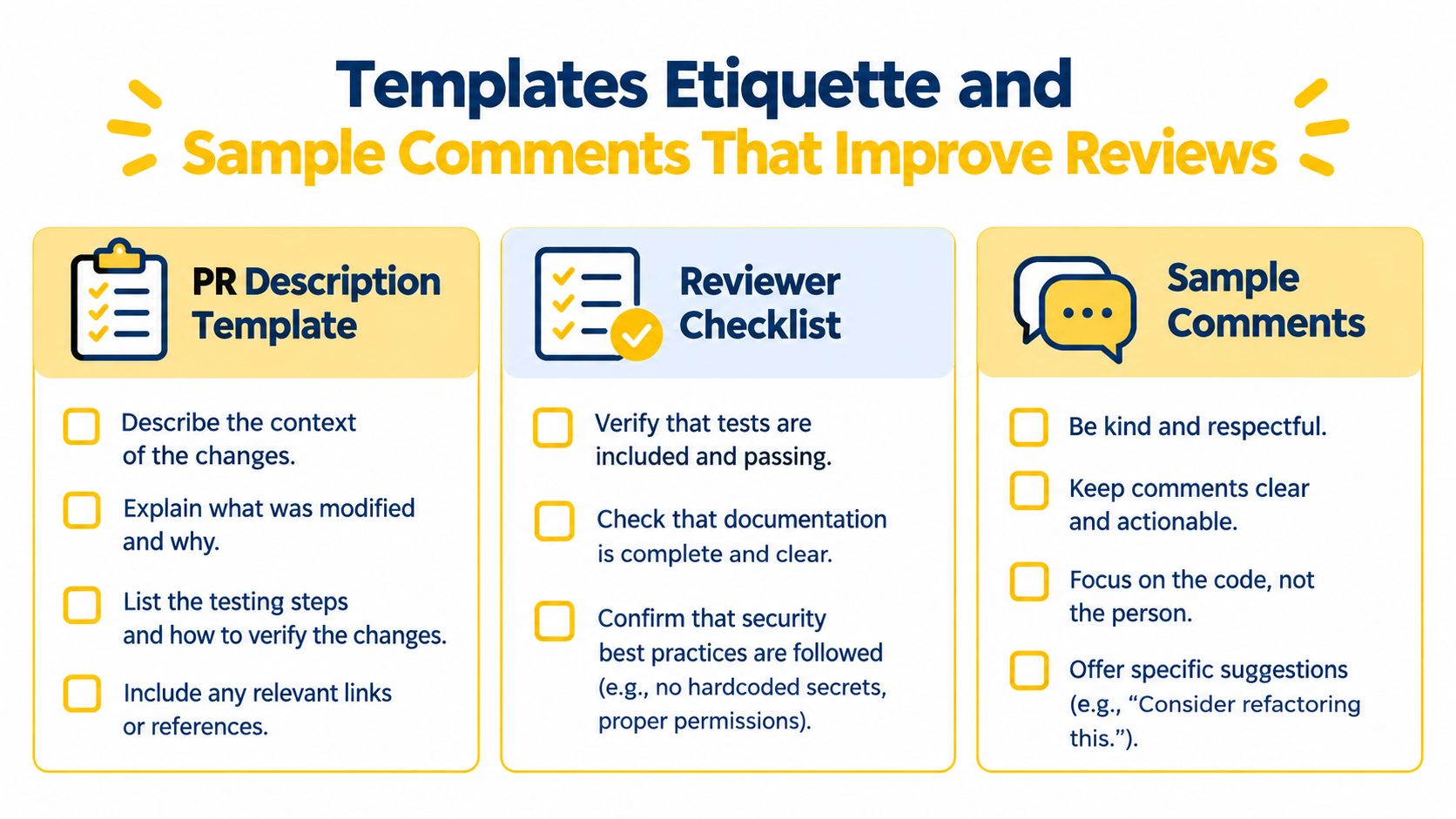
A practical PR description template
## Purpose
What problem does this change solve?

## Scope
What behavior changes, and what does not change?

## Risk
Does this touch consensus, wallet security, cryptography, mining, networking, or dependencies?

## Validation
Which tests, builds, fuzzers, or manual checks were run?

## Review notes
Which files or invariants need particular attention?

## Follow-up
What remains out of scope or uncertain?
The author should link the issue, include screenshots only when behavior is visual, and mention test limitations plainly. “Tests pass” is less useful than naming the test groups and explaining what they cover.
A reviewer checklist that stays usable
Review in this order:
- Intent: Does the diff solve the stated problem?
- Scope: Did unrelated cleanup enter the PR?
- Behavior: Are normal, invalid, boundary, and failure paths covered?
- Protocol: Could nodes, wallets, or miners interpret the result differently?
- Security: Could input, dependencies, logging, or state handling expose funds or control?
- Tests: Do the tests verify the requirement, or merely reproduce the implementation?
- Maintenance: Will the next contributor understand the decision?
Use comment levels consistently. Reserve blocking language for correctness, security, consensus, or required evidence. Mark style preferences as suggestions, and don't make an author defend a harmless choice that doesn't affect the project.
Comments that move the work forward
Weak: “This seems wrong.”
Better: “Could this reject an input whose encoded length is valid but whose decoded value exceeds the protocol limit? Please add a boundary test and explain the intended failure path.”
Weak: “Add tests.”
Better: “Please add a test for two nodes receiving the same malformed transaction. I want to verify both paths reject it before state changes.”
For consensus logic, be direct without being theatrical:
Consensus question: Which invariant guarantees that every node computes the same reward at this height? Please point to the existing rule or add a test that captures it.
For a maintainability concern:
“Could you keep this validation in the existing transaction-checking helper? Duplicating it here creates two places that future protocol changes would need to update.”
For a possible security issue:
“This path appears to carry user-controlled data into signing preparation. Please document the trust boundary and add a test showing that malformed input is rejected without producing a signature.”
Contributors should respond to the technical issue, push follow-up commits with clear messages, and mark conversations resolved only when the requested evidence exists. Reviewers should re-read the updated lines, not assume a commit named “fix review” solved the concern. When disagreement remains, state the invariant, gather a small reproducible test, and let the maintainer make the decision. Public disagreement is healthy when it produces a durable record rather than a personal contest.
Measuring Success and Continuously Improving Your Process
A review process earns trust when it helps an open-source cryptocurrency merge safe changes without exhausting its maintainers. Measure friction and escaped risk, then use the results to adjust the workflow rather than turning metrics into contributor targets.
Start with signals that expose where review capacity is going:
- Review turnaround: How long contributors wait for a useful first response, not merely an automated status.
- PR size distribution: Whether changes stay understandable or arrive as bundles that hide consensus, mining, and wallet changes together.
- Comment usefulness: Whether comments identify defects, clarify design, improve maintainability, or create noise.
- Defect escape rate: Escaped defects divided by total merged PRs for the same period. Record where each defect was found, such as testing, release, or user reports.
- Risk coverage: Whether changes to consensus, signing, address handling, and mining code received the specialist attention repository rules require.
- Rework patterns: How often authors reopen the same concern because requirements or invariants were unclear.
Read these measures together. A low escape rate can reflect strong review, limited testing, or too few changes reaching production. A long turnaround can indicate overloaded specialists rather than poor contributor performance. Review a histogram of turnaround times, not only its average: a tight cluster with a long tail points to a small set of PRs waiting for scarce protocol expertise.
Comment counts also need context. A reviewer who catches a consensus mismatch may leave one comment, while a large refactor can produce many maintainability notes without exposing an immediate security failure. Track whether comments led to a test, documented invariant, code change, or explicit maintainer decision.
Keep a lightweight record of who has reviewed consensus, wallet, and mining code. Pair newer contributors with experienced maintainers instead of rotating reviewers randomly. This expands the reviewer pool while preserving the context needed for high-risk paths. When PR volume exceeds capacity, route low-risk documentation and tooling changes through the normal queue, but reserve specialist review for protocol, signing, serialization, and mining-algorithm changes.
Run a short retrospective after a serious escaped defect, a stalled release, or a sustained PR backlog. A manager run after action review provides a practical structure for asking what happened, what the team expected, where the process failed, and which specific change should follow. Record an action such as adding a boundary test, changing CODEOWNERS, tightening the PR template, or requiring specialist approval for a new file path.
For the next 30 days, choose a small improvement set: define risk labels, enforce automated checks, add the PR template, identify owners for consensus and wallet code, and review the first batch of metrics. AI-generated code can receive automated triage and summaries, while protocol judgment and project-specific policy remain with human maintainers.
The goal is a living system that preserves velocity while making dangerous changes difficult to merge unnoticed.
Cascoin offers an open-source cryptocurrency with publicly inspectable code, community contribution paths, multiple mining options including Labyrinth Mining, MinotaurX, and SHA-256, and on-chain verification through Casplorer. Visit Cascoin to explore its repositories, documentation, and community channels.