Bitcoin New York Guide for Users and Businesses
You've just arrived in New York and want to buy Bitcoin, pay a freelancer, accept digital assets at your business, or explore mining in upstate communities. The technology may look familiar, but Bitcoin in New York operates under a different practical rulebook. A service that seems ordinary elsewhere may require state authorization here, while mining projects must account for permits, emissions, and competition for electricity.
That tension defines Bitcoin New York. The state has been an early center of Bitcoin culture, a major financial market, and one of the strictest regulatory environments for virtual-currency businesses. This guide explains how those pieces fit together, from the city's early Bitcoin history to BitLicense obligations, everyday access, mining policy, and the legal changes businesses should monitor.
For individuals, the key question is whether a provider is authorized and whether its custody and transaction practices suit your needs. For businesses, the question is broader: does your model involve transmitting, holding, exchanging, selling, or issuing virtual currency in a way that brings New York obligations into play? The answer can affect product design, partnerships, banking, compliance staffing, and expansion plans.
Table of Contents
- Introduction to Bitcoin in New York Today
- How New York Became a Bitcoin Hub
- Understanding BitLicense and New York Crypto Regulation
- Where to Buy Spend and Use Bitcoin in New York
- Bitcoin Mining and Energy Policy in New York State
- Legal and Practical Tips for Users and Businesses
- Community Events and Resources to Stay Informed
Introduction to Bitcoin in New York Today
A visitor searching for Bitcoin in New York often starts with a simple task. They want to open an account, purchase a small amount, send it to a wallet, or find a local merchant that accepts it. The first surprise is that access isn't determined only by whether the technology works. New York's licensing framework can determine whether a business may provide the service at all.
That makes the state different from a market where a user can choose almost any global platform. A New York resident needs to think about authorization, identity checks, custody arrangements, transaction limits, and the provider's ability to serve residents under state rules. A merchant or startup faces an additional question: whether accepting Bitcoin is merely a payment decision or part of a regulated virtual-currency business activity.
New York's importance comes from its unusual combination of financial influence and regulatory intensity. The state gave Bitcoin an early public platform, then developed formal oversight that shaped how exchanges, custodians, payment companies, and other firms approached the market. The result is an environment where legitimacy and operational readiness matter as much as technical capability.
A practical way to read the landscape
You can think of the state's Bitcoin environment as three connected layers:
- Access: How individuals buy, hold, send, and potentially spend Bitcoin.
- Authorization: How businesses determine whether their activities require a BitLicense or another form of approval.
- Infrastructure: How mining operations secure electricity, permits, and community acceptance.
These layers interact. A company may have strong software but still lack permission to serve New York customers. A mining site may have suitable hardware but face energy or emissions constraints. A business planning to use Bitcoin as collateral may also need to understand how revised commercial law treats digital assets.
Practical rule: In New York, treat authorization and infrastructure as part of the product, not as paperwork added after launch.
The sections that follow are designed for both newcomers and operators. Users will find a way to evaluate providers without assuming that every wallet or ATM is equally suitable. Businesses will find a decision framework for identifying regulatory triggers, anticipating the proposed 2026 CRYPTO Act, and assessing whether a mining or data-center plan can work under changing grid policy.
How New York Became a Bitcoin Hub
New York's Bitcoin story began with visibility. In August 2011, about 50 enthusiasts gathered at the Roosevelt Hotel for an event described as the world's first Bitcoin Conference and World Expo, as documented in the history of Bitcoin's New York timeline. The gathering mattered because it placed an online experiment in a city already associated with global finance, media, and technology.
That setting changed the audience. Bitcoin was no longer discussed only in specialist online communities. A public event in New York gave people a place to meet, explain the technology, and connect it to financial infrastructure that many outsiders already understood. The city didn't create Bitcoin, but it helped give Bitcoin a recognizable public stage.
From community to commercial infrastructure
The next stage came through physical and institutional development. Bitcoin Center NYC opened at the start of 2014, creating a visible location for education, discussion, and commercial experimentation. Around the same period, New York regulators began formal hearings and rulemaking on virtual currency, with activity recorded in November 2013 and March 2014 in the historical timeline.
Those developments show two forms of growth happening together. Community organizers were making Bitcoin easier to encounter, while regulators were deciding how virtual-currency companies should operate in a major financial jurisdiction. New York's path therefore wasn't just a story of rising enthusiasm. It was a shift from informal discovery toward supervised financial activity.
The state's first formal licensing milestones followed quickly. The BitLicense framework took effect on June 24, 2015, and Circle received the first BitLicense on September 22, 2015, according to the same historical record. Those dates placed New York at the center of U.S. Bitcoin policy during a formative period.
Why the sequence still matters
By the time New York began formalizing virtual-currency oversight, the city already had a community, a public venue, and a financial identity. That combination made the state an attractive but demanding place for crypto businesses. Approval could open access to a major market, but the application and supervision burden could also discourage firms that lacked the resources to comply.
The historical lesson is straightforward: New York became a Bitcoin hub because culture, finance, and regulation developed together. That explains why today's questions rarely stop at “Can I buy Bitcoin?” They include “Who can serve me?”, “What activity needs authorization?”, and “Can this infrastructure operate under state energy policy?”
The following video offers another introduction to the relationship between Bitcoin and the state's regulatory environment.
Understanding BitLicense and New York Crypto Regulation
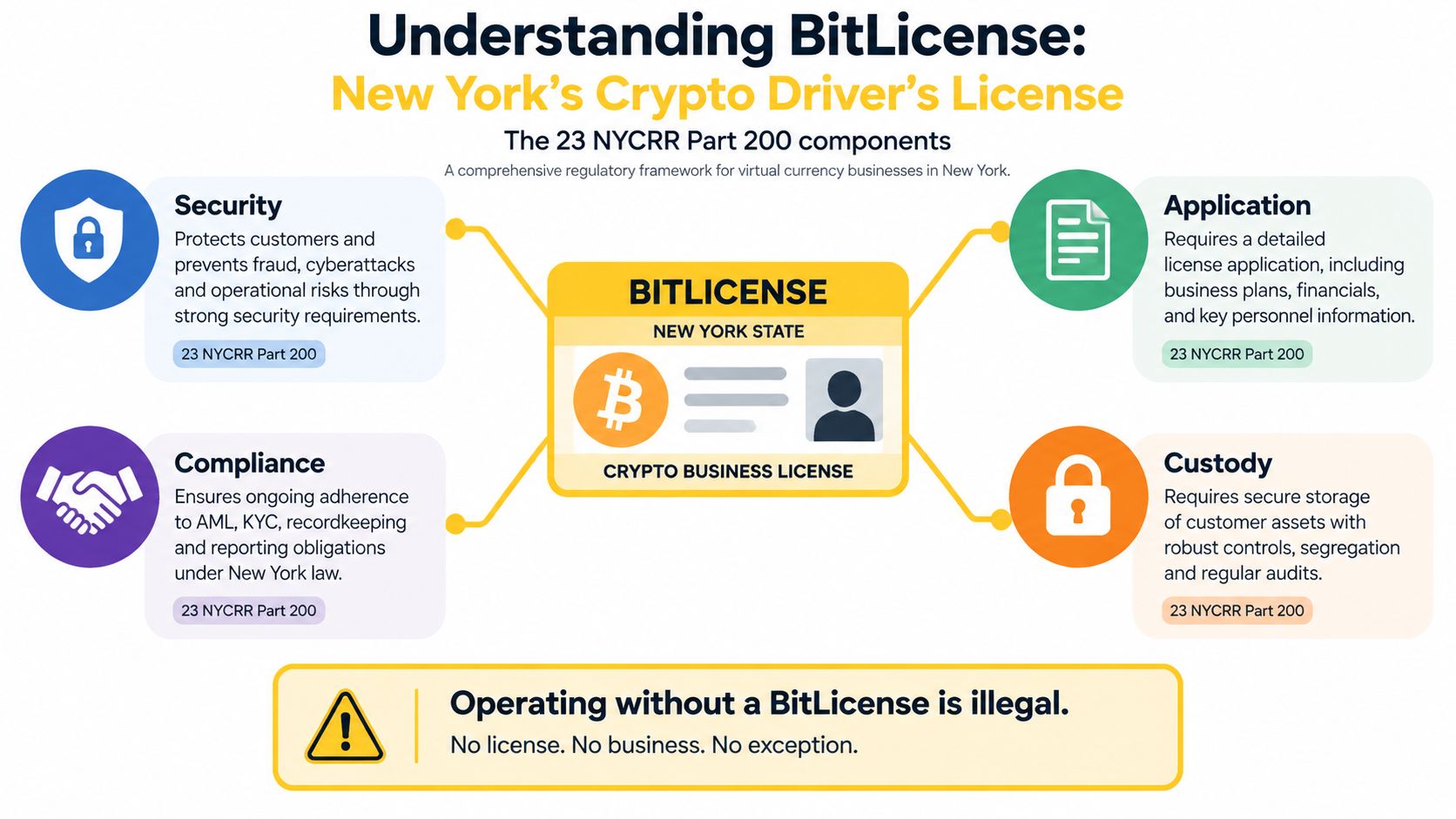
The simplest way to understand a BitLicense is to treat it as a financial operating license for specific virtual-currency activities. New York's rules, adopted in 2015 under 23 NYCRR Part 200, require a business engaging in virtual-currency business activity involving New York or a New York resident to obtain authorization, according to the New York Department of Financial Services virtual-currency requirements.
The rules cover more than a traditional exchange. They include transmission, custody, exchange, buying or selling as a customer business, and issuing or administering virtual currency. A company that doesn't call itself an exchange can still face licensing questions if its actual service performs one of those functions.
The activity matters more than the label
Consider a startup offering a wallet with optional managed storage. “Wallet company” is a marketing description. The regulatory analysis must ask whether the company controls customer assets, transmits them, exchanges them, or performs another listed activity.
A business also shouldn't assume that a non-custodial design automatically avoids New York obligations. The state's framework can create a high-friction compliance layer for models that fit an enumerated category, even when the company's product language emphasizes software rather than financial services.
| Business activity | Practical question |
|---|---|
| Transmission | Does the company move virtual currency for a customer or between parties? |
| Custody | Can the company control, store, or access customer assets? |
| Exchange | Does it facilitate conversion between virtual currency or other assets? |
| Customer buying or selling | Does it act as a business counterparty for customers? |
| Issuance or administration | Does it create or manage a virtual currency system? |
New York's demanding approach is visible in its approval history. By June 2020, only 25 companies had received BitLicense approval, according to reporting on the BitLicense timeline and approval process. The same source records 22 applications in the first round by August 13, 2015, the first approval on September 22, 2015, and the 10th BitLicense on November 14, 2018. These figures don't measure the value of the license, but they do show how slowly approvals accumulated.
For operators: A compliance plan should begin with a function-by-function map of the product, not with the company's preferred legal description.
What the 2026 changes could mean
In 2026, New York proposed the CRYPTO Act, which could make operating an unlicensed virtual-currency business potentially criminal, as described in coverage of the proposed New York Crypto Act. Because the proposal is not the same as an enacted rule, businesses should monitor its status rather than treat every proposed consequence as current law.
The state also moved in June 2026 to update commercial law so Bitcoin can be treated as a “controllable electronic record” under revised UCC rules, according to the same legal analysis. That change matters to lenders and businesses because it can affect questions about control, collateral, and secured transactions. It doesn't replace BitLicense analysis. It adds another legal layer for firms using Bitcoin in commercial arrangements.
Businesses that operate internationally may benefit from comparing New York's approach with other jurisdictions. For a broader perspective on cross-border obligations, UK regulatory compliance insights can help teams see how licensing, governance, and risk controls differ across markets. For related background on legal treatment of blockchain systems, review this blockchain law guide.
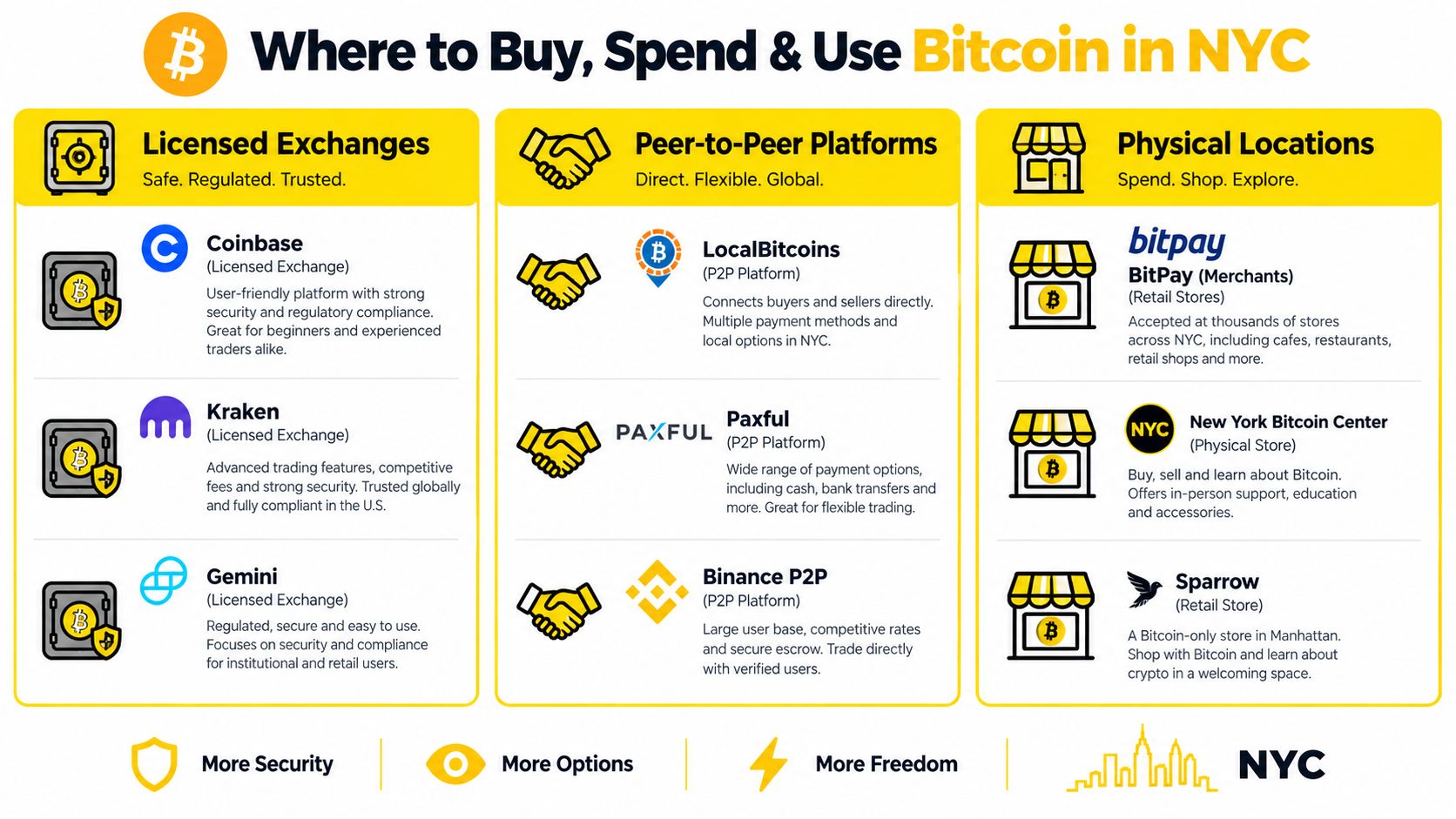
Where to Buy Spend and Use Bitcoin in New York
For most New Yorkers, access starts with choosing a provider. The safest comparison isn't “which platform has the lowest advertised fee?” It's which provider is authorized to serve New York, explains custody clearly, and offers transaction controls you can understand.
A licensed exchange is usually the most structured option for purchasing Bitcoin. It may provide identity verification, account security tools, transaction records, and a defined customer-support process. That convenience comes with onboarding requirements and a provider-controlled account, so users should understand whether they can withdraw Bitcoin to a wallet they control.
Comparing common access routes
| Route | Best suited to | Main questions to ask |
|---|---|---|
| Licensed exchange | Users who want an account-based purchase and recordkeeping | Is the provider authorized for New York residents? Who controls the keys? |
| Peer-to-peer service | Users seeking direct transactions with another party | What protections exist if the counterparty fails to complete the trade? |
| Bitcoin ATM | Someone who values physical convenience | Who operates the machine, what verification is required, and where is support provided? |
| Direct merchant payment | Buyers spending Bitcoin for goods or services | Does the merchant actually accept Bitcoin, and how is the exchange rate handled? |
Bitcoin ATMs deserve extra caution. A machine in a neighborhood store may look local and trustworthy, but the physical location doesn't prove that the operator is authorized. Before using one, record the operator's legal name, review its fee and identity requirements, confirm the destination address on the screen, and keep the receipt.
Peer-to-peer transactions require a different form of diligence. You're evaluating both the platform and the counterparty. Don't send funds based only on a social-media profile, a chat conversation, or pressure to act immediately. A legitimate transaction should give you time to verify the payment details and preserve a clear record.
Spending requires merchant confirmation
Bitcoin acceptance varies by merchant and can change without notice. Ask before ordering, verify the payment destination carefully, and keep the transaction record with the invoice or receipt. If a business quotes a Bitcoin price, clarify whether it locks the conversion rate at checkout or recalculates it when payment confirms.
You'll find more practical examples in this guide to where to spend Bitcoin. The important principle is simple: convenience doesn't remove the need for verification.
For businesses accepting Bitcoin, separate payment acceptance from custody whenever possible. Document who converts the asset, who holds it during settlement, and how refunds are handled. Those choices can affect both operational risk and the regulatory analysis described earlier.
Bitcoin Mining and Energy Policy in New York State
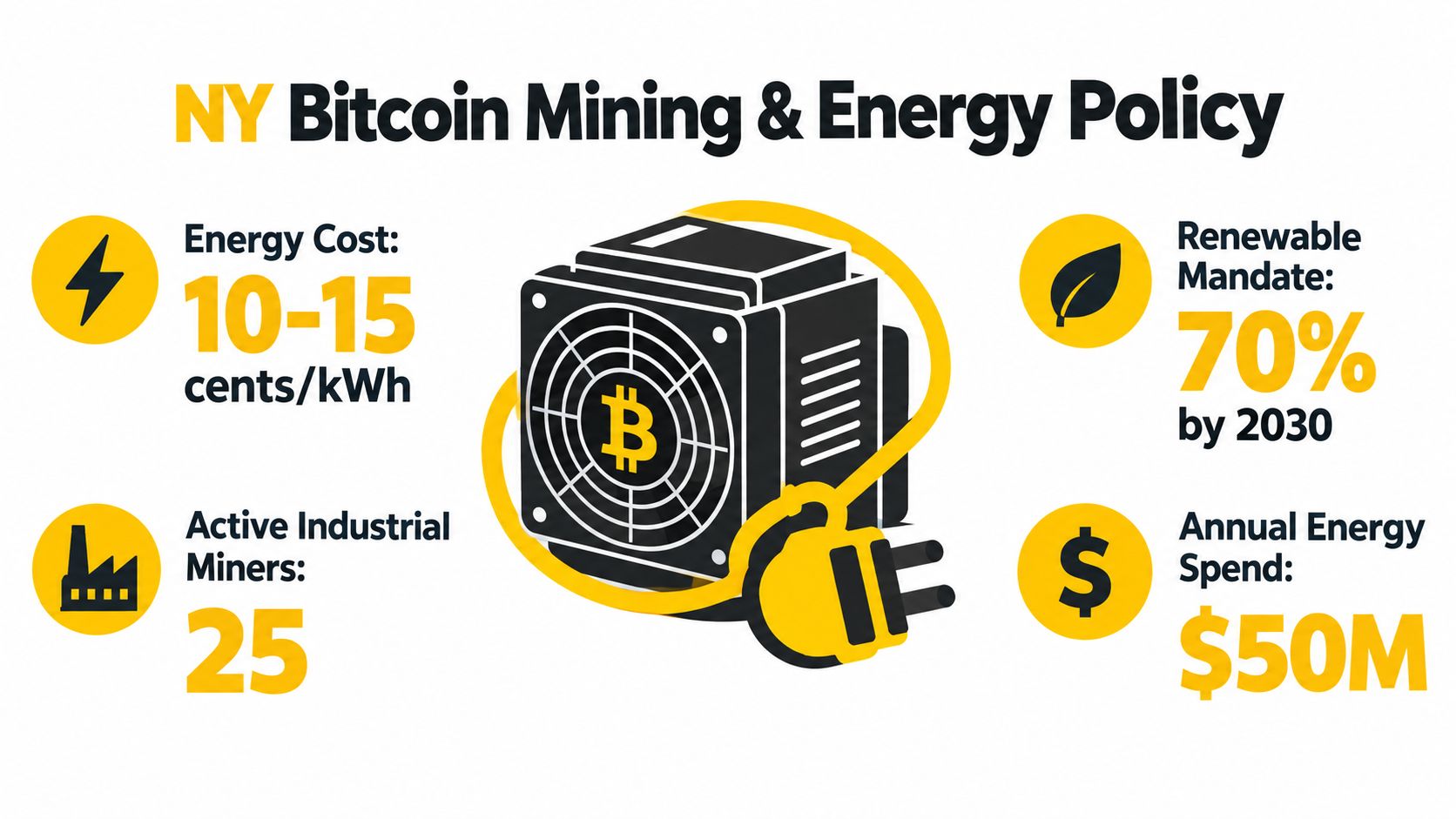
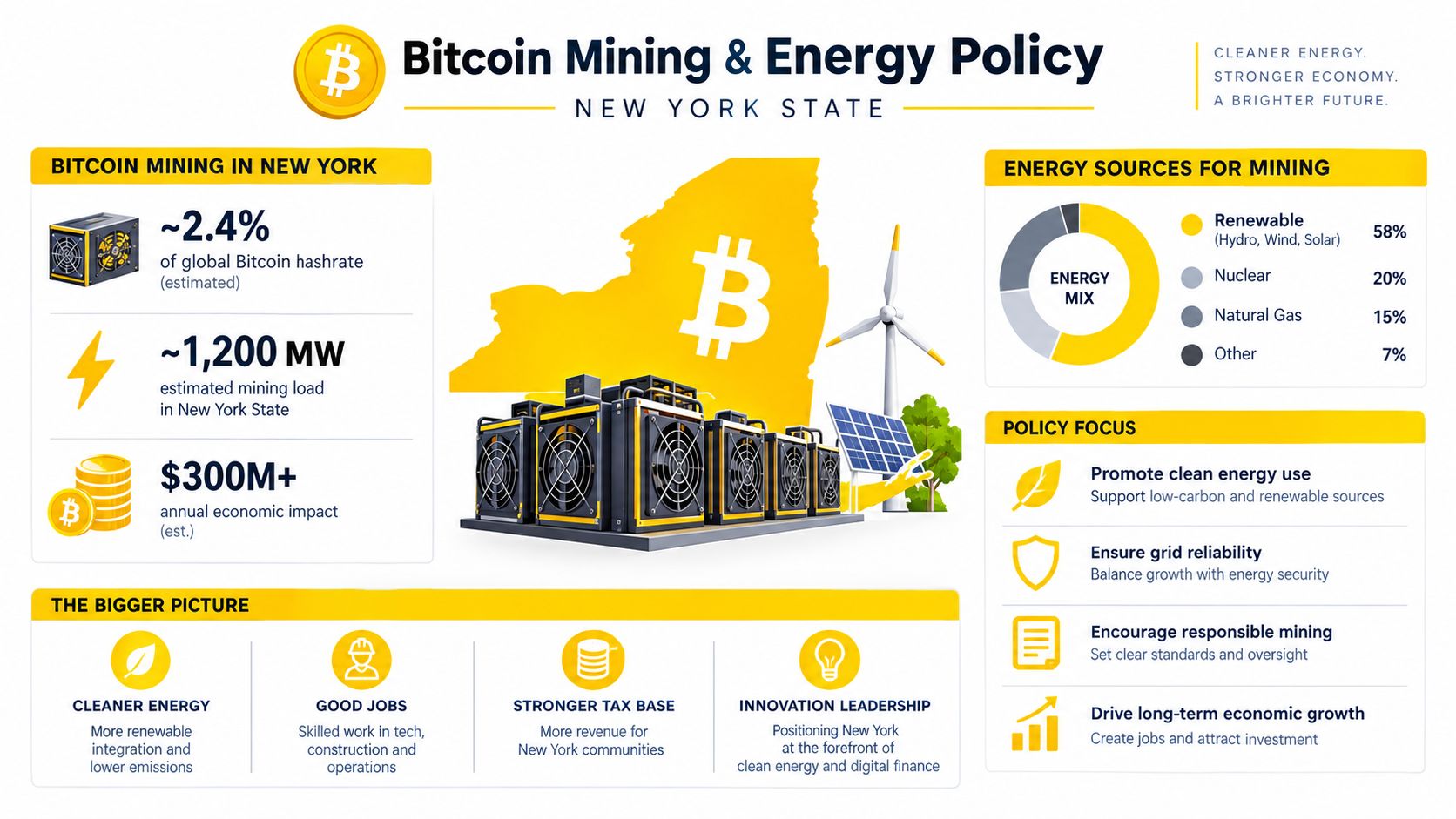
Bitcoin mining in New York is an infrastructure decision before it's a hardware decision. Operators need a suitable site, reliable power, permits, cooling capacity, and a plan for environmental obligations. Electricity pricing matters, but so do the rules governing the source and use of that electricity.
A Finger Lakes mining operation was required to reduce emissions by 44%, equal to 282,000 tons of carbon dioxide by 2030, under an agreement with state regulators, according to reporting on the operation's air permit and emissions requirements. The example shows how a permit can directly affect a facility's operating model. A site may have access to power and still face limits on how that power is generated or used.
Load size changes the public conversation
One upstate Bitcoin-mining facility was reported at 107 MW, roughly enough energy for 75,000 homes, in reporting on New York's data-center permit freeze and grid concerns. That comparison helps explain why local officials focus on load and grid capacity rather than treating mining as an abstract technology debate.
In July 2026, New York paused new or expanding large data-center permits while regulators studied electricity, water, air-quality, and community impacts. Reporting on the pause also notes that it extends scrutiny already applied to Bitcoin mining, creating a direct connection between crypto infrastructure and the broader data-center economy.
Site-selection test: A mining plan isn't operationally sound until its electricity source, permit pathway, emissions profile, and local grid impact have been reviewed together.
The competition with AI and other data centers makes this more important. A miner seeking a large connection may compete with facilities serving different commercial priorities but drawing on the same constrained grid. That can affect approval timing, power availability, community negotiations, and the economic assumptions behind a mining project.
For a wider discussion of environmental trade-offs, see this explanation of the ecological impacts of mining. The practical conclusion for New York operators is that energy policy isn't a side issue. It determines where mining can happen, how large it can become, and whether the business model remains viable after permits and environmental conditions are applied.
Legal and Practical Tips for Users and Businesses
The right compliance response depends on what you do with Bitcoin, not on whether you use the word “crypto” in your branding. An individual buying and holding Bitcoin has a different risk profile from an exchange transmitting customer funds. A merchant accepting payment has a different operational problem from a data center running mining equipment.
For individuals
Start with provider verification. Use the New York Department of Financial Services virtual-currency business directory and review the provider's legal identity, not just its consumer-facing brand. If the service uses a partner, identify which company handles custody, conversion, and transmission.
Then make your records usable:
- Control check: Know whether the provider holds the Bitcoin or whether you can withdraw it to a wallet you control.
- Transaction record: Save purchase confirmations, withdrawal details, receipts, and relevant account statements.
- Fraud check: Ignore unsolicited investment offers, urgent requests, and anyone asking you to pay extra funds to release a withdrawal.
- Recovery plan: Keep wallet backups and account-recovery information separate from everyday login details.
Don't assume a physical ATM or a polished website is proof of legitimacy. Verify the operator before sending money, and stop if the instructions become confusing or unusually urgent.
For businesses
A business should create a written activity map before building or launching:
- List the functions. Mark every point where the company receives, holds, transmits, exchanges, sells, or issues virtual currency.
- Identify New York contact. Record whether the service targets New York residents, operates from the state, or handles transactions involving the state.
- Separate custody. Decide whether a regulated partner, rather than the company, controls customer assets.
- Obtain legal advice. Ask counsel to assess BitLicense requirements under 23 NYCRR Part 200 and any applicable money-transmission obligations.
- Monitor pending law. Track the CRYPTO Act rather than waiting for an enforcement event to reveal how lawmakers address unlicensed activity.
- Review commercial contracts. If Bitcoin may serve as collateral, examine the revised UCC treatment of controllable electronic records and document control rights precisely.
A lean business model can reduce exposure, but “non-custodial” isn't a magic exemption. The substance of the service still matters.
Operational habit: Keep a dated record of licensing analysis, product changes, vendor roles, and counsel's conclusions. A clear audit trail helps the team respond when the product evolves or regulators ask questions.
For miners, add a separate infrastructure file covering site permissions, power agreements, air permits, water use, and community conditions. The same business may need a BitLicense analysis for customer-facing services and an environmental review for its physical operations.
Community Events and Resources to Stay Informed
New York's Bitcoin community began with people meeting in person, and that habit remains useful. Meetups, developer gatherings, conferences, and local discussion groups can help newcomers distinguish practical experience from promotional claims. They're also valuable for businesses that need introductions to compliance professionals, infrastructure providers, accountants, and engineers who understand the state's operating environment.
Use community events for education, not as a substitute for verification. A speaker's confidence doesn't establish that a platform is licensed, a mining site is permitted, or an investment is suitable. Ask for the legal entity name, confirm regulatory information through official channels, and keep independent records.
Build a monitoring routine
A New York Bitcoin user or operator should follow several information streams:
- Regulatory updates: Check NYDFS announcements and virtual-currency business materials for licensing and supervisory changes.
- Legislative developments: Track proposed laws, including changes that could affect unlicensed activity or commercial treatment of Bitcoin.
- Local decisions: Watch permit and community proceedings where mining or data-center projects are proposed.
- Technical documentation: Review wallet, custody, and payment documentation before relying on a service.
- Community signals: Use meetups and developer channels to identify practical issues early, then verify them independently.
The useful mindset is neither blind optimism nor blanket suspicion. New York's ecosystem rewards people who ask specific questions, preserve records, and revisit assumptions when rules or infrastructure conditions change.
If you're a user, verify your provider before funding an account. If you're building a business, map regulated functions before writing the launch plan. If you're evaluating mining, secure a credible power and permit analysis before buying equipment.
Cascoin offers an open-source, community-driven approach to lower-power cryptocurrency mining, with Labyrinth Mining, CPU-friendly MinotaurX, and SHA-256 options for different participants. Visit Cascoin to explore the code, wallets, mining pool, documentation, and community resources before deciding whether it fits your responsible Bitcoin and crypto interests.