Cryptocurrency Environmental Impact Explained and Reduced
A lot of people start the crypto climate debate with electricity. That's understandable, but it misses the more useful question. The same amount of electricity can produce very different emissions depending on where and when that power is drawn.
That shift matters because Bitcoin's footprint has never been small. An OECD analysis reports that in 2021 Bitcoin was responsible for about 65 Mt CO2 per year, about 0.2% of global emissions, and that one Bitcoin transaction averaged about 670 kg CO2, roughly comparable to a passenger seat on a flight from Amsterdam to New York, according to the OECD report on digital asset environmental impact. Those numbers are striking, but they're only the start of the story.
For miners, developers, and curious users, the practical issue isn't just whether crypto uses energy. It's what kind of system causes that demand, how the local grid responds, and which design choices can lower the impact without pretending the problem doesn't exist. Some networks rely on a pure hardware arms race. Others replace that race with staking, lighter computation, or alternative mining designs.
That's why the cryptocurrency environmental impact discussion has become more precise. People still care about big annual power figures, but they also want to know whether a mining operation is using fossil-heavy evening power, cleaner midday surplus, or a lower-power protocol in the first place. Investors ask those questions. Communities ask them. Regulators increasingly do too.
The most useful climate question in crypto isn't “How many terawatt-hours?” It's “What emissions came from which power source, in which place, at which time?”
A balanced view helps. This topic is easy to turn into slogans. “Crypto is wasteful” flattens important differences. “Crypto uses renewables” can hide the fact that total demand still matters. The truth sits in the engineering details.
Table of Contents
- Introduction to Cryptocurrency Environmental Impact Today
- How Cryptocurrency Uses Energy and Creates Emissions
- Quantifying the Footprint From Energy to E-Waste
- Comparing Consensus Mechanisms and Mining Models
- Proven Strategies to Reduce Crypto Environmental Impact
- Actionable Steps for Eco Conscious Miners and Developers
- Building a More Sustainable Crypto Future Together
Introduction to Cryptocurrency Environmental Impact Today
Bitcoin alone has at times been estimated to use electricity on the scale of a small country, as noted earlier in the OECD source already cited in this article. That headline grabs attention, but it can also blur the engineering question.
Environmental impact is not just a big annual power number. It is a combination of where the electricity comes from, what time the machines run, what hardware the system requires, and how the protocol is designed in the first place.
A simple analogy helps. Two factories can use the same amount of electricity in a year and still have very different emissions. One might run at noon on a grid full of solar power. The other might run on winter evenings when gas and coal plants set the marginal supply. Crypto works the same way. Annual terawatt-hours show size. They do not fully show climate impact.
That shift in thinking has changed the debate. Early arguments often treated all kilowatt-hours as equal. Analysts, regulators, and developers now ask narrower and better questions. Which grid served the load? Was power drawn during peak demand or during surplus generation? Did the network rely on a hardware race, or did it choose a design that avoids one?
Those questions matter because crypto systems are not all built alike. Some rely on continuous competition between specialized machines. Others use staking or lower-power validation methods. Some newer approaches, including designs described as Labyrinth Mining, aim to reduce the direct link between network security and ever-rising electricity demand. The point is not that one label solves the problem. The point is that protocol design changes the energy equation before the first miner even plugs in a machine.
A practical way to judge environmental claims is to ask four questions in order:
- What is the security model? Competitive computation, staking, and hybrid designs create very different energy demands.
- What hardware does participation require? A network that depends on specialized ASIC fleets creates a different footprint from one that can run on lighter equipment.
- When and where is electricity consumed? Grid mix and time of use can change emissions even when total power use looks similar on paper.
- How transparent is the project? Clear reporting on energy sources, operating assumptions, and hardware needs is more useful than broad sustainability slogans.
This is why the strongest version of the crypto climate discussion is more precise than the loudest headlines. Large electricity demand still matters. So do marginal emissions, grid stress, equipment turnover, and the design choices that can reduce each of them. A useful starting question is no longer just “How much energy does crypto use?” It is “What kind of system created that demand, and what happened on the grid when it ran?”
How Cryptocurrency Uses Energy and Creates Emissions
Bitcoin's annual electricity demand has been estimated in the range of a small country in some years, but that headline figure only answers one question. It tells you how much power a network may use. It does not tell you when that power was drawn, which generators ramped up to supply it, or how a different protocol design could change the result.
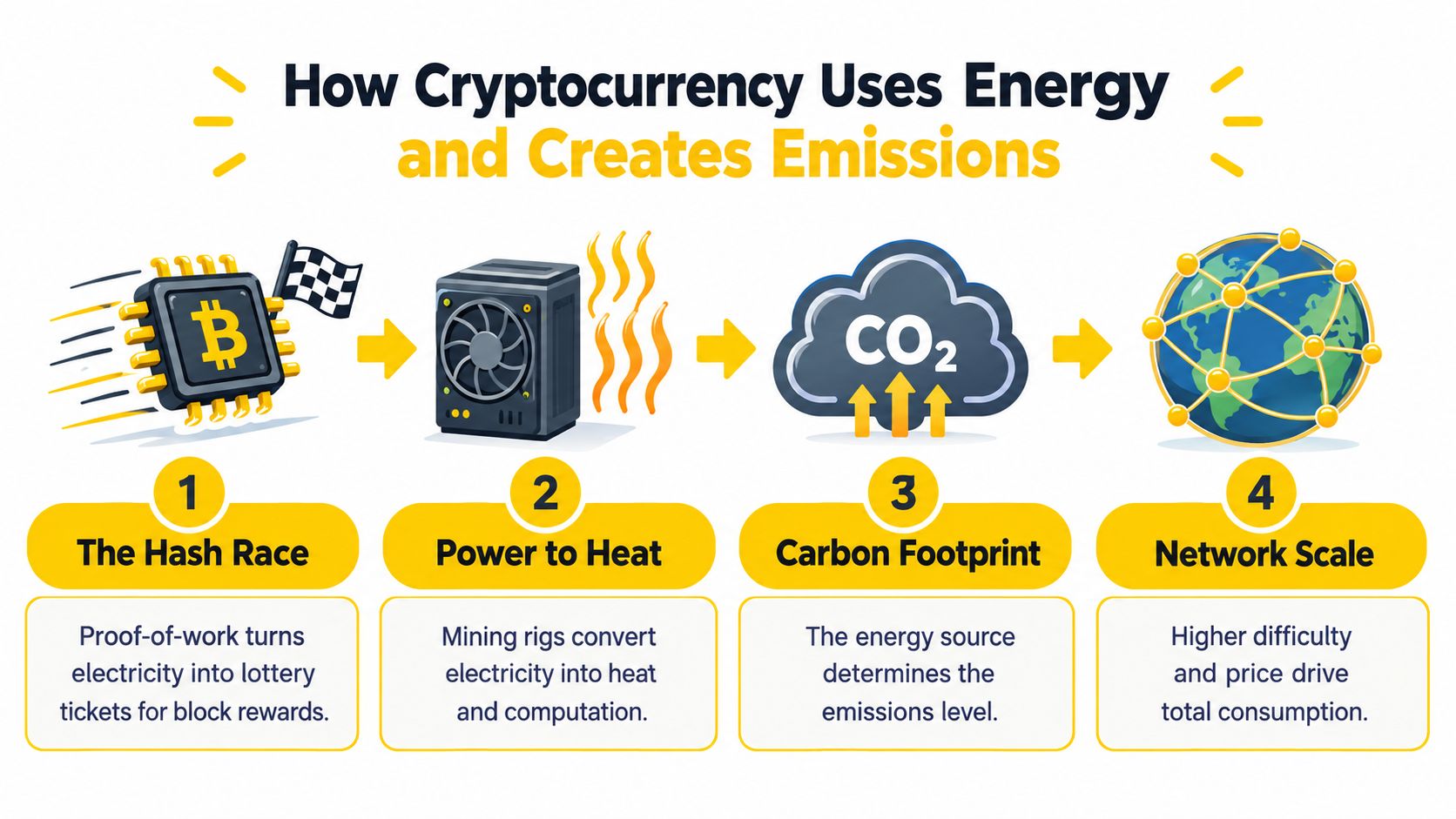
That distinction matters because crypto creates environmental impact in stages, like a chain of cause and effect.
Proof-of-work networks use security through competition. Thousands of miners race to solve a puzzle, and only one wins the right to add the next block. The rest still used electricity during the attempt. If you want a quick primer on the mechanics, this overview of cryptocurrency mining explained is a helpful companion.
The hash race in plain English
A proof-of-work network works like a giant guessing contest that refreshes every few minutes. Each mining machine makes rapid guesses. More machines mean more guesses, and more guesses mean a better chance to win rewards.
That is why energy use in proof-of-work does not track transaction count in a simple way. It tracks competition. Researchers describing proof-of-work systems note that electricity demand follows hashrate, hardware deployment, and miner incentives more closely than the number of payments users send, as explained in the Sustainability review on proof-of-work electricity demand.
Electricity use is only the first layer
A mining rig turns electricity into computation and heat. The heat is not a side note. It affects cooling needs, fan power, building design, and where miners can operate efficiently.
Emissions enter the picture at the power source. The same machine can cause very different climate impact depending on whether it runs on a coal-heavy grid at peak demand or on lower-carbon power during periods of surplus generation. The OECD report on digital assets discusses this gap between electricity consumption and environmental outcomes, especially once local grid conditions are considered in the OECD report on the environmental impact of digital assets.
That is the key reframing. Total electricity use matters, but time-specific and location-specific emissions often matter more for climate impact. A megawatt-hour consumed in one place at one hour can carry a very different emissions profile from the same megawatt-hour consumed somewhere else.
To make the mechanics visual, this short explainer is useful:
Why design choices change the energy equation
Mining economics add a feedback loop. When block rewards become more attractive, operators often add hardware until margins tighten again. Analysts have also examined how this incentive structure can keep energy demand tied to profitability rather than user activity, including in institutional work from the International Energy Agency on cryptocurrency electricity consumption.
This is why protocol design matters so much. A system that depends on endless competitive guessing pulls energy demand upward in a way that a staking system, a hybrid model, or lower-computation designs may not. Labyrinth Mining is part of that broader design conversation. The practical question is whether a network can preserve security while weakening the old link between stronger security and ever-larger power draw.
Engineers use efficiency metrics in many fields to compare useful output with energy input. Crypto miners do the same at the hardware and facility level, even if the network-level incentives still drive overall demand. If you want a simple example of how engineers frame that trade-off, you can browse Kagool efficiency guide. The lesson carries over cleanly. Better design at the machine level helps, but better design at the protocol level can change the whole system.
Quantifying the Footprint From Energy to E-Waste
Bitcoin's electricity demand has been estimated in the range of a mid-sized country. The Cambridge Bitcoin Electricity Consumption Index tracks that scale in near real time, which is a better starting point than treating crypto as a small background load.
That headline number helps, but it can also blur together three different questions. How much electricity a network uses. How much carbon pollution that electricity creates. How much hardware gets replaced along the way.
Those are related, not identical.
Country-scale electricity and emissions
Annual terawatt-hours are the easiest figure to quote because they compress a complex system into one number. They are useful in the same way a car's annual fuel use is useful. You quickly see whether you are looking at a scooter, a pickup truck, or a freight train.
But electricity use alone does not tell you the full environmental cost. A miner drawing power during a windy night in one region can produce a different emissions result than an identical miner drawing power from a coal-heavy grid at peak demand in another region. The machine may be the same. The footprint is not.
That point matters because public debate often treats energy use and emissions as interchangeable. They are not. Analysts at the U.S. Energy Information Administration review of crypto mining electricity implications describe this as a grid issue that depends on where demand shows up and how local power systems respond.
Why per-transaction numbers confuse people
Per-transaction comparisons are memorable, but they often teach the wrong mental model.
A proof-of-work network uses energy more like a constantly running security system than like a toaster that turns on for one slice of bread. If the network processes a few more transactions, the power draw does not rise in a neat one-to-one way. The mining race continues across the whole network whether a block is full or half full.
So "energy per transaction" can be a rough communication shortcut, but it is weak as an engineering measure. If you want to estimate environmental impact, time and location matter more than dividing annual electricity by annual transaction count.
Hardware turnover is part of the footprint
E-waste is easier to miss because it does not appear on a power bill.
Specialized mining hardware has a hard economic life. When newer machines produce more hashes per watt, older units can become unprofitable long before they physically fail. That pushes operators to replace working equipment for competitive reasons, not only for maintenance reasons.
The result is a footprint with two layers. One layer comes from electricity and cooling during operation. The other comes from manufacturing, shipping, and discarding hardware. General-purpose hardware can reduce some of that churn, while ASIC-heavy models often intensify it. The trade-off is that specialized hardware can also deliver much better efficiency for the task it was built to do.
Hardware design changes environmental outcomes. If a network rewards constant equipment replacement, part of its footprint sits in warehouses, supply chains, and scrap streams, not just in megawatt-hours.
A better way to read the numbers
A simple table helps separate the buckets:
| Impact Dimension | Best Use of the Metric | Common Mistake |
|---|---|---|
| Annual electricity use | Shows the scale of network demand | Treating TWh as if it directly equals carbon emissions |
| Location and time of power use | Estimates the emissions intensity of mining | Ignoring regional grid mix and peak demand effects |
| Per-transaction footprint | Gives a rough public-facing comparison | Assuming each transaction "causes" a fixed slice of total energy use |
| Hardware replacement rate | Highlights e-waste and embedded manufacturing impacts | Looking only at operational electricity |
Why design choices change the footprint
This is also where design changes, including approaches such as Labyrinth Mining, deserve attention. If a protocol reduces the need for an endless hardware arms race, it can change more than the headline power number. It can also change where miners operate, how often equipment gets replaced, and how tightly network security is tied to raw electricity consumption.
That is the useful reframing. The question is not only "How many TWh?" The better question is "When is the power used, where is it used, what powers it, and what hardware cycle does the protocol encourage?" Those factors get you much closer to the environmental footprint than a single annual number ever can.
Comparing Consensus Mechanisms and Mining Models
A consensus mechanism is the rulebook that decides who gets to add the next block. That rulebook does more than shape security. It shapes how much electricity the network needs, what kind of hardware people buy, and whether emissions cluster in cleaner or dirtier grids at certain hours.
That is why annual power totals only tell part of the story.
Proof of work versus proof of stake
Proof of work works like a lock that opens only after enough computation has been spent. Miners compete to solve the puzzle, and the network accepts the winner. Security comes from that ongoing competition, so electricity use is part of the design, not an accident.
Proof of stake uses a different lock. Validators put coins at risk instead of running a constant machine race. A validator can be penalized for bad behavior, so the system leans on financial risk more than raw computation. The operational energy need is usually much lower because the network does not ask thousands of machines to keep burning power to prove they are serious.
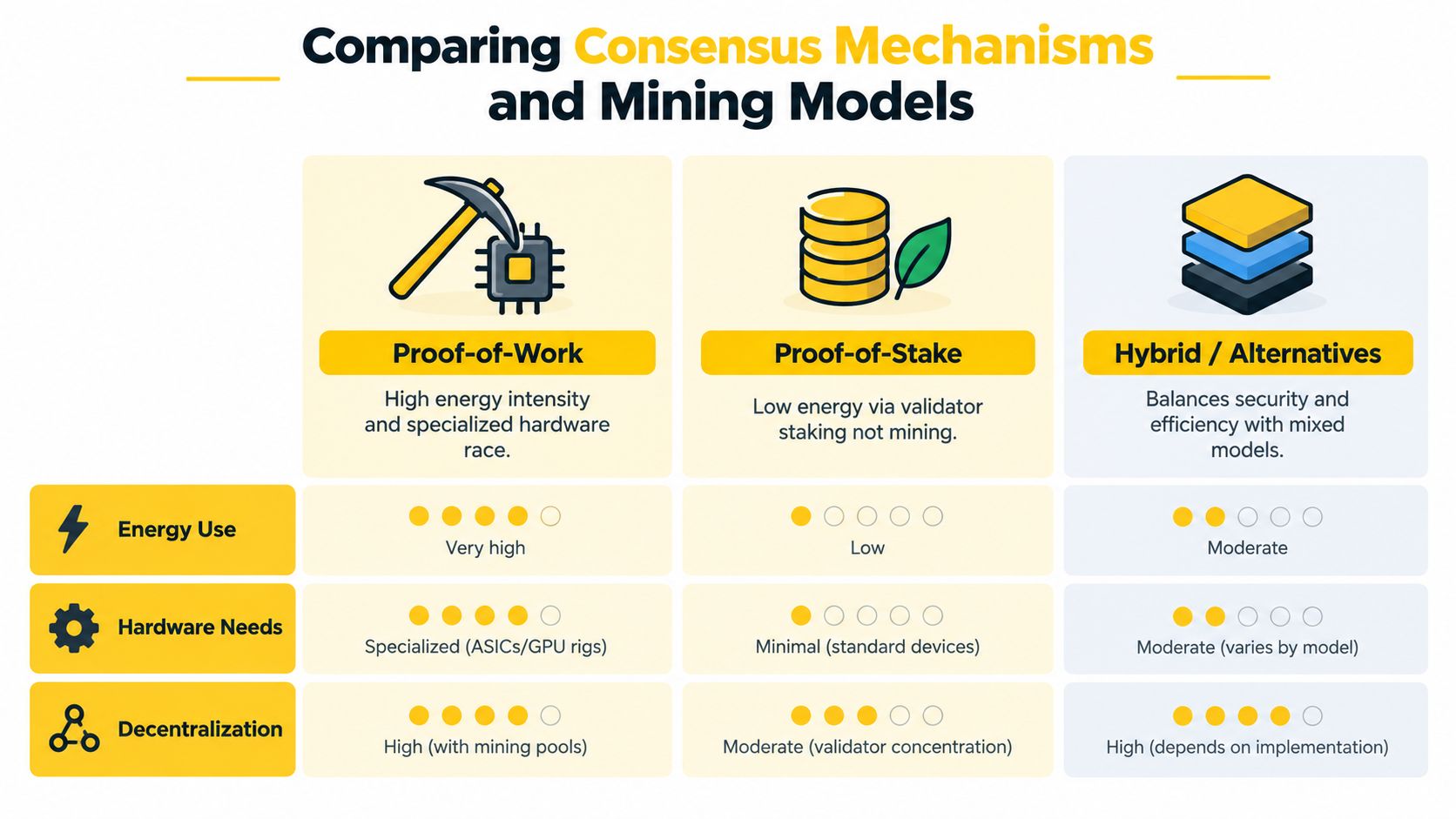
That sounds like proof of stake wins on environment by default. On operational electricity, it often does. But the better comparison is still more specific: what hardware does the system encourage, where do participants run it, and does the design push activity into high-emission hours or places with cleaner surplus power?
Proof of work is not one environmental profile
Proof of work is a category, not a single machine layout. Two proof-of-work networks can have very different footprints even if both use mining.
Some designs reward specialized ASIC hardware. That can increase efficiency per unit of computation, but it can also tighten the hardware race and shorten the useful life of older machines. Other designs are more CPU-friendly. Those systems may spread participation across more ordinary hardware and reduce pressure for constant specialization, though the results still depend on incentives and electricity sources.
Labyrinth Mining matters in this comparison because design choices can change the whole energy equation, not just trim it at the margins. If a mining model reduces the need for a nonstop hardware arms race, the effect can show up in several places at once: lower hardware churn, different site economics, and less pressure to tie security directly to ever-rising electricity burn.
For a more technical comparison of how these systems secure a chain, this guide to blockchain consensus mechanisms explains the trade-offs in plain language.
A practical comparison
| Model | How security is paid for | Likely hardware pattern | Environmental question to ask |
|---|---|---|---|
| Proof of Work | Ongoing computation | Often specialized miners, though some variants allow CPU participation | What are the local grid mix, operating hours, and hardware replacement cycle? |
| Proof of Stake | Capital at risk | General server infrastructure | Who can validate, and what supporting infrastructure does the network require? |
| Hybrid or alternative models | A mix of work, stake, or lighter participation rules | Depends on the protocol design | Does the design reduce both electricity demand and hardware churn, or only one of them? |
A simple way to read this table is to separate energy use from emissions. Energy is how much work the system asks for. Emissions depend on when and where that work happens. A miner pulling power from a cleaner grid during low-demand periods does not have the same footprint as an identical miner running on a fossil-heavy grid at peak hours.
Physical location still matters for every model. Operators compare grid reliability, cooling conditions, latency, and building constraints before they ever plug in a machine. A global data center directory and map is useful here because it turns mining from an abstract internet activity into a real-world siting problem with real infrastructure trade-offs.
The main lesson is simple. Do not stop at "proof of work" or "proof of stake" as labels. Ask what behavior the protocol rewards, what hardware it makes economical, and how tightly security is coupled to electricity use at specific times and in specific places.
Proven Strategies to Reduce Crypto Environmental Impact
The biggest gains usually come from changing the rules of the system before changing the power source. If a protocol rewards nonstop computation, cleaner electricity helps, but the network still asks machines to burn through work and hardware. If the protocol reduces unnecessary work in the first place, every later choice gets easier.
That is the useful shift in perspective. Headline electricity totals matter, but they do not tell you the whole climate story. A mining operation using the same amount of electricity can produce very different emissions depending on the hour, the local grid, the cooling design, and the type of hardware it burns through over time.
Start at the protocol level
Protocol design works like the blueprint for a factory. Once the blueprint says every participant must run an expensive race, operators can only optimize around that requirement. If the blueprint asks for less wasteful behavior, the footprint drops before anyone plugs in a machine.
For teams building or choosing a network, three design decisions shape the result:
- How the network reaches consensus: Systems that avoid a constant computation race usually cut electricity demand at the source.
- How participation is rewarded: Incentives decide whether operators can run steadily and efficiently or whether they are pushed into a hardware arms race.
- How much hardware specialization the design encourages: A model that depends on narrow-purpose machines can increase replacement churn and e-waste.
This is also where design ideas such as Labyrinth Mining change the energy equation. The important question is not whether a model sounds novel. It is whether it reduces wasted computation, broadens efficient participation, and lowers pressure for rapid hardware turnover.
Focus on emissions by hour and place
Once the protocol is set, operations become the next control point. Here, the common mistake is tracking only yearly electricity totals. That is like judging city traffic by counting cars for the whole week without asking whether they all showed up during rush hour.
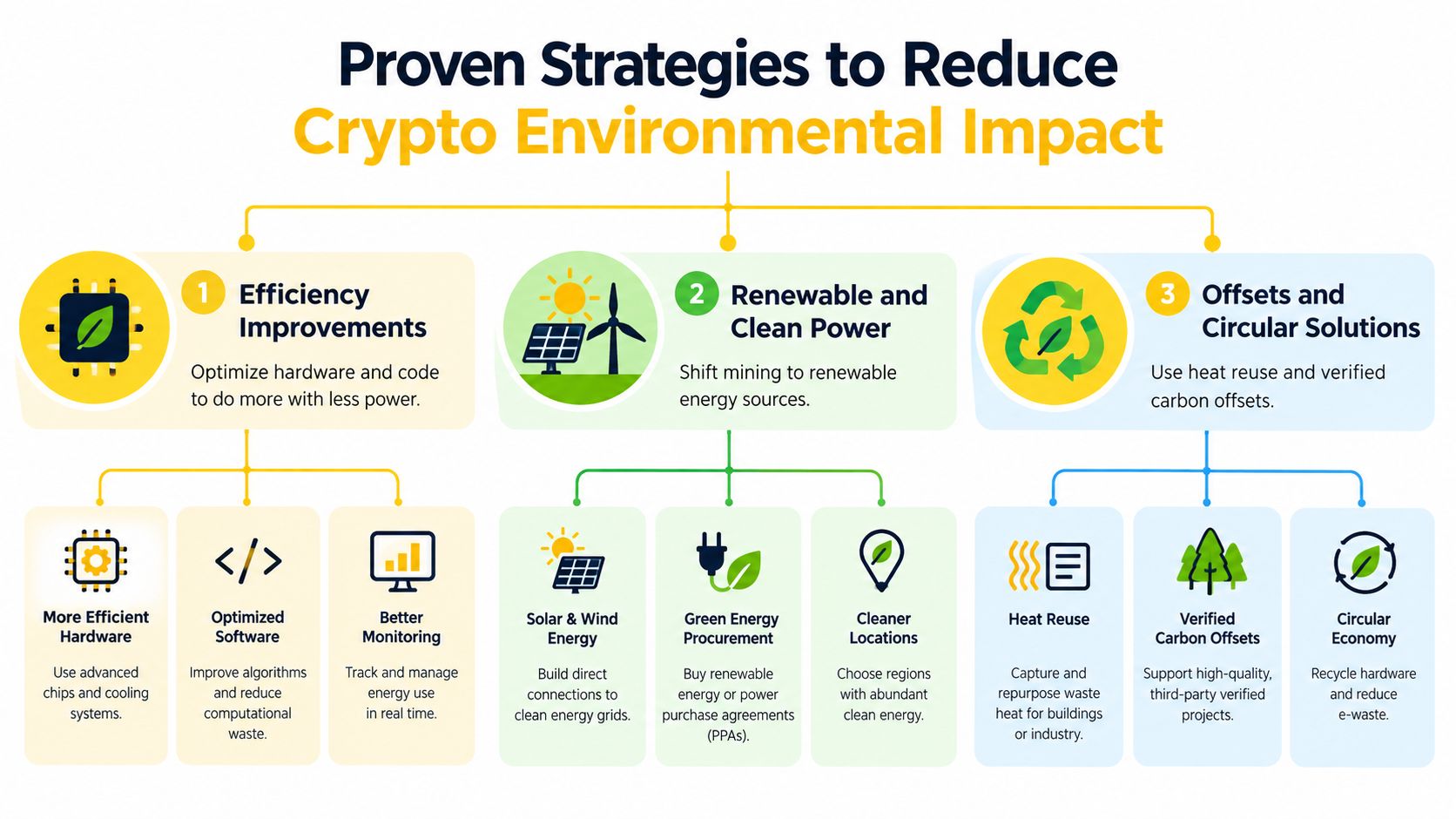
A better operating strategy looks at three things together:
Time of use
The same miner can have a different emissions profile at different hours. Power used when the grid is cleaner or under less stress does not carry the same impact as power used during dirtier peak periods.Location of use
Grid mix still matters. Two identical facilities running identical hardware can create very different emissions because local electricity systems are different.Heat and cooling performance
Mining hardware turns much of its electricity into heat. Poor airflow wastes power twice. First in the machine, then again in the cooling system. Better layout, ventilation, and heat reuse can lower the footprint of the same workload.
Choose hardware for the job, not for bragging rights
Bigger machines are not automatically greener. Efficiency depends on fit.
A good comparison is engines. A heavy truck engine is excellent for hauling freight, but wasteful for a short city commute. Mining hardware works the same way. The right setup depends on the network design, local electricity conditions, cooling limits, and how long the hardware is likely to stay useful before replacement.
That last point matters because environmental impact is not only about power draw. Fast hardware turnover adds manufacturing demand and electronic waste. A strategy that accepts slightly lower peak output in exchange for longer hardware life can reduce total impact in ways a simple electricity metric misses.
Scrutinize green claims with specific questions
Environmental claims are only useful when they explain what is being measured. A project can advertise "green mining" and still avoid the details that matter most.
Look for answers to questions like these:
- What exactly is being measured: electricity use, carbon emissions, e-waste, or all three?
- Are emissions estimates tied to a specific location and time of operation, or just annual averages?
- What hardware does the model depend on, and how often is that hardware likely to be replaced?
- Do the protocol rules reduce wasted computation, or do they only shift where the power comes from?
- Can outside reviewers inspect the code, the participation model, and the operating assumptions?
Clear claims are usually concrete. Vague claims usually hide trade-offs.
Actionable Steps for Eco Conscious Miners and Developers
A miner and a protocol designer affect the footprint at different points in the system. The miner chooses when and where electricity is used. The developer chooses how much work the network asks for in the first place. If you want lower emissions, you need both sides working on the same problem.
Steps miners can take now

Start with a simple mental model. A mining rig is like a heater that also performs calculations. Nearly all of the electricity ends up as heat, so every watt you feed into the machine creates a second job for fans, ventilation, or air conditioning. That is why carbon impact depends on timing and location, not only on annual power use.
For miners, the most useful changes are operational:
- Match hardware to the job: A bigger machine is not always a cleaner choice. If a network can be mined well on ordinary hardware, chasing maximum output may raise power draw and shorten equipment life without improving the result much.
- Treat cooling as part of the energy budget: Bad airflow wastes electricity twice. The miner runs hotter, and the room needs more cooling. Small layout changes can cut that waste. This guide to cooling efficiency for mining setups shows the kinds of adjustments that matter.
- Run with the grid, not against it: A kilowatt-hour is not equally carbon-intensive at every hour. In some places, midday power is cleaner because solar supply is high. In others, evening demand pulls in dirtier generation. Scheduling flexible workloads around those patterns can lower emissions without changing the machine.
- Check pool and project transparency: If software rules, payout logic, or operating assumptions are hidden, you cannot judge the trade-off you are accepting.
A useful question is, "If I mine for the next six months, what part of my impact comes from electricity, and what part comes from replacing hardware sooner?" That split changes from one setup to another.
What developers should change upstream
Developers set the rules of the race. If the rules reward constant escalation, miners will buy faster gear, run it harder, and replace it sooner. If the rules reduce wasted computation or allow useful participation on less specialized hardware, the energy picture changes before anyone plugs in a rig.
That is why protocol design should be treated like power system design. Small rule choices shape large real-world outcomes.
Good design questions include:
- Does the system require a nonstop competition for security, or can it reduce duplicate work?
- Can people participate on widely available hardware, or does the design funnel activity toward specialized machines?
- Do node and client requirements stay light enough that normal users can verify the network?
- Can outside reviewers inspect the code and test the environmental claims against actual behavior?
Cascoin is a useful example because it offers different participation paths with different energy profiles. Labyrinth Mining aims to reduce the pure hash-race pattern by making participation lower-power and more game-like. It also supports CPU-friendly MinotaurX and SHA-256 for ASIC operators. The point is not that one mode fits every user. The point is that mining design itself changes the energy equation, which is a more practical way to discuss environmental impact than treating all crypto systems as one category.
Better crypto design starts by asking how much work security actually requires, and which parts of the workload are only there because the protocol rewards excess competition.
A simple filter for evaluating any project
Before you join a network, test it like an engineer reviewing a machine:
- What exactly provides security
- What hardware the rules push participants toward
- When and where the expected electricity use is likely to occur
- How easy it is for independent people to inspect the software
- Whether the project explains emissions in time-specific and location-specific terms, not only in headline electricity totals
That last check matters more than it first appears. Two miners can use similar amounts of electricity and still cause very different emissions if one runs during cleaner grid hours or in a lower-carbon region. Clear projects explain that difference. Weak projects hide it behind broad annual numbers or vague green branding.
Building a More Sustainable Crypto Future Together
A single annual electricity total can hide the part that matters most. Emissions depend on when mining runs, where that power comes from, and whether the protocol pushes people into wasteful competition or reduces it through design.
That is why crypto's environmental impact is not one fixed trait of blockchain systems. It is the result of choices. The rules decide what kind of work secures the network. Those rules shape the hardware people buy, the hours they run it, and the pressure to chase output at any cost.
A good comparison is traffic in a city. Counting only the number of cars tells you something, but not enough. Rush hour on a dirty grid and light traffic during cleaner hours do not have the same effect. Crypto works in a similar way. Two networks can post similar electricity use on paper and still produce very different emissions in practice.
That shifts the question from "How big is the headline number?" to "What behavior does this system reward?"
The better systems are easier to examine because they show their mechanics in public. Open code, public verification, and active community review do not make a network sustainable by themselves. They do make it easier to check whether the environmental story matches the actual design.
Cascoin is one example of that design-focused approach. Its public code and mining options, including Labyrinth Mining and CPU-friendly participation paths, let people inspect how the project tries to reduce the pure hash-race pattern instead of treating energy use as an unavoidable constant. That does not settle the debate. It gives users something concrete to evaluate.
Crypto will probably stay experimental and contested. That is normal for a young field. A careful response is simple. Inspect the mechanism, check the timing and location of expected electricity use, and decide whether the security trade-off makes sense for emissions it is likely to create.
If you want to examine a project taking that approach in public, visit Cascoin.