Free Bitcoin Spin Explained: Legit Wins or Hidden Traps
Most free Bitcoin spin offers are real promotions, but they're rarely withdrawable at face value. The original Bitcoin faucet paid 5 BTC per visitor when it launched on June 12, 2010, and that simple giveaway model later morphed into today's spins, bonuses, and reward wheels that usually lock winnings behind wagering, expiry rules, and cash-out caps.
The popular advice on this topic is backwards. People keep asking which free Bitcoin spin is legit, when the better question is whether the reward survives the terms long enough to reach your wallet. In most cases, the answer is no, or not in the clean, simple way the banner implies.
I'm skeptical because the business model tells you almost everything. If a site is giving away crypto, it needs something back. Sometimes that's ad views. Sometimes it's gambling volume. Sometimes it's your wallet connection, your attention, or a nudge toward making a first deposit. “Free” is usually just the bait.
Table of Contents
- What Free Bitcoin Spin Actually Means
- The Faucet Roots Behind Every Spin
- The Term Sheet That Decides If You Withdraw
- Scam Signals to Spot Before You Spin
- Safer Ways to Earn Small Amounts of Crypto
- Weighing the Real Cost of a Free Spin
- A Better Question Than Is It Free
What Free Bitcoin Spin Actually Means
“Free Bitcoin spin” sounds specific, but it usually describes three completely different systems hiding behind the same wheel graphic. If you don't classify the offer first, you can't judge the risk.
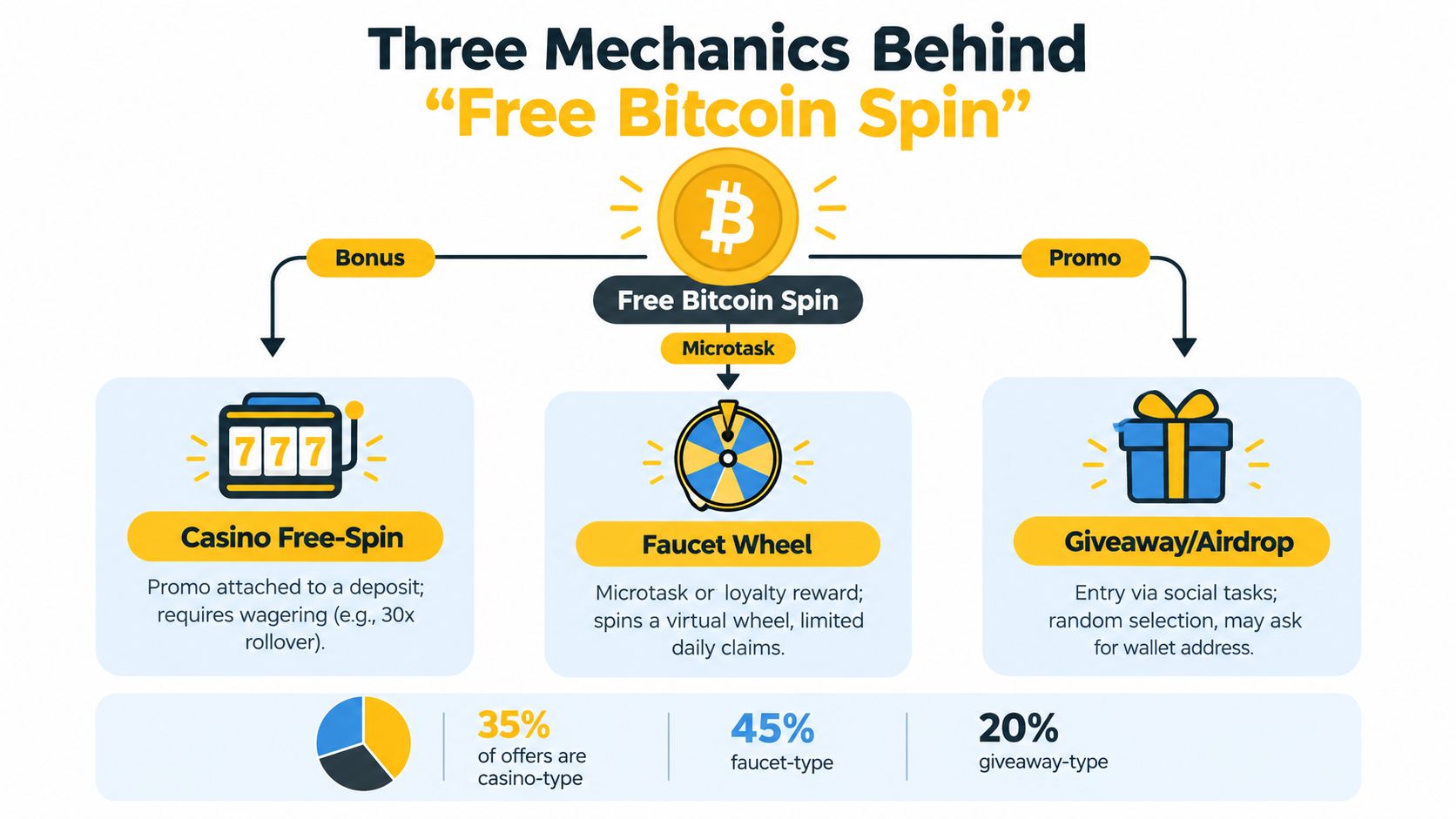
Casino bonus spins
This is the version you might click from search results. You see a banner that looks like a gift. It promises free spins, no-deposit spins, or a welcome wheel. In practice, it's a gambling bonus attached to account creation, and often attached to a deposit somewhere in the flow even if the headline tries to sound frictionless.
A BitStarz-style banner is the right mental model here. The spin isn't “free Bitcoin” in the simple sense. It's a slot promotion, and any winnings usually move into a bonus balance first.
Faucet wheels
This is closer to the old “earn tiny bits of crypto” idea. A Cointiply-style wheel fits this category. You spin once a day, watch ads, complete a task, click through offers, or sign up for something. The site monetizes your attention, then pays out a tiny crypto reward if you keep coming back.
This model looks harmless, but it's still a business. You're not receiving a gift. You're doing low-value digital labor for a tiny claim.
Practical rule: If the wheel sits next to ad walls, surveys, timers, and referral prompts, you're looking at a faucet business, not generosity.
Giveaway and airdrop spinners
The third type is a growth funnel dressed up as a game. A project runs a wheel-of-fortune page, asks you to follow an X account, join Telegram, share a referral code, or connect a wallet. Sometimes it asks for a wallet signature to “verify” eligibility. The spin animation is mostly theater.
These aren't gambling products and they aren't classic faucets. They're user acquisition campaigns.
Same wheel, different economics
The interface fools people because all three use the same visual language. Spin button. Prize slices. Confetti. Fake urgency.
But the economics are different:
- Casino spins sell action and try to convert you into a depositor.
- Faucet wheels sell your attention to advertisers.
- Giveaway spinners sell growth metrics to a token project or app.
That's why blanket advice fails. A free Bitcoin spin isn't one thing. It's a label slapped onto three separate machines.
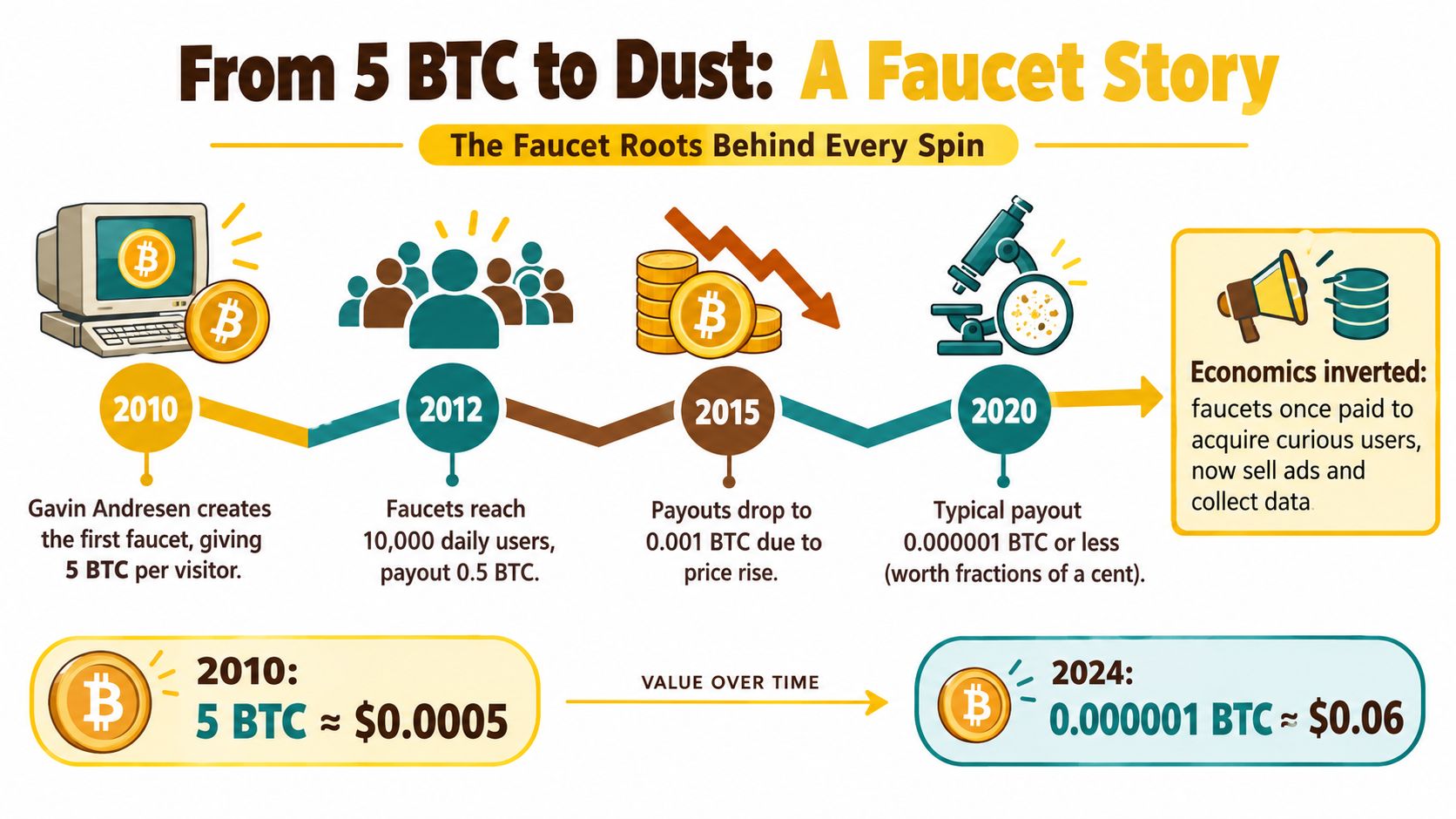
The Faucet Roots Behind Every Spin
Today's spin sites didn't appear out of nowhere. They're descendants of the original Bitcoin faucet.
On June 12, 2010, early Bitcoin developer Gavin Andresen launched the first widely recognized Bitcoin faucet, which initially paid 5 BTC per visitor for solving a CAPTCHA. Over its life, the faucet is widely reported to have distributed about 19,700 BTC before shutting down in 2012 as Bitcoin's value rose and the model became harder to sustain, according to the Bitcoin history summary on Wikipedia.
Back then, 5 BTC was worth only a few cents, which made the giveaway cheap enough to function as onboarding. That was the whole point. Let ordinary people try Bitcoin without buying any.
Why the flat payout died
The original faucet worked because Bitcoin was obscure and cheap. That stopped being true. Later historical summaries even describe faucets as the “original airdrops”, which tells you how important they were for early user acquisition, as noted in this Bitcoin.com historical retrospective.
Once Bitcoin appreciated, the faucet math broke. Giving out meaningful amounts got expensive fast. Operators had to replace straightforward payouts with something more controllable.
That's where the spin wheel comes in.
Why operators switched to spins
A spinner solves two operator problems at once. First, it turns a fixed cost into a variable one. Second, it keeps users chasing the next claim instead of noticing how small the average reward is.
You don't need a conspiracy theory to explain this. You just need basic economics. A modern technical guide explains that faucet operators usually fund payouts from ad revenue plus a hot-wallet float, but ad income is often only a fraction of a cent per pageview, so payout obligations rise roughly with traffic while revenue doesn't keep up. Operators then cut rewards toward zero or shut down, according to this technical faucet economics guide from PipeFlare.
The video below gives useful background on how these faucet mechanics evolved into the broader “free crypto” culture online.
What that means for you
The spin isn't there because operators want to be generous. It's there because the old faucet model got squeezed.
The wheel is a cost-control device with game-like packaging.
That's the part most “top free spin sites” lists skip. They talk about rewards. They don't talk about sustainability. If the operator can only make tiny revenue per visitor, the reward has to shrink, get delayed, or come wrapped in conditions.
The Term Sheet That Decides If You Withdraw
This is the section most sites bury because it kills the mood. The artwork says “free.” The terms decide whether it ever becomes money.
Independent crypto-casino explainers note that winnings usually move into a bonus balance first and only become withdrawable after wagering, expiry, verification, and max-cashout rules are satisfied. They also note that some offers advertise a large headline bonus while the withdrawal terms differ sharply from the banner, as explained in this CryptoSlate guide to free spins and bonus terms.
The clauses that matter
Read these before you spin:
- Wagering requirement: If winnings must be played through before withdrawal, the “gift” is really conditional play credit.
- Max cashout: A site may let you win more on paper than you can withdraw.
- Expiry: Bonus balances often vanish if you don't clear the conditions fast enough.
- Game restrictions: Slots may count, while table games or other categories don't.
- Verification gates: Withdrawal can trigger ID checks, address checks, or source-of-funds questions.
- Queue friction: Some sites slow withdrawals just enough to tempt users into gambling the balance back.
Term-Sheet Reality Across Spin Types
| Mechanic | Wagering | Max Cashout | Expiry | KYC Trigger |
|---|---|---|---|---|
| Casino free-spin offer | Usually present and central to whether winnings convert | Often capped by bonus terms | Often short and easy to miss | Common at withdrawal |
| Faucet spinner reward | Usually no classic wagering, but often blocked by thresholds or extra tasks | Often constrained by low balances and site rules | Claim windows and inactivity rules may apply | Sometimes triggered before payout |
| Giveaway or airdrop spinner | Usually no gambling rollover, but task completion is the gate | Often limited by campaign rules or token liquidity reality | Often tied to campaign windows | Often tied to claiming or exchange off-ramp |
Don't ignore the cash-out math
Another issue gets less attention than it should. The question isn't whether the spin exists. It's what survives all the gates. A recent explainer notes that some BTC gambling products can impose withdrawal thresholds around 0.001 BTC and fees around 0.0002 BTC, which can wipe out small balances before they feel useful, according to this Bitcoin.com guide to free spins and BTC gambling friction.
If you do manage to withdraw anything, store it properly instead of leaving scraps on a promotional site. A simple starting point is this guide on how to store Bitcoin safely.
If the terms make you calculate three separate hurdles before cash-out, the operator already knows most users won't get there.
The fast filter
Use this test before bothering:
- Find the withdrawal section first. Not the banner.
- Check whether winnings become cash or bonus balance.
- Look for caps, expiry, and deposit requirements.
- If the terms are vague, assume the friction is intentional.
That's blunt, but it's usually right.
Scam Signals to Spot Before You Spin
Not every bad free Bitcoin spin offer is an outright scam. Plenty are just miserable deals. But the red flags are different depending on what kind of offer you clicked, so lumping them together doesn't help.
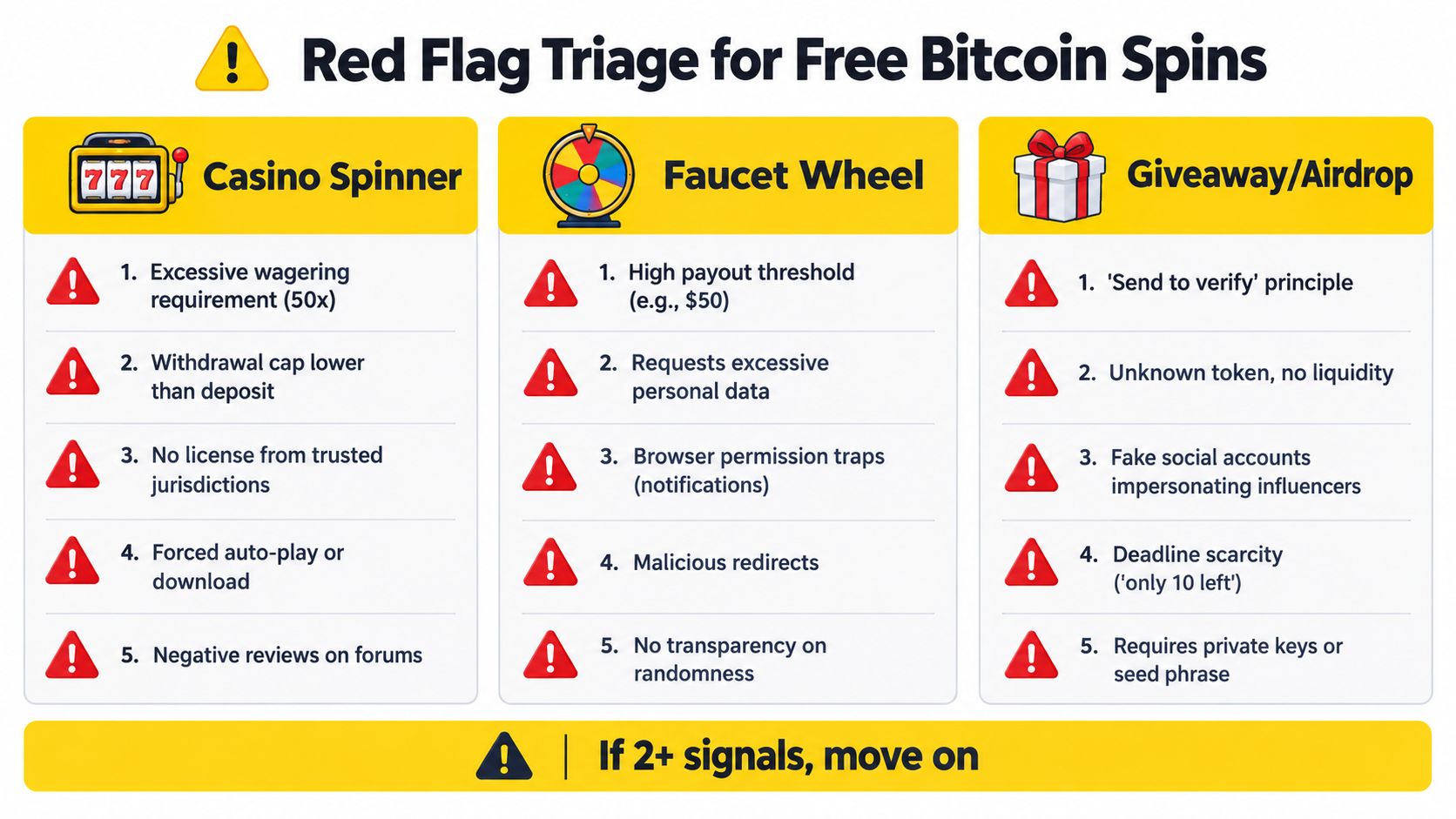
Casino spinner red flags
Casino-style spins become dangerous when the site hides who regulates it, how withdrawals work, or how bonus abuse is defined.
Watch for these:
- Hidden or fake license details: A footer badge that doesn't link to any real registry is decoration.
- Terms that undercut the headline: A big free-spin promise paired with a tiny max withdrawal tells you the banner is bait.
- Elastic confiscation language: If “bonus abuse” can mean almost anything, the operator has an all-purpose excuse to void balances.
- Push toward immediate deposit: If the whole flow keeps steering you to fund before reading terms, that's the actual objective.
Faucet wheel red flags
A faucet can be low-risk in money terms and still be a bad trade.
Check these points:
- Moving withdrawal threshold: If the target seems to rise as your balance grows, leave.
- Deposit required before withdrawal: That defeats the point of a faucet.
- Ad overload: If your spin timer only resets after a stack of redirects or forced ad views, the reward is just camouflage for monetization.
- Privacy leakage: Research on the Bitcoin ecosystem notes that some faucets publish recipient IP addresses with recent giveaways, creating a privacy risk when payouts aren't batched and address reuse is possible, as discussed in this doctoral research on the Bitcoin ecosystem.
Giveaway and airdrop red flags
This category is where people get drained fastest, because the setup looks playful while the wallet risk is real.
Skip immediately if the offer:
- Asks for a seed phrase or private key: No legitimate giveaway needs it.
- Demands upfront gas to claim a prize: That's a classic drain pattern.
- Uses a near-copy social handle: One extra underscore is enough to fool rushed users.
- Requests blind wallet signatures: If you don't understand the signature request, don't sign it.
A wheel graphic doesn't reduce wallet risk. It just makes the page look less threatening.
A simple triage rule
You don't need to become a forensic analyst. You need a threshold for walking away.
- One major wallet-security red flag: leave immediately.
- Two business-model red flags: assume the expected value is already negative.
- Any pressure tactic: close the tab.
If you want a practical reminder of how scam pages manipulate urgency, fake support, and trust signals, this computer scam warning for Edmonton users is useful even outside crypto. The tactics are different, but the psychology is the same.
Safer Ways to Earn Small Amounts of Crypto
If your real goal is “I want a little crypto without lighting money on fire,” you've got better options than bouncing between sketchy spin pages. None of these are magic. They're just cleaner trades.
Lower-Risk Alternatives to a Free Bitcoin Spin
| Method | Typical Earnings | Time Cost | Main Risk | Best For |
|---|---|---|---|---|
| Traditional faucets | Very small and usually tied to ads or claim timers | Low per claim, repetitive over time | Privacy trade-offs and low-value attention drain | People who want zero setup |
| Verified airdrops | Can range from nothing to meaningful rewards if a project later lists | Moderate, because quests take effort | Most campaigns go nowhere | Active users already exploring wallets and testnets |
| Microtask platforms | Usually tiny rewards for searches, browsing, or simple tasks | Steady but attention-heavy | Data collection and platform dependence | Users with spare attention |
| Eco-focused mining on everyday hardware | Slow accumulation rather than instant payouts | Ongoing but lightweight once set up | Token volatility and setup friction | People who prefer a consistent process |
What I'd pick by friction tolerance
If you hate setup, use a faucet occasionally and keep your expectations microscopic. You're trading attention for crumbs.
If you already use wallets and testnets, verified airdrops make more sense. At least the effort is tied to learning a real product instead of feeding a spin timer.
Microtask apps sit in the middle. They're dull, but they're usually more honest about the trade. You perform a task. You get a small reward. No fake jackpot fantasy needed.
One other path is low-energy mining on ordinary hardware. Cascoin offers Labyrinth Mining, a lightweight mining model aimed at slow accumulation rather than spin-based promos. If you want a practical comparison with other “free Bitcoin” paths, this guide on how you can earn free bitcoins is a useful starting point.
The recommendation I'd actually give a friend
Pick one lane.
- For zero setup: use a faucet sparingly.
- For skill-building: pursue airdrops tied to products you'd use anyway.
- For passive tinkering: try lightweight mining or similar low-maintenance methods.
- For pure entertainment: call casino spins gambling, not earning.
That last distinction matters. The minute you call gambling “earning,” you start lying to yourself.
Weighing the Real Cost of a Free Spin
A free Bitcoin spin isn't free. It costs time, attention, personal data, and usually a chunk of patience. In some cases, it also nudges you toward a deposit, which is where a cheap promo turns into an expensive habit.
The right way to judge one is as an expected-value problem with friction layered on top. Not “can I win?” but “what survives the process?”
The hidden costs people skip
The obvious cost is time. Registration, email confirmation, learning the rules, clicking through bonus pages, maybe doing KYC, then waiting to see whether your balance is even withdrawable. None of that shows up in the banner.
The less obvious costs matter too:
- Data exposure: you may hand over identity documents, device fingerprints, or wallet activity.
- Tax mess: even tiny rewards can create annoying recordkeeping.
- Behavioral pull: bonus systems are built to keep you engaged long enough to spend.
A blunt decision framework
Use this checklist:
- How many steps stand between claim and withdrawal?
- Does the offer require a deposit anywhere in the path?
- Would you still do it if the final reward was much smaller than the headline?
- Will the process tempt you to chase losses or “top up” to get a payout?
If the answer to the last question is yes, the risk just changed categories. You're no longer evaluating a promo. You're evaluating your own tendency to get pulled deeper.
Treat the setup time as part of the price. Because it is.
My rule of thumb
If you still want to use a spin, keep it in the entertainment bucket. Use only operators with clear withdrawal pages, never recycle passwords, and never deposit just to rescue a tiny bonus balance. That move traps people constantly.
If you want a lower-friction route than casino-style spins, compare it against alternatives that don't rely on gambling mechanics at all. This overview of free cloud mining options is worth reading for contrast alone, because it pushes you to compare process and risk instead of chasing wheel animations.
A Better Question Than Is It Free
“Is this free Bitcoin spin legit?” sounds sensible, but it's the wrong question. Plenty of these offers are technically legitimate. That still doesn't make them worth your time.
The better question is this: would you do the same work for the likely outcome if nobody called it free?
Use a time-versus-reward filter
Take the headline reward and mentally discount it. Then factor in signup friction, terms, withdrawal rules, and the chance that you'll end up with nothing withdrawable. If the likely return feels insulting once you strip away the casino colors and spinning wheel, trust that instinct.
This is why the word “free” is so effective. It distracts you from the exchange happening. You're giving up time, attention, data, and sometimes optionality. The site is not giving away value for no reason.
The question that cuts through the noise
Ask yourself one thing before clicking claim:
- Would I do this for a very low hourly rate if the page looked boring instead of exciting?
If the answer is no, skip it.
That filter cleans up almost everything. It cuts through fake urgency, giant prize slices, referral bait, and “limited-time” copy. It also stops you from treating random spins as a strategy.
My bottom line
If you enjoy the occasional spin as entertainment, fine. Just label it clearly and protect your wallet.
If you want to accumulate small amounts of crypto, don't jump between ten different spin sites chasing scraps. Pick one cleaner path and stick with it. A few trusted faucets, selective airdrop participation, or a low-energy accumulation method beats a dozen “free” offers that never quite cash out.
If you're done chasing tiny spin bonuses and want a steadier way to explore crypto, Cascoin offers an open-source, low-energy mining approach built around Labyrinth Mining instead of ad funnels and wagering traps. It won't pretend a wheel spin is a windfall, and that's the point.