How to Buy Bitcoin Gold Safely in 2026

You've found a BTG listing, the price looks cheap, and the exchange makes the purchase button impossible to miss. Slow down. Buying Bitcoin Gold isn't mainly an order-entry problem. It's a routing problem involving your country, the exchange's actual BTG market, the payment rail, and the wallet that receives the coins.
Bitcoin Gold is a small-cap asset with thinner liquidity than major cryptocurrencies. Current trackers place its market capitalization around $8.4 million to $9.4 million, with rankings roughly between #865 and #1007, depending on the source and timing (CoinLore historical BTG data). That changes the correct buying process. You need to verify access first, compare direct and indirect routes, and treat the withdrawal as the highest-risk step.
Table of Contents
- What Bitcoin Gold Actually Is Before You Buy It
- The Two Ways to Get BTG Into Your Wallet
- Picking an Exchange That Actually Lists BTG
- Setting Up, Verifying, and Funding Your Account
- Placing the Buy Order Without Getting Killed by the Spread
- Withdrawing BTG to a Wallet That Supports the Chain
- Safety, Taxes, and the Real Reason You're Buying BTG
What Bitcoin Gold Actually Is Before You Buy It
You find BTG listed, choose a payment route, and then discover the exchange will not serve your jurisdiction or let you withdraw native coins. Avoid that mistake by identifying the route first. BTG is an independent Bitcoin fork with its own chain, wallet compatibility requirements, market structure, and security history.
Bitcoin Gold launched on 24 October 2017, with market-data sources placing its start date between 23 and 25 October 2017. It reached an all-time high on 23 October 2017, almost immediately around launch, and historical data lists an opening price near $499.87 (CoinLore historical price data). That history describes an asset whose early trading activity centered on initial exchange listings and fork-related attention, not sustained Bitcoin-level demand.
The project forked from Bitcoin at block 491,407, after Bitcoin block 491,406. It later changed its proof-of-work from Equihash to Equihash-BTG, a change intended to reduce ASIC-driven concentration and lower exposure to future 51% attack risk (Finance Magnates' coverage of the protocol change). BTG also uses a 10 MB block size and runs on its own UTXO chain, separate from Bitcoin's chain.
That separation determines your buying route. A generic Bitcoin wallet does not automatically support BTG, and a Bitcoin address is not a safe BTG destination. Verify the exchange's jurisdictional access, the available BTG market, and native withdrawal support before you deposit funds. Questions around SegWit support, miner decentralization, and BTG's uneven security record make it a specialized, speculative network rather than a BTC substitute.
Readers comparing assets through broader cryptocurrency trading in 2026 should treat BTG as a routing decision before treating it as an order-entry task. Thin books can worsen execution, delay withdrawals, and narrow your venue choices even when a search result shows the ticker. Decide whether your platform supports direct fiat trading or requires a BTC-then-swap route, then confirm the receiving wallet before clicking Buy.
BTG vs BTC at a Glance
| Attribute | Bitcoin (BTC) | Bitcoin Gold (BTG) |
|---|---|---|
| Relationship | Original Bitcoin network | Hard fork of Bitcoin |
| Launch | Bitcoin's original network | Launched in October 2017 |
| Chain | Bitcoin mainnet | Separate BTG blockchain |
| Mining approach | SHA-256 proof-of-work | Equihash-BTG proof-of-work |
| Wallet requirement | BTC-compatible wallet | Wallet with explicit BTG support |
| Market profile | Major, deep market | Small-cap, thinner market |
| Buying implication | Broad venue and payment access | Route and liquidity must be verified first |
BTG may be easy to find, but buying it well requires checking access, liquidity, and chain support first.
The Two Ways to Get BTG Into Your Wallet
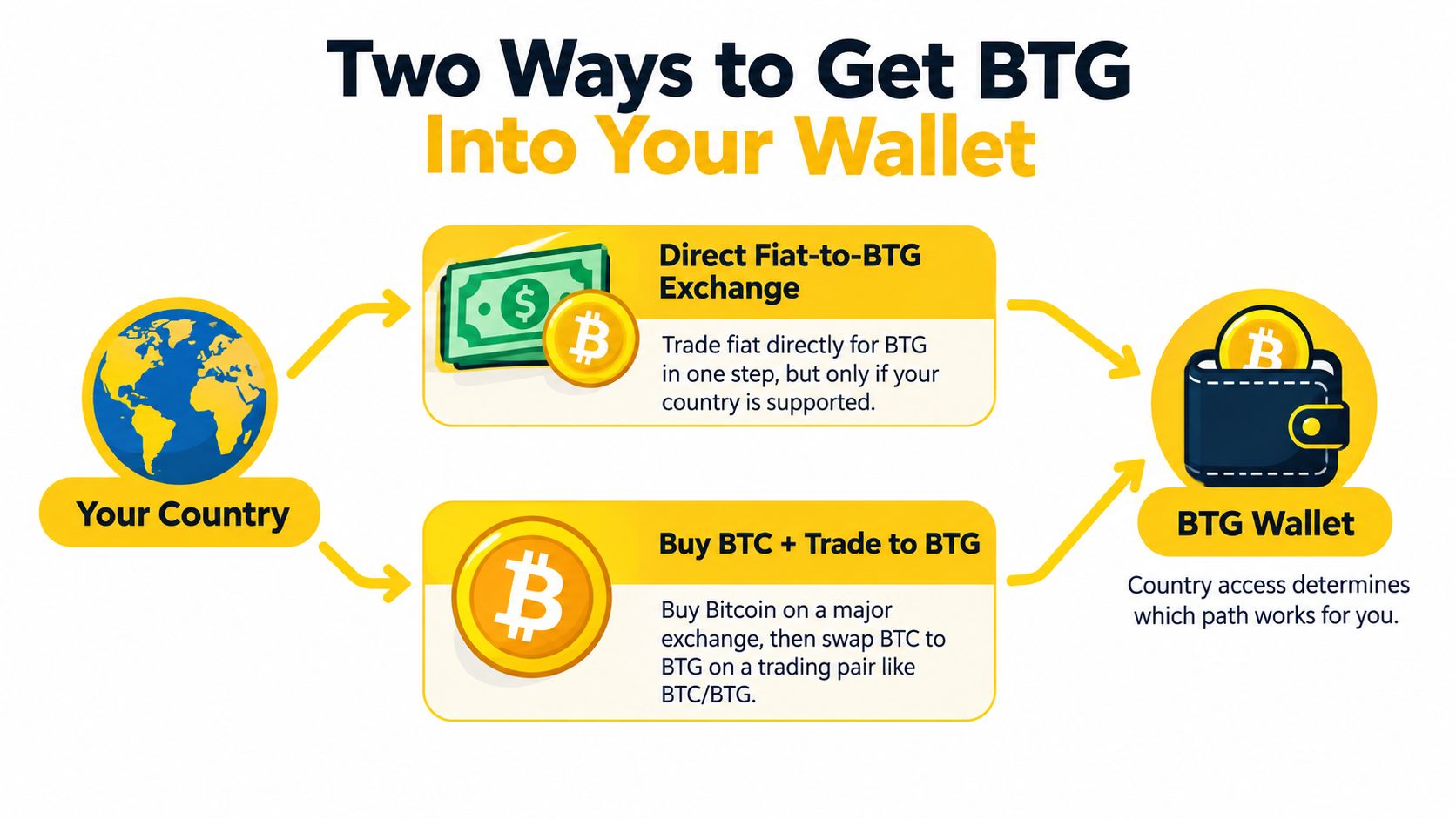
Your country usually determines the route before the exchange does. A platform may display BTG while blocking residents of your jurisdiction, disabling fiat deposits, or allowing trading without native BTG withdrawals.
Route A, direct fiat to BTG
A direct BTG purchase uses a venue offering a BTG pair against your local currency. You deposit through an available bank or card rail, select BTG, and place the order. This is the cleaner route when it works because it removes an intermediate conversion.
The weakness is availability. Direct fiat markets can have wider spreads, fewer payment options, and limited order-book depth. A displayed BTG price doesn't prove that the venue can process your currency or withdraw native coins.
Route B, buy another asset first
The more widely available route is to buy BTC, ETH, or USDT on a major exchange, then trade that asset for BTG on a venue with a real BTG pair. It involves more steps, but it can open access where direct fiat-to-BTG trading isn't available.
You'll usually pay for that flexibility through an additional trade, another spread, and another transfer decision. Moving BTC or USDT between venues also expands the number of places where you can choose the wrong network or destination.
Practical rule: Check jurisdiction, listing, and withdrawal support before depositing money. Don't choose the route by price alone.
A direct purchase may leave BTG in the exchange account until you withdraw it. The indirect route may require a transfer of the intermediate asset first, followed by a BTG withdrawal. That makes the second route more flexible, but operationally less forgiving.
Picking an Exchange That Actually Lists BTG
A familiar exchange name doesn't help if it doesn't support native BTG deposits and withdrawals. For this asset, the listing page matters more than the brand's general reputation.
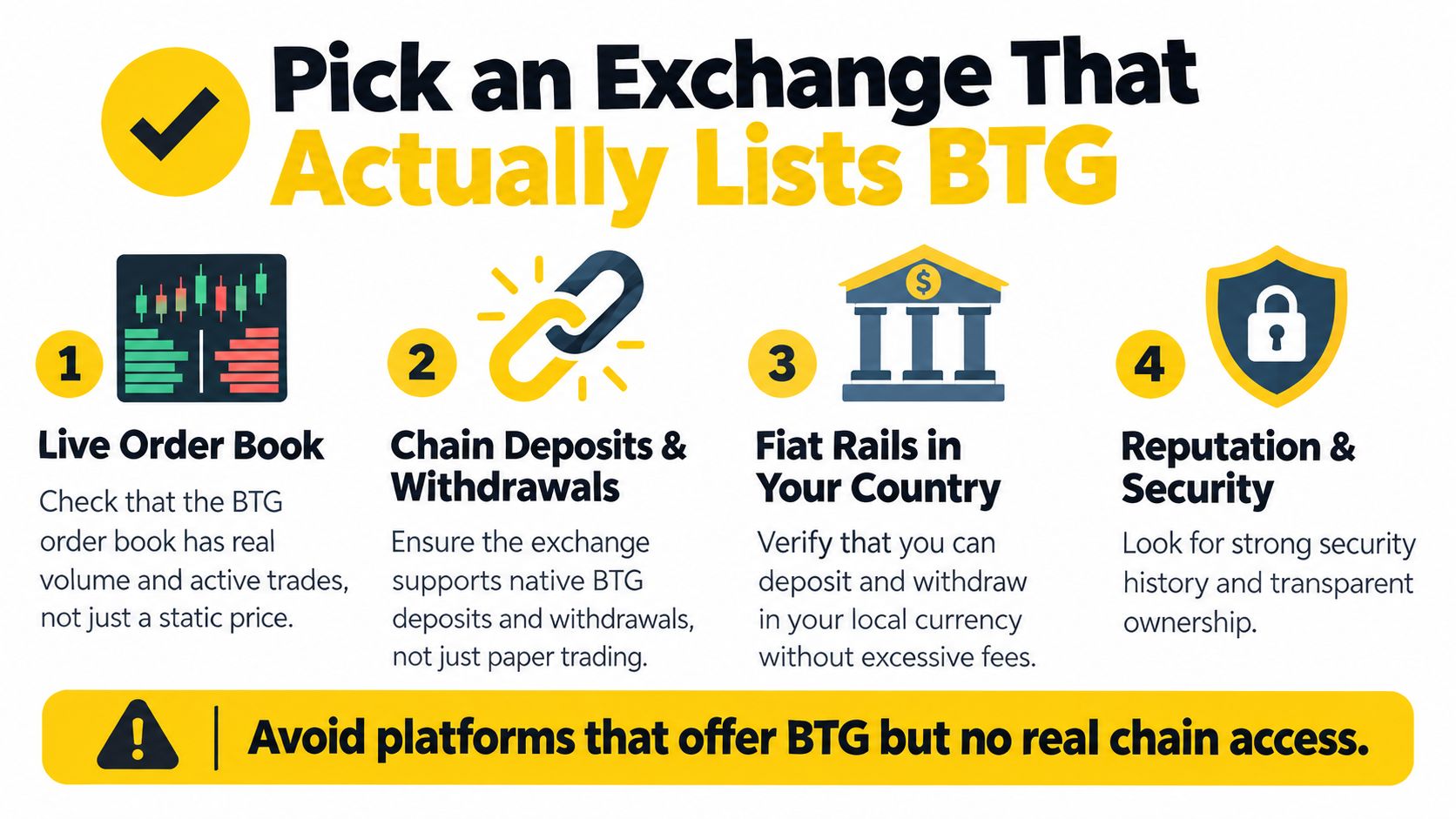
Start by opening the venue's BTG market and checking whether trades are actively occurring. A static chart or a displayed conversion widget isn't enough. You want a functioning BTG order book with visible bids and asks, recent executions, and a withdrawal option that specifically identifies the BTG network.
The four checks I'd make
- Live order book: Confirm that the BTG market has real bids, asks, and recent trades. A price feed without meaningful depth won't protect you from slippage.
- Native chain access: Open the deposit and withdrawal screens. Confirm that the platform supports the BTG chain itself, not a wrapped token representing BTG on another network.
- Local funding rails: Check whether your country can use the advertised bank transfer, card, or crypto deposit method. Payment availability is jurisdiction-specific.
- Reputation and custody controls: Look for a clear operator, strong account-security options, transparent policies, and evidence that withdrawals function normally.
A venue with a genuine BTG/BTC or BTG/USDT market may be more useful than a famous platform that doesn't list BTG. Don't force a purchase through a broker that only shows an estimated price and never gives you control of the native asset.
Warning signs worth stopping for
Paused withdrawals deserve a pause in your purchase. So do unexplained maintenance notices, support instructions delivered through private messages, and listings that don't clearly identify the blockchain. Wrapped BTG can have a different contract, address format, and redemption risk from native BTG.
You don't need a vendor list to filter venues. Before signing up, answer four questions: Can I use this platform in my country? Is the BTG market active? Can I withdraw native BTG? Does the exchange clearly state its fees and network requirements? If any answer is unclear, skip it.
Setting Up, Verifying, and Funding Your Account
Set up security before moving money. Use a dedicated email address, enable hardware-based two-factor authentication if the platform supports it, and prefer an authenticator app over SMS. A physical security key offers stronger protection against account takeover.
Complete KYC before you need an immediate trade. Exchanges may request verification when a purchase or withdrawal reaches a platform-specific threshold, depending on local compliance rules and the venue's policy. Prepare a passport or national identity document, plus a selfie or proof of address if requested. Review times vary, so do not transfer funds until the account is approved.
Funding choices
Match the deposit method to your chosen BTG route:
- Bank transfer: Usually the sensible option for larger deposits when the exchange supports your local system. Settlement may take longer, but the fee structure is often clearer.
- Card deposit: Convenient for a direct BTG market, though you should check the card fee and whether the issuer treats the transaction as a cash advance.
- BTC or USDT deposit: Use this when the venue offers only crypto-to-crypto BTG markets. Confirm the deposit network on both sides before sending.
- SEPA or Faster Payments: Useful for eligible regional users, subject to exchange support and your residence.
Payment rails differ by country and venue. The 2026 fiat crypto integration overview explains that market structure, banking access, and platform support do not line up everywhere. Keep bank and exchange records together, particularly if you use online banking. This guide to buying BTC through online banking covers the related funding route.
Slow down before confirming the deposit. Check the minimum amount, fee policy, settlement status, and whether the account can trade and withdraw native BTG. A completed fiat deposit does not prove that the BTG market or withdrawal function is available. If the platform's KYC terms, funding route, or BTG access remains unclear, stop there and choose another venue.
Placing the Buy Order Without Getting Killed by the Spread
BTG is where a careless market order becomes an expensive lesson. Before clicking Buy, decide which route gives you the cleanest execution: a direct fiat-to-BTG pair or a BTC, ETH, or USDT route. The right choice depends on your jurisdiction, the exchange's actual BTG listing, and the depth available at that moment.
Read the order book before choosing the order type
A market order executes immediately against available sell orders. It does not guarantee the average price. On a thin BTG book, one order can consume several price levels before the exchange finishes matching it.
A limit order sets the maximum price you will pay. Use it when controlling execution matters more than immediate completion. Place the order slightly inside the best ask if you want a reasonable chance of filling, then watch whether the displayed depth can handle your size.
Keep the order smaller than the visible book. If liquidity is shallow, split the purchase into several limit orders. Cancel and replace an unfilled order instead of chasing the price upward. If the exchange offers a slippage-tolerance field, set it deliberately. Do not accept a broad default without checking what it permits.
Select the pair carefully
Use the most liquid BTG pair available. It may be BTG/USDT, BTG/BTC, or a direct fiat pair. The quote currency is less important than the pair's actual depth, spread, and recent trading activity.
Compare the best bid, best ask, and mid-market price before submitting. A spread above roughly 0.5% on a major pair or 1% on a USDT pair signals light liquidity under the practical buying guidance used for this workflow. In that situation, a market order can produce a poor fill even when the displayed BTG price looks attractive.
If your chosen exchange lists BTG only against BTC or USDT, include the extra conversion in your decision. A deeper crypto pair can improve execution, while a direct fiat pair can remove one trade and one spread. Check the final BTG amount rather than choosing by convenience.
Count every cost layer
The headline BTG price is only one part of the purchase cost. Check each layer:
- Trading fee: The exchange charges for executing the order.
- Funding fee: Bank transfers may cost less than card deposits, depending on the platform and payment method.
- Spread: Your fill can sit above the mid-market quote, especially on a thin book.
- Intermediate conversion: Buying BTC, ETH, or USDT first adds another trade and another spread.
- Withdrawal fee: The exchange may deduct BTG or charge a network-related amount when you move the coins to your wallet.
The practical buying guidance for this workflow places typical taker fees around 0.1% to 0.25%, card funding fees around 1% to 3%, and the indirect-route drag around 0.4% to 0.8% compared with a direct fiat-to-BTG path. Treat those as reference ranges, not promises. Your exchange's fee schedule and final order preview determine the actual cost.
Compare a $500 route
For a $500 purchase, the direct route involves one fiat-to-BTG trade, plus funding, trading, spread, and eventual withdrawal costs. The indirect route first buys BTC, ETH, or USDT, then exchanges that asset for BTG. You therefore add a second trading fee and another spread before withdrawing.
Do not assume the indirect route is cheaper. Its market may be deeper, but a slow transfer can expose you to BTG price movement that outweighs the fee saving. Compare the final BTG amount in the preview, including every fee, rather than comparing advertised trading fees alone.
After the order fills, review the average executed price, fee deduction, and amount available for withdrawal. Save the trade confirmation immediately. If the execution differs sharply from the quoted price, stop and investigate the order book and fee breakdown before placing another order.
Withdrawing BTG to a Wallet That Supports the Chain
Withdrawal is the point to slow down. A completed exchange order can still end badly if the destination wallet cannot handle Bitcoin Gold.
Choose a wallet that explicitly lists BTG support. Options include Bitcoin Gold Core, a hardware wallet with confirmed BTG compatibility, or a light wallet that indexes the BTG network. Bitcoin support, UTXO support, or a similar address format does not prove BTG compatibility. A wallet guide covering the best crypto wallets for iPhone can help you compare custody features, but verify BTG support on the wallet's own documentation before transferring funds.
Use a controlled withdrawal sequence
- Create or open the BTG wallet. Generate the receiving address inside the wallet. Do not copy one from a search result or private message.
- Confirm the network. The exchange withdrawal page must identify Bitcoin Gold, not Bitcoin or a wrapped-token network.
- Copy and inspect the address. Compare its beginning and ending characters with the wallet display. Paste carefully and use the exchange's address confirmation tools.
- Send a small test amount. Wait for the transaction to appear, then confirm it in a BTG block explorer before sending the remaining balance.
- Record the transaction ID. Store it with your purchase record and wallet backup details.
The destination must support the exact BTG chain and its address requirements. If the exchange offers a network selector, choose Bitcoin Gold by name and confirm the wallet matches it. Do not select a network based only on a lower fee.
Back up the seed phrase offline. Never enter it into a website, support chat, or exchange form. Keep the recovery details separate from the device holding the wallet, and leave only the amount needed for trading on the exchange. A test transfer costs time, but it is the cheapest way to catch a chain or address mistake before the full withdrawal.
Safety, Taxes, and the Real Reason You're Buying BTG
Small-cap assets attract predictable scams. Fake support accounts send direct messages, phishing sites copy exchange login pages, and pump groups manufacture urgency around thin order books. No legitimate support agent needs your seed phrase, one-time code, or remote access to your device.
Treat BTG as a speculative fork, not as digital gold. Forbes' discussion of the relationship between gold and Bitcoin argues that Bitcoin has behaved more like a liquidity-sensitive risk asset while gold has functioned as a traditional store of value (Forbes analysis of gold and Bitcoin). The same coverage notes that their 90-day correlation reached roughly 0.50 to 0.86, described as the highest since 2020. That macro relationship doesn't turn BTG into a gold hedge. BTG adds its own liquidity, chain, security, and execution risks.
Tax treatment varies by jurisdiction, but BTG is generally handled as property rather than cash in many tax systems. Buying may not create the same obligation as selling, but swapping BTC, ETH, or USDT into BTG can be a disposal event under local rules. Keep dated records of your cost basis, fees, proceeds, wallet transfers, and every conversion. For broader context on crypto regulation and ownership responsibilities, review this blockchain law resource.
Before adding to a position, confirm:
- Wallet backup: Your seed phrase is stored offline and recoverable.
- Account security: Hardware 2FA is active and withdrawal protections are enabled.
- Tax log: Every purchase, swap, fee, and sale has a dated record.
- Exit plan: You know what price, time frame, or thesis change would make you sell.
- Position size: A complete loss wouldn't damage your essential finances.
My recommendation is straightforward. Route the purchase through the venue with the clearest native BTG support and best executable liquidity, use a limit order, test the withdrawal, and buy only if you can explain why you want BTG beyond its low sticker price.
Cascoin gives crypto users an open-source project to explore through Labyrinth Mining, CPU-friendly mining, public code, downloadable wallets, and verifiable on-chain activity. If BTG has pushed you to compare transparent, community-driven networks and responsible custody, visit Cascoin to review the project and decide whether it fits your interests.