How to Mine with ASIC: The Practical Guide for 2026
You've found a used ASIC miner online, checked its advertised hash rate, and started wondering whether it can earn enough Bitcoin to justify the purchase. Then the less attractive questions appear. Can your electrical service support it? Where will the hot air go? Can you tolerate the noise in the room next to your office or bedroom? Most guides jump straight to pool settings and wallet addresses. A practical answer to how to mine with ASIC starts earlier, with the electricity rate, hardware generation, ventilation plan, and living conditions that determine whether the setup makes sense at all.
ASIC mining can still suit operators with efficient equipment and unusually cheap power. It can also turn into an expensive, noisy space heater for a household paying ordinary residential rates. The sections below focus on the decisions that matter after the marketing page closes, from break-even analysis and installation to firmware, reliability, and alternatives.
Table of Contents
- Is ASIC Mining Still Viable in 2026
- Preparing Power and Cooling Infrastructure
- Installing Firmware and Mining Software
- Configuring for Efficiency and Reliability
- Mining Cascoin via SHA-256 or Labyrinth
- Monitoring, Troubleshooting, and Maintenance
- Deciding If ASIC Mining Fits Your Situation
Is ASIC Mining Still Viable in 2026
An ASIC can run profitably on paper and still be a poor fit for a home. Before comparing terahashes, check whether the machine can cover its electricity bill under your actual tariff. Recent profitability coverage places the commonly discussed break-even range below roughly $0.05 to $0.08 per kilowatt-hour, while many residential users pay around $0.10 to $0.12 per kilowatt-hour. That gap can decide the project before hardware cost, pool fees, repairs, ventilation, and downtime are included. The 2025 cryptocurrency mining profitability analysis provides the cited break-even context.
Bitcoin mining has changed with the network. Commercially shipped ASIC miners reached customers in 2013, and Canaan's Avalon units, followed by later Avalon and Bitmain equipment, displaced CPU, GPU, and FPGA hardware for SHA-256 mining. Historical coverage records efficiency improving from roughly 10,333 J/TH for Avalon 1 to about 2,000 J/TH for some late-2013 models. That shift established specialized, industrial-scale mining. CoinDesk's history of ASIC mining documents the transition.
The electricity filter
Start with the miner's rated wattage and add a realistic allowance for supporting equipment. Your calculation needs to answer three questions:
- What does the miner consume continuously? Convert its power rating into daily and monthly energy using your local billing unit.
- What rate does the utility charge? Include time-of-use pricing, demand charges where applicable, taxes, and seasonal changes.
- What happens when revenue falls? Mining income changes with Bitcoin's market price, network difficulty, transaction conditions, and pool payout structure. A setup that works only during favorable conditions has little margin.
Older Antminer S19-generation machines face particular pressure. A 2026 report cited in the profitability research says some older units need electricity below about five cents per kilowatt-hour to remain cash-flow positive. A 2025 review also highlighted the phase-out of older 25 to 38 J/TH hardware. Treat a low purchase price as a reason to inspect efficiency, not as proof of value.
Practical rule: If the machine only works on paper at your current electricity rate, don't buy it first and hope conditions improve later.
Choosing hardware by efficiency
Hash rate measures computational output. Joules per terahash shows how much power the machine needs to produce that output, making it the more useful comparison when electricity is expensive. Modern examples in the available hardware data include Bitmain's Antminer S21 at about 200 TH/s and near 17.5 J/TH, while the S21 Pro reaches approximately 234 TH/s at around 15 J/TH. Those figures appear in Galaxy's 2024 mining report.
Compare machines in this order:
- Efficiency: Lower J/TH generally leaves more room when electricity costs rise or network conditions weaken.
- Hash rate: Higher output does not guarantee better economics if the machine draws disproportionate power.
- Cooling design: Air-cooled hardware is simpler to deploy, while hydro or immersion systems require more infrastructure and technical support.
- Condition: Request operating history, board photographs, fan condition, error logs, and a live hash-rate demonstration.
- Parts and resale: Control boards, fans, power supplies, and firmware support make a machine easier to keep productive.
Buy from a manufacturer or established distributor when warranty and delivery certainty matter. Used equipment can work, but price it as industrial hardware with a finite service life. Be cautious if a seller refuses a serial-number check, provides only stock photographs, promises guaranteed returns, or describes a refurbished miner as “new.”
Before purchasing, calculate the bill at your tariff, decide whether the heat and noise fit the room, and reject any machine that fails those household tests.
Preparing Power and Cooling Infrastructure
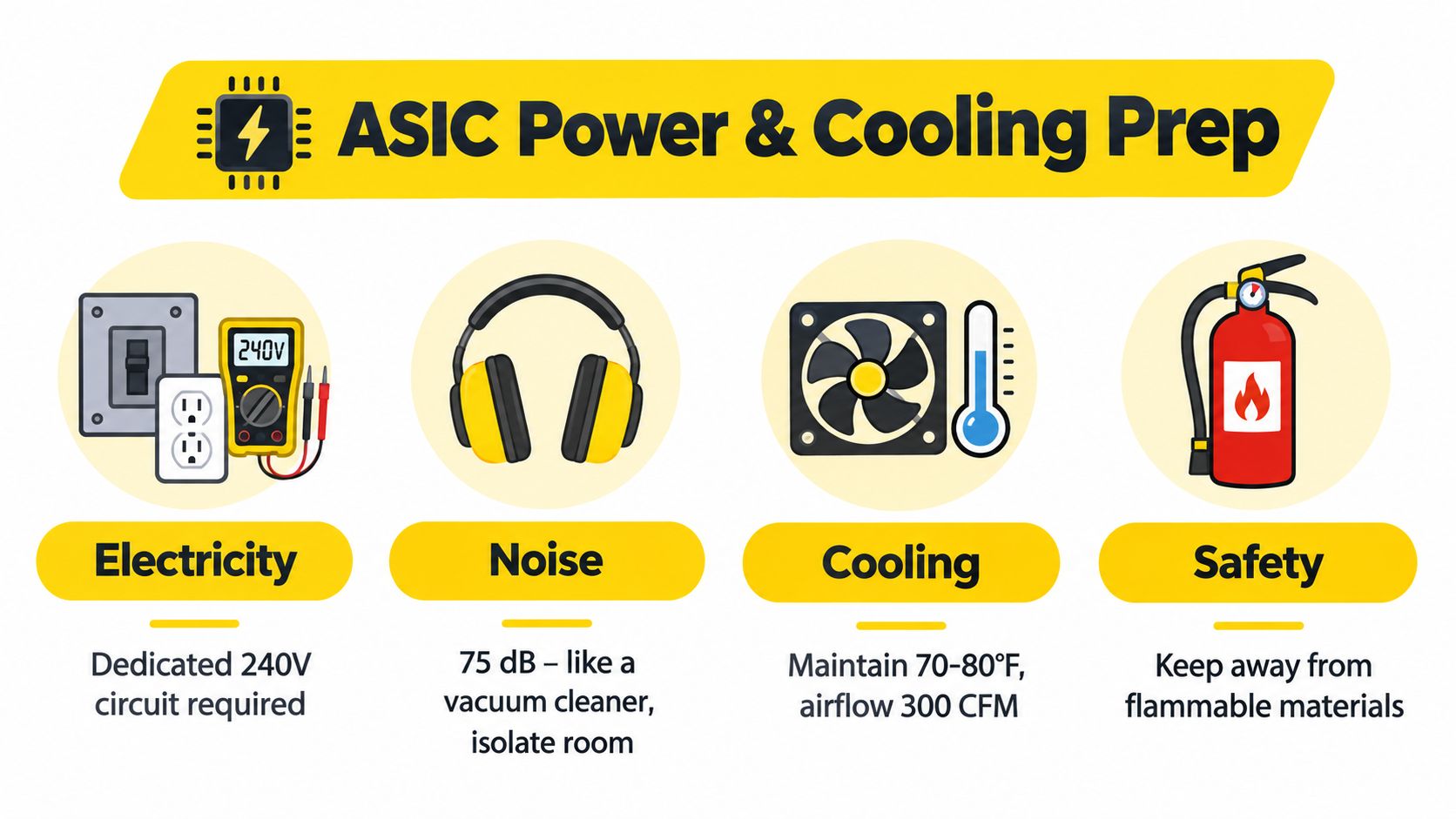
An ASIC installation begins with the electrical panel, not the miner's web interface. Confirm the machine's voltage, current, plug type, circuit capacity, grounding, and cable requirements with a qualified electrician. A continuous mining load deserves a dedicated circuit and protective equipment selected for the installation, rather than an improvised extension lead or a crowded household outlet.
If your service needs more capacity, a licensed electrician can assess an appropriate service upgrade for EV charging, which uses similar planning questions around available capacity, dedicated circuits, and safe load management. Don't treat that page as a substitute for an on-site assessment. The electrician still needs to verify your panel, conductors, disconnects, and local code requirements.
Build the airflow path before switching on
An air-cooled ASIC turns nearly all of its electrical input into heat. Place the intake where it can draw clean, cooler air, then route exhaust outside or into a properly designed extraction system. Recirculating hot exhaust back into the intake causes thermal throttling and makes the room steadily harder to cool.
Bare ASICs can reach around 75 decibels, according to recent cooling guidance from Million Miner. That noise isn't a minor inconvenience. In an apartment, shared house, or attached garage, it can create complaints and make the miner unusable even when the electricity calculation looks acceptable.
Use a physically isolated room, rigid ducting where appropriate, dust filtration that doesn't choke airflow, and temperature monitoring at both intake and exhaust. Pre-emptive cooling matters before hot weather arrives. A fan added after the miner starts throttling is a reaction, not a reliable operating plan.
For the electrical details relevant to particular equipment, consult this Cascoin guide to power supply requirements alongside the manufacturer's documentation. Never modify high-voltage wiring or bypass protective devices to make an ASIC fit a home setup.
Installing Firmware and Mining Software
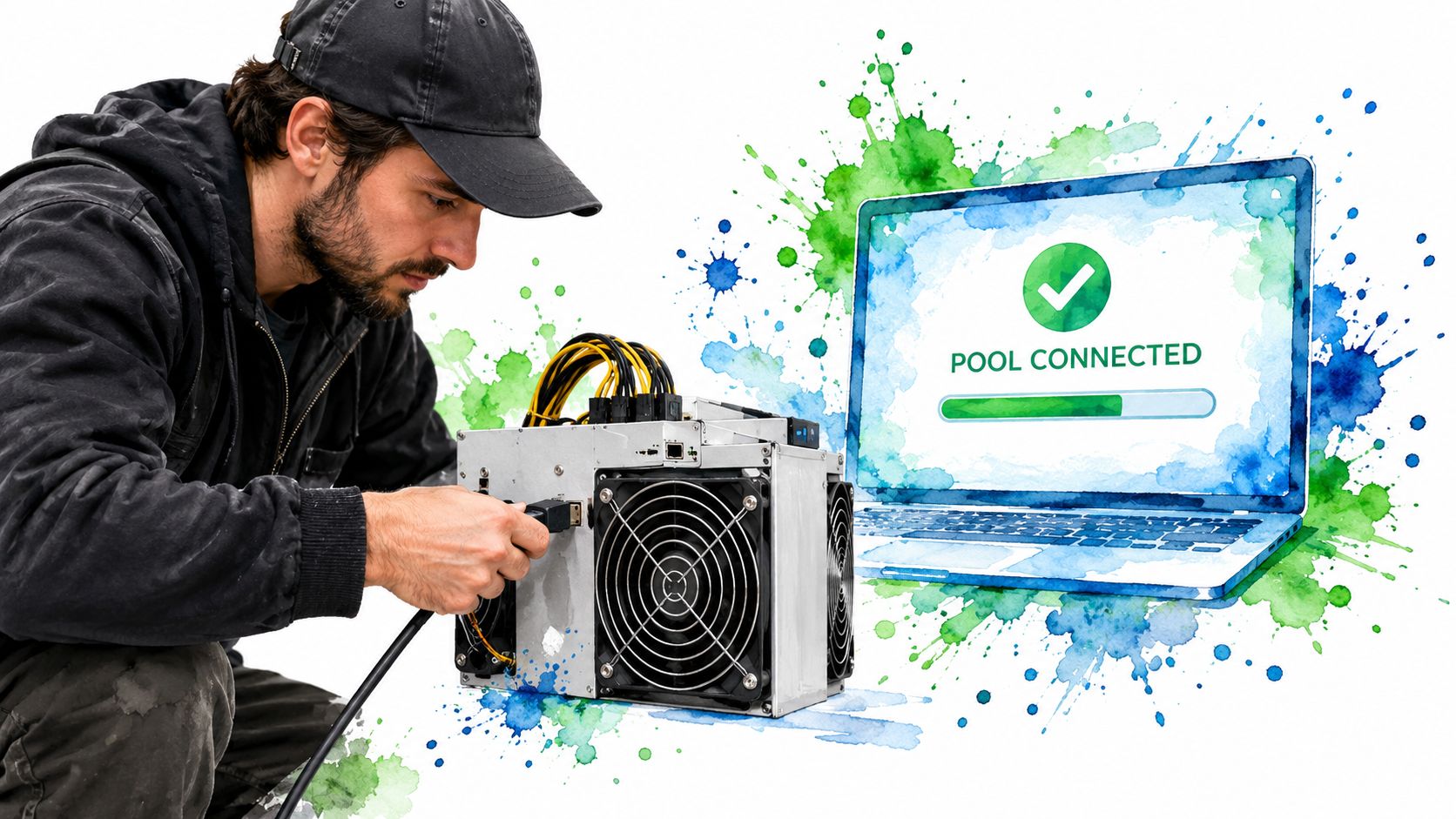
Once power and airflow are ready, connect the ASIC to your local network with a stable wired connection and locate it through the manufacturer's approved discovery process. Open the miner's administration interface, change the default credentials, update the stock firmware if a trusted release is available, and record the original configuration before changing performance settings.
Select firmware deliberately
Stock firmware is the simplest starting point. It generally offers the manufacturer's supported interface and a lower risk of incompatibility. Alternative firmware such as Braiins OS or Arctic firmware can expose more control over voltage, clock behavior, fan response, and monitoring, but compatibility and warranty implications vary by model. Download firmware only from the developer or manufacturer, verify the model match, and keep a recovery path.
A pool account is the next practical step. Create a worker name, copy the pool's current server address and port from its documentation, and enter the correct payout wallet. Use a wallet address intended for the asset you're mining, not an exchange deposit address unless the exchange explicitly supports that arrangement.
The configuration normally contains several pool endpoints. Put a primary pool first and backups after it so the ASIC can reconnect if the primary endpoint becomes unavailable. Use a clear worker label that identifies the physical machine, such as a room or rack reference, without placing sensitive information in the label.
After saving, check both the local dashboard and pool dashboard. A working miner should report accepted shares, a stable effective hash rate, board status, temperatures, and connectivity. A pool account showing no worker activity usually points to an incorrect endpoint, wallet or worker format, network problem, or firmware incompatibility. For broader software choices, compare the available mining programs documented by Cascoin, then confirm that the selected software supports your ASIC and algorithm.
Configuring for Efficiency and Reliability
The highest clock setting isn't automatically the most profitable setting. A miner that produces more hashes while consuming disproportionately more electricity, raising fan speed, and increasing hardware errors may deliver worse results than a restrained configuration.
Start with the manufacturer's stable profile. Let the machine run long enough to establish baseline hash rate, board temperatures, rejected shares, fan behavior, and power draw. Change one setting at a time, then observe whether the pool's effective hash rate improves without a corresponding rise in hardware errors or thermal stress.
Tune for your operating environment
Custom firmware can let you adjust voltage, clock speed, and fan curves. Underclocking can make sense when electricity is expensive or ambient temperatures are high. Overclocking requires enough electrical and cooling headroom, and it can reduce practical uptime if boards become unstable.
Use a simple operating hierarchy:
- First, protect uptime: Keep temperatures within the manufacturer's published range and investigate repeated board errors.
- Next, reduce waste: Compare hash rate per watt, not hash rate alone.
- Then, refine controls: Adjust fan response to room conditions so the miner doesn't run at maximum cooling unnecessarily, but never restrict airflow to reduce noise.
- Finally, document changes: Record firmware version and settings so you can restore a known-good profile.
Monitor the pool's effective rate rather than trusting a short local reading. Watch for gradually increasing rejected shares, one board falling behind, repeated restarts, or a fan curve that becomes more aggressive as dust accumulates. Efficiency is a sustained operating result, not a screenshot from the first hour.
Mining Cascoin via SHA-256 or Labyrinth
A home SHA-256 miner competes in a mature, industrial-scale network. Analysts expected Bitcoin's network hashrate at the end of 2024 to fall between 675 EH and 725 EH, while Glassnode recorded 666.4 EH/s in September 2024. The practical implication is straightforward: one household machine joins a very large competition. It does not operate in an easy early-mining environment, so electricity pricing, heat removal, and constant fan noise determine whether the setup is tolerable as much as its advertised hash rate does.
Cascoin presents a separate path for operators assessing an open-source project with more than one participation model. Cascoin's open-source mining project uses an ecological, gamified approach called Labyrinth Mining, while also supporting SHA-256 for experienced ASIC operators. Its code is publicly available through Codeberg and GitHub, and the Casplorer block explorer lets operators check on-chain activity.
Which approach fits
| Approach | Suitable operator | Main trade-off |
|---|---|---|
| SHA-256 ASIC mining | An operator who already owns compatible hardware and has a strong power plan | High hashpower brings substantial electrical, thermal, and acoustic demands |
| Labyrinth Mining | Someone interested in Cascoin's gamified, ecological participation model | It uses a different workload and setup from conventional SHA-256 ASIC mining |
| Other low-power options | A beginner or operator testing participation without an ASIC installation | Lower infrastructure demands can mean a different contribution and reward model |
Choose SHA-256 only after your hardware, pool, wallet, and electricity costs fit the operating conditions. A miner that makes the room too hot or loud is not practical because it can run. Choose Labyrinth Mining when the maze-based model better suits your goals or living space than a conventional ASIC.
Before committing funds, verify the software, wallet, pool instructions, and chain activity through public project resources. Avoid anonymous configuration files, especially when you cannot confirm their origin or the workload they assign.
Monitoring, Troubleshooting, and Maintenance
A miner can appear online while losing performance. The useful dashboard signals are effective hash rate, accepted and rejected shares, board status, temperature, fan speed, power behavior, and connection history. Check trends rather than reacting to one brief fluctuation.
When a worker disappears, start with the simplest causes. Confirm that the miner has power, the Ethernet cable is seated, the router has connectivity, and the pool endpoint is reachable. If the local interface is available but the pool shows no shares, review the pool URL, port, wallet, and worker credentials. Pool support can investigate account or endpoint issues, but it can't repair a loose cable or failing power supply.
Thermal problems need a physical inspection. Check whether the intake is blocked, filters are loaded with dust, exhaust air is returning to the room, or fans are behaving abnormally. Reduce the operating profile before the miner reaches repeated shutdowns, then correct the airflow problem rather than masking it with an aggressive clock setting.
Keep a maintenance record
- Dust and airflow: Power down safely before cleaning heat sinks, fans, and filters. Dust raises resistance to airflow and can push a marginal setup into throttling.
- Power connections: Inspect plugs, sockets, cables, and the power supply for discoloration, heat damage, looseness, or unusual odor.
- Firmware: Apply trusted updates when they address stability or security, but keep a copy of the working configuration and avoid firmware from unofficial sellers.
- Network reliability: Use a wired connection where possible and label cables so a reset doesn't create confusion.
- Performance history: Record settings and dashboard readings. A slow decline is easier to diagnose when you have a baseline.
The Cascoin maintenance guide provides a useful reference for inspection habits. Don't open energized equipment, defeat safety systems, or continue operating a miner with damaged electrical components.
Deciding If ASIC Mining Fits Your Situation
ASIC mining fits a narrow practical profile. You need electricity near the viable range described earlier, a safe circuit, a place where constant noise won't cause problems, a dependable exhaust route, and enough technical comfort to diagnose failures. You also need capital you can afford to leave exposed to changing network economics and hardware resale conditions.
A homeowner with cheap surplus power, a detached ventilated space, and modern efficient equipment may have a workable project. A renter paying ordinary residential rates, living beside the miner, and relying on improvised cooling should probably pause. An older ASIC can be inexpensive to acquire and still be uneconomic to operate.
Use this final filter:
- Proceed when the electricity rate, infrastructure, equipment efficiency, and noise plan work together without optimistic revenue assumptions.
- Pause when you haven't measured the tariff, confirmed circuit capacity, or planned exhaust.
- Pivot when the living environment can't support the heat and sound. A lower-power mining model or a different participation method may fit better than forcing an industrial appliance into a home.
ASIC mining isn't “dead,” but it isn't plug-and-play income either. The successful operator treats hash rate as only one input and makes electricity, uptime, cooling, and household practicality part of the purchase decision.
Cascoin gives ASIC operators a SHA-256 option while also offering Labyrinth Mining as an ecological, gamified way to participate without treating every problem as a hash-rate race. Visit Cascoin to review its open-source code, wallet, mining options, and public chain resources before choosing your next setup.