When Should I Buy Bitcoin: A Practical Decision Framework

You're probably here because Bitcoin just moved hard in one direction and now your brain is doing what everyone's brain does. If price ripped, you feel late. If price dumped, you're afraid it's about to dump more. So you type a simple question into search: when should I buy Bitcoin?
The honest answer is that this isn't really a date problem. It's a conditions problem.
People who do this well usually aren't waiting for one magical Tuesday afternoon. They buy when three things line up: their own finances are ready, the market structure isn't broken, and they have a clear way to enter without letting emotions run the trade. That's what works across cycles. Not prediction. Process.
Table of Contents
- Why This Question Is Harder Than It Sounds
- Start With Your Own Situation Before Any Chart
- The Halving Cycle and What It Actually Tells You
- Technical and On-Chain Signals Worth Watching
- DCA, Lump-Sum, or Phased Entry
- Risk Management, Custody, Fees, and Mindset
- Three Real Buyer Profiles and How They Would Act
- Your Decision Checklist and an Honest Disclaimer
Why This Question Is Harder Than It Sounds
You buy after a big rally and feel stupid if it dips 12 percent the next week. You wait for a cleaner setup, and Bitcoin rips without you. That loop is why this question trips people up.
Bitcoin does not give you the usual anchors. No closing bell. No management guidance. No tidy valuation model that settles the argument. Price moves on liquidity, macro pressure, positioning, sentiment, and reflexive momentum, often all at once.
Why timing feels obvious only after the fact
Bitcoin's long-term upside gets quoted constantly. What gets ignored is the path. It has delivered huge multi-year gains and brutal drawdowns in the same asset, which is why hindsight creates fake confidence. The bottom always looks clean on an old chart. In real time, it looks like bad news, broken momentum, and a crowd telling you to wait one more week.
First-time buyers usually get trapped here. They see a sharp red move, freeze, and tell themselves they are being disciplined by waiting for confirmation. Then confirmation arrives only after price is meaningfully higher. That is not patience. That is delay dressed up as prudence.
Practical rule: If your plan requires nailing the exact bottom, it is not a plan.
A more useful question to ask instead
Stop asking for the perfect date. Ask whether conditions make a buy reasonable.
That means checking three things at the same time:
- Macro context: Is liquidity improving, are rate expectations easing, or is risk appetite getting stronger?
- Market structure: Is Bitcoin holding key levels and basing, or is it still in a disorderly breakdown?
- Positioning and participation: Are long-term holders staying firm, are coins moving back on chain, and is momentum stabilizing instead of unraveling?
That framework is how experienced buyers avoid the false choice between “buy now” and “wait forever.” You are not trying to predict one exact candle. You are trying to identify an entry window where the odds stop being reckless.
Seasonality gets too much credit in these conversations. Analysts at Barchart have shown in their Bitcoin seasonality chart that calendar tendencies exist, but they are weak compared with what happens after a major shock or trend reset. “Buy in Q4” is lazy advice. Buy when conditions improve, then phase in with a method you can follow.
Start With Your Own Situation Before Any Chart
Jumping straight to RSI, moving averages, and cycle charts is backwards. If your personal setup is wrong, the chart won't save you.
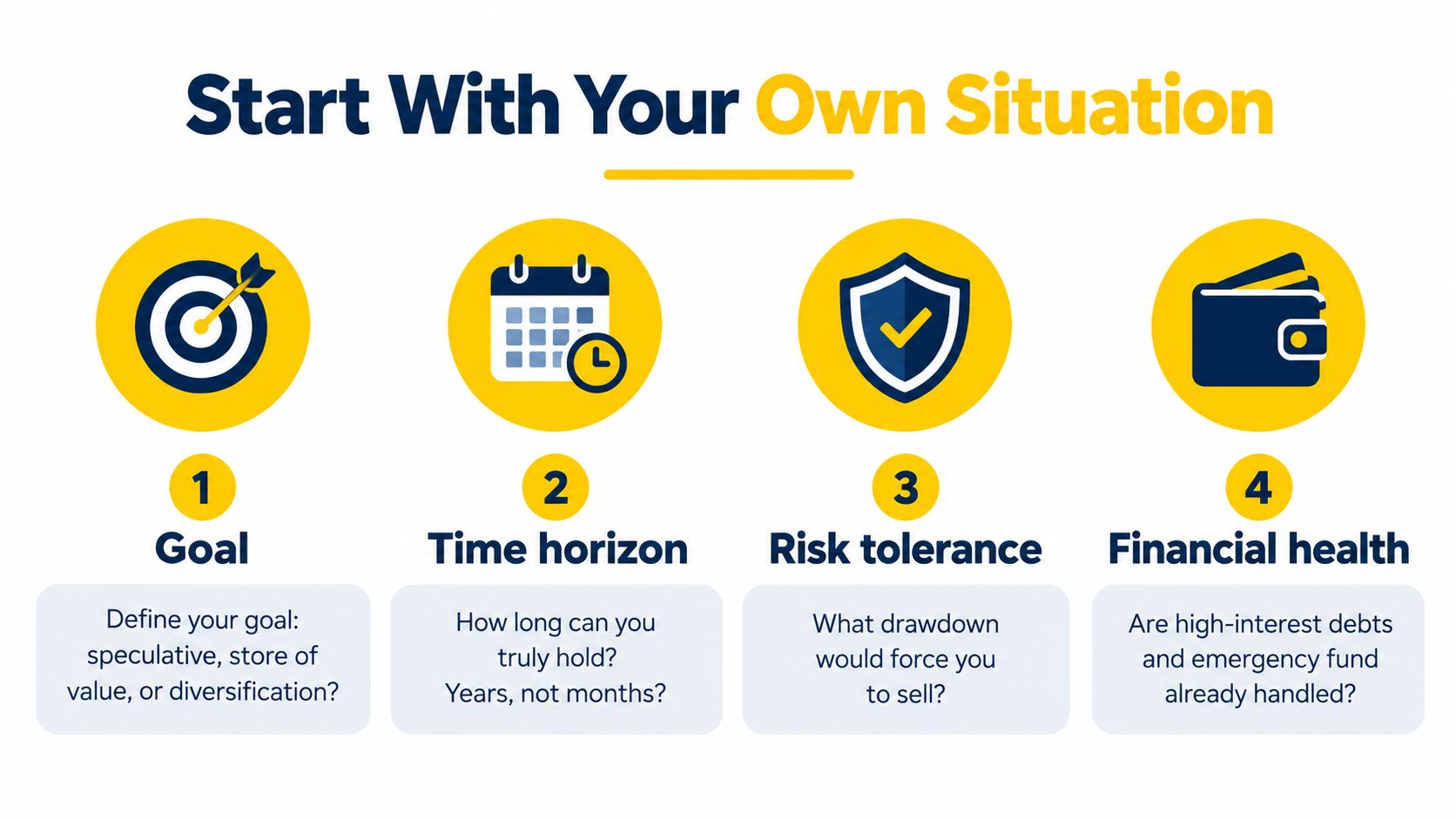
Know what you want Bitcoin to do for you
Start with your goal. Be concrete.
Maybe you want speculative upside and you're comfortable with volatility. Maybe you want a long-term store of value and don't care about short-term swings. Maybe you just want diversification so you're not sitting entirely in cash or traditional assets. Those are different motives, and they lead to different buying behavior.
Self-check: Can you describe your reason for buying in one sentence without mentioning price predictions?
Match the strategy to your holding period
Your time horizon changes everything.
A buyer with a short window will care a lot more about entry quality and drawdown risk. A buyer with a long runway can survive ugly periods as long as they don't overallocate. If you think in months, Bitcoin will stress you out. If you think in years, it becomes easier to act rationally.
Use the sleep test for position sizing
You also need a size that won't force a bad decision.
A small allocation often works better than a “conviction” bet that keeps you staring at candles all night. For many people, a 2 to 5% allocation passes the sleep test. The right amount is the amount you can hold without panic-selling the first time price gets ugly.
Self-check: If Bitcoin dropped hard after you bought, would you hold, buy more, or immediately want out?
Decide how you'll exit before you enter
The last question is the one almost nobody answers. What's your exit plan?
You can set a rebalancing rule, decide you'll sell portions into strength, or commit to holding indefinitely unless your life situation changes. Any of those can work. What doesn't work is buying first and inventing the exit later.
- Target-based exit: Good for traders who want rules.
- Rebalancing exit: Good for investors who want discipline.
- Open-ended hold: Good only if you already accept deep drawdowns.
Self-check: Do you know what would make you sell, trim, or stop buying?
The Halving Cycle and What It Actually Tells You
If you've watched Bitcoin for any length of time, you know the halving matters. But people oversimplify it.
The useful takeaway isn't “buy on halving day.” The useful takeaway is that Bitcoin's supply schedule has historically created a cycle framework, and buyers often get paid more for accumulating before the crowd gets euphoric.
What the historical record actually says
Bitcoin's block subsidy dropped from 50 to 25 BTC on November 28, 2012 at block 210,000, then to 12.5 BTC on July 9, 2016 at block 420,000, then to 6.25 BTC on May 11, 2020 at block 630,000, and then to 3.125 BTC on April 20, 2024 at block 840,000 according to CoinGecko's Bitcoin halving history. The same summary notes rough post-halving expansions of about +9,200%, +2,900%, +700%, and about +98% so far from the 2024 cycle peak data cited in 2026.
That's the part people ignore: returns have diminished over time.
| Bitcoin Halving Cycles: Rough Returns and Accumulation Windows | ||||
|---|---|---|---|---|
| Halving Date | Approx. Pre-Halving Low | Approx. Post-Halving Peak | Gain % | Typical Accumulation Window |
| November 28, 2012 | Pre-halving low before 2012 event | Next cycle peak | About 9,200% | Mostly before and around the halving |
| July 9, 2016 | Pre-halving low before 2016 event | Next cycle peak | About 2,900% | Mostly before and around the halving |
| May 11, 2020 | Pre-halving low before 2020 event | Next cycle peak | Around 700% | Mostly before and around the halving |
| April 20, 2024 | Pre-halving low before 2024 event | Peak data cited in 2026 | About 98% so far | Mostly before and around the halving |
What to do with that information
The pattern is clear enough to be useful. Historically, the stronger move was often made by people who accumulated well ahead of the halving instead of chasing after the event.
That makes a mid-2024 buyer and a late-2025 buyer very different creatures. The earlier buyer is usually entering closer to an accumulation phase. The later buyer is more likely reacting to narrative and momentum after a lot of repricing has already happened. Same asset. Different risk.
Buy when supply conditions are improving and sentiment still feels awkward. Don't wait until everyone around you suddenly has a Bitcoin opinion.
One more reality check. The halving still matters, but it doesn't act alone anymore. Macro liquidity, ETF-related demand, and broad risk appetite now matter a lot too. So use the halving as an anchor, not as a complete system.
Technical and On-Chain Signals Worth Watching
If you want one practical framework, use trend first, momentum second, on-chain third.
That keeps you from doing what beginners always do, which is buying something merely because it looks “cheap” after a nasty drop. Cheap can always get cheaper. You want evidence that buyers are returning.
A simple technical setup that filters bad entries
A strong basic buy zone is when price stays above the 200-day moving average while the 14-day RSI pulls back into the 30 to 50 range and then turns upward, based on RSI guidance for crypto trading. In plain English, you want the larger trend intact while short-term momentum resets.
That's much better than buying a random red candle.
If you're still learning chart structure, this guide to chart patterns explained simply is worth your time because it helps you distinguish a healthy pullback from a messy breakdown. And if you're comparing Bitcoin to other crypto assets, understanding market cap in crypto helps you avoid treating every coin like it behaves the same way Bitcoin does.
| Key Entry Signals Side by Side | |||
|---|---|---|---|
| Signal | Type | Buy-Zone Reading | Confirmation Source |
| 200-day moving average | Technical trend filter | Price holds above it | Chart platform weekly or daily trend view |
| 14-day RSI | Momentum | Pullback into 30 to 50, then turns up | Momentum indicator on chart |
| MVRV Z-Score | On-chain valuation | Below 1.0 is historically more attractive | On-chain dashboard |
| Long-term holder SOPR | On-chain behavior | Below 1.0 suggests loss realization | On-chain dashboard |
| Exchange balances | On-chain flow | Rising balances can align with compression phases | On-chain dashboard |
| Hash Ribbons or miner-capitulation signals | Miner stress | Capitulation-style compression | On-chain dashboard |
The on-chain layer that gives more conviction
Longer-horizon signals get more interesting when MVRV Z-Score is below 1.0, long-term holder SOPR is below 1.0, exchange balances are rising, and miner-stress tools such as Hash Ribbons are flashing compression, based on cycle-bottom conditions summarized here. That combination has often aligned with pre-halving accumulation zones, while major tops have tended to show much hotter MVRV readings, often above 6.
Don't worship any one indicator. Stack them.
My rule is simple:
- One signal: interesting, but not enough
- Two signals: start paying attention
- Three signals: reasonable time to scale in
That approach keeps you out of a lot of nonsense.
DCA, Lump-Sum, or Phased Entry
You do not need to pick the perfect day. You need a buying method that matches the conditions on the chart and the actual state of your bank account.
That is the mistake behind the whole "when should I buy Bitcoin" question. People hunt for a date. The better question is simpler. Are conditions good enough to start building a position, and if yes, how should you enter?
DCA is the default for regular income
If you get paid every month and you are building a position from savings, use dollar-cost averaging.
It works because it removes the urge to make every buy feel brilliant. You set the amount, set the schedule, and keep going while the broader setup stays acceptable. That matters in Bitcoin because price can rip higher, dump hard, then reverse again before anyone feels comfortable.
DCA is not flashy. It is effective.
Lump sum fits a narrow setup
Lump-sum buying makes sense when you already have cash ready, the position is small relative to your overall finances, and your framework already says current conditions are reasonable.
Use it when you are buying into a valid window, not when you are reacting to a green candle that made you feel late. A lot of buyers call that conviction. It is usually FOMO with better vocabulary.
| Strategy | Best Cash Flow | Main Strength | Main Weakness |
|---|---|---|---|
| DCA | Recurring income | Lowers timing stress and cuts emotional mistakes | Feels too slow in strong rallies |
| Lump-sum | Windfall or pre-funded allocation | Gets full exposure immediately when conditions already look good | Hard to sit through an instant pullback |
| Phased entry | Flexible capital with a rules-based plan | Matches entry size to improving conditions | Fails if you keep changing the rules |
Phased entry is the best answer for many buyers
For a lot of people, phased entry is what works.
It answers the question. Not "what day do I buy?" but "what conditions justify adding more?" You start with a smaller buy when Bitcoin enters your acceptable zone. Then you add only if the evidence improves across different layers, macro pressure eases, on-chain behavior stops looking weak, and price starts confirming instead of just bouncing.
A simple version looks like this:
- Buy the first tranche when Bitcoin fits your allocation plan and the broader setup looks reasonable
- Add the second tranche when trend conditions improve
- Add the third tranche when momentum turns constructive
- Keep the final tranche for stronger confirmation or a sharp pullback into support
That structure keeps you from going all in too early and from freezing while the market moves without you.
If you want a plain-English explanation of how returns in crypto tend to develop over time, this guide on how people make money from Bitcoin is a useful companion to the entry question.
My view is straightforward. DCA is the safest default. Lump sum is fine in a narrow set of cases. Phased entry is the strongest choice when you want to tie your buys to improving conditions instead of guessing one magic price.
Risk Management, Custody, Fees, and Mindset
Bad buys usually do not start with the chart. They start with poor sizing, lazy storage, and a mindset that falls apart the first time Bitcoin drops hard.
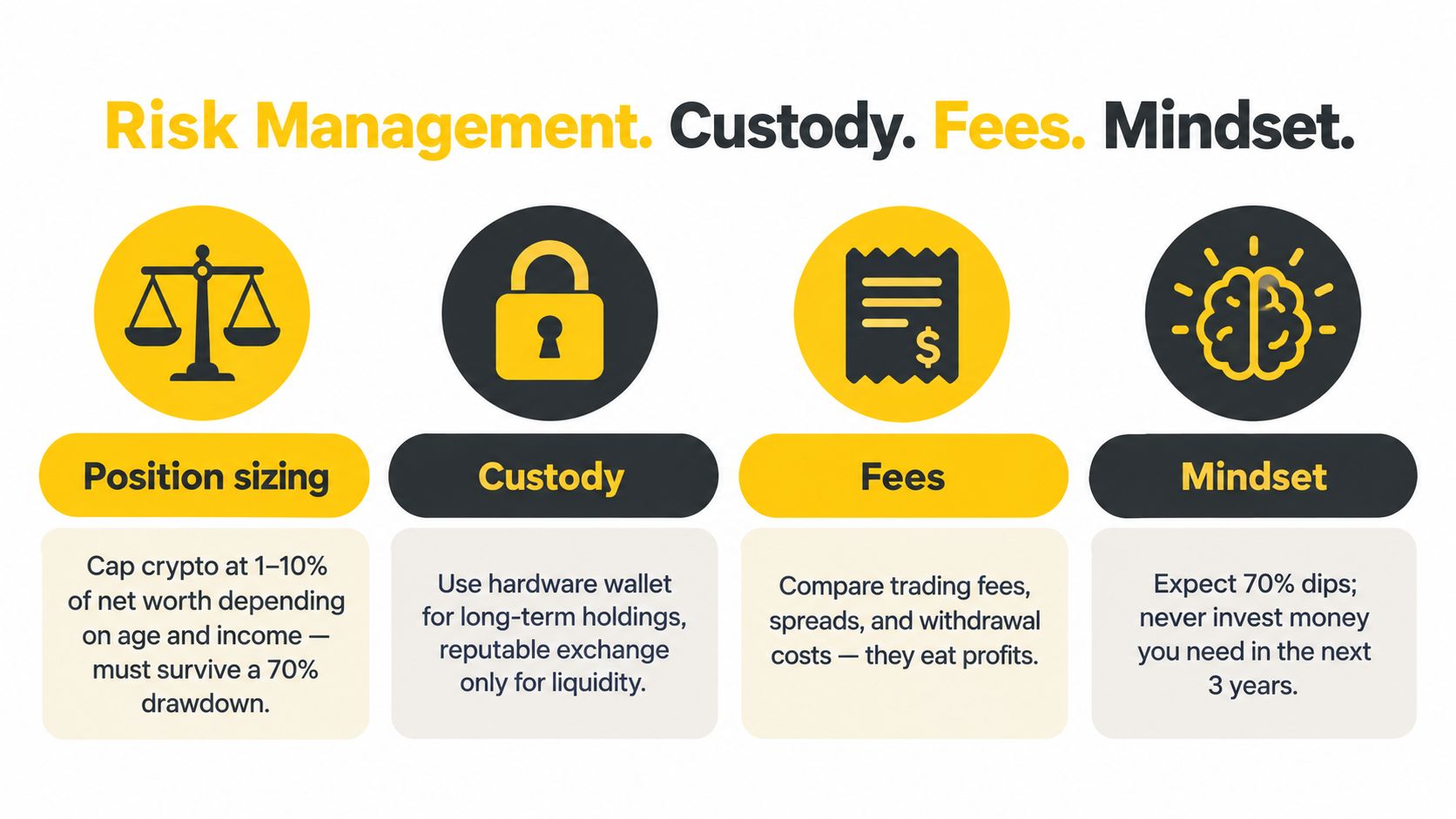
Size the position so you can survive being wrong
Bitcoin has a long history of brutal drawdowns during broader multi-cycle growth. That is normal behavior for this asset, not a rare accident. Your position has to reflect that reality.
A practical rule is simple. Buy an amount that would still let you sleep if Bitcoin gets cut in half and then keeps falling. For some buyers, that means a very small allocation. Good. Small is fine if it keeps you rational.
A rough range many buyers use is 1 to 10 percent of net worth, but the exact number matters less than this test: if a sharp selloff would push you into panic, your size is too big.
Custody is part of the entry decision
Buying Bitcoin without a storage plan is sloppy.
If you plan to trade around the position, holding some coins on a reputable exchange can be reasonable. If you plan to hold for months or years, move to self-custody and learn the process before your stack gets meaningful. This guide on how to store Bitcoin safely is a good place to start.
Do not treat custody like admin work. Treat it like ownership.
Fees quietly ruin average entries
A decent setup can turn mediocre once fees, spreads, and withdrawal friction are added in. New buyers miss this all the time because they focus only on headline price.
Check these before you place any order:
- Trading fees: Know the maker and taker cost, not just the marketing page
- Spread: A bad spread acts like an extra hidden fee
- Withdrawal terms: Some platforms make self-custody slower or more expensive than expected
- Tax recordkeeping: Your future paperwork starts the day you buy
This matters more if you are using phased entries. Four small buys on an expensive platform can be worse than one well-placed buy on a cheaper one.
Your mindset decides whether the plan survives contact with volatility
The hard part is rarely finding a decent buy window. The hard part is sticking to your rules when price gets ugly, headlines get louder, and your last purchase immediately goes red.
Write down three things before you buy: your intended allocation, where the coins will be stored, and what would make you add, pause, or stop. If that feels excessive, you are still treating Bitcoin like a bet instead of a position.
Automation can help, but blind automation is still lazy decision-making. If you want a clearer sense of how structured systems differ from copying trades without understanding them, read why copyfomo is different.
One factual example from the broader mining side of crypto: projects such as Cascoin follow a different path, focusing on open-source participation and multiple mining methods rather than a Bitcoin timing product. That distinction matters. Not every smart crypto move is about finding the perfect buy date.
Three Real Buyer Profiles and How They Would Act
Advice gets clearer when you attach it to a real person.
Not everyone asking when should I buy Bitcoin needs the same answer. The right move depends on experience, cash flow, and how actively you want to manage the position.
Profile one is the cautious saver
This buyer is new, budget-conscious, and doesn't want to stare at charts.
They care more about building a position than maximizing entry precision. For them, the right action is boring on purpose: build cash reserves first, set an auto-buy, and ignore most of crypto Twitter. They don't need RSI, MVRV, or a hot take on seasonality. They need consistency.
Action summary: Use automatic DCA and keep the position small enough that volatility won't interrupt your life.
Profile two is the cycle trader
This buyer likes setups and can follow rules.
They won't buy just because price is down. They wait for structural confirmation, then ladder in as signals align. They also write the exit before the entry. That's the key difference between a trader and a tourist.
The trader's edge usually isn't prediction. It's obeying a plan when everyone else is reacting emotionally.
Profile three is the long-term accumulator
This buyer already believes Bitcoin deserves a meaningful place in the portfolio.
They aren't obsessed with the exact candle. They care about whether the broader window looks reasonable. They may use a partial lump sum during an accumulation phase, then rebalance over time instead of treating every dip like a personal emergency.
| Buyer Profile Comparison: Cautious Saver vs Cycle Trader vs Long-Term Accumulator | |||
|---|---|---|---|
| Dimension | Cautious Saver | Cycle Trader | Long-Term Accumulator |
| Main goal | Build exposure slowly | Capture a cleaner cycle entry | Build and hold a strategic position |
| Best entry method | DCA | Phased entry with triggers | Lump sum plus selective adds |
| Use of charts | Minimal | High | Moderate |
| Reaction to drawdowns | Keep buying if size is small | Reassess signals and stick to rules | Treat as possible reentry or rebalance event |
| Exit style | Flexible, often long hold | Prewritten trading plan | Rebalancing-based |
Action summary: Buy in windows, not in panic, and judge success by process before outcome.
Your Decision Checklist and an Honest Disclaimer
At this point, the answer to when should I buy Bitcoin should feel less mystical.
You buy when your finances can handle the volatility, your strategy matches your time horizon, and market conditions are reasonable enough to justify entry. Not because a month looks seasonally strong. Not because someone online posted rocket emojis. Not because you're bored.
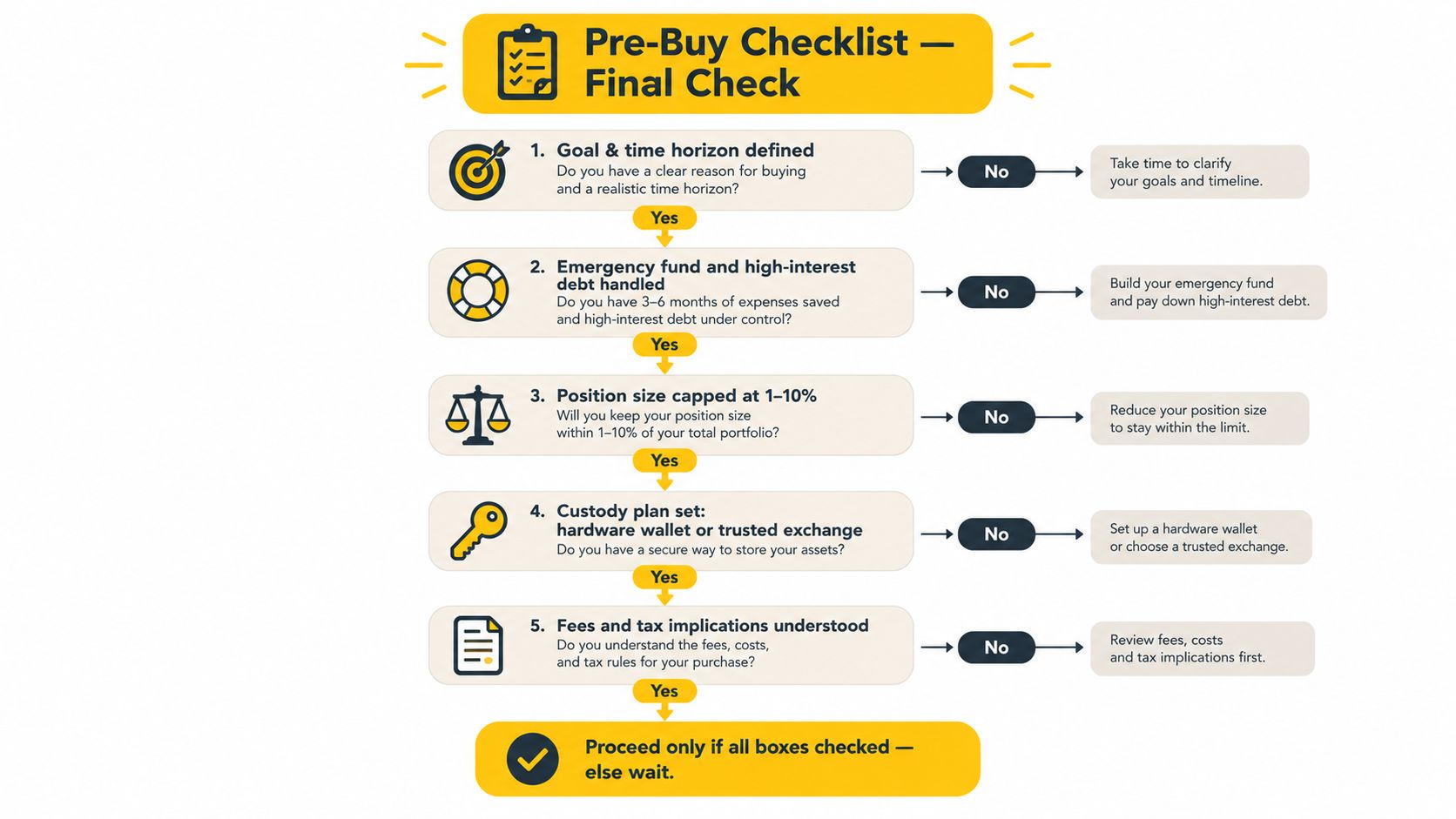
Use this before every buy
Run through this list and be ruthless:
- Goal is defined: You know whether this is speculation, diversification, or a long-term hold.
- Time horizon is real: You can hold through ugly periods without needing the money soon.
- Emergency basics are handled: High-interest debt and cash-buffer issues aren't forcing the trade.
- Position size is capped: You know the maximum portfolio share you're willing to risk.
- Entry method is chosen: DCA, lump sum, or phased entry is decided in advance.
- Triggers are written down: If you're using technical or on-chain signals, they're specific.
- Custody plan exists: You know where the coins will live after purchase.
- Fees and taxes are checked: You understand the cost of acting.
- Behavior rules are set: You know what you'll do if price drops hard after entry.
The disclaimer that matters
This is not personalized investment advice. It's a decision framework.
Bitcoin is volatile. Historical patterns can help, but they don't guarantee future outcomes. Even useful signals fail. Even good entries can look stupid for a while. If you're making a meaningful allocation, talk to a qualified financial professional who understands your broader situation before acting.
The advantage isn't certainty. The advantage is having a process when everyone else is guessing.
If you're trying to make smarter crypto decisions, Cascoin offers a practical mix of crypto education, mining-related insights, and a transparent open-source project you can inspect instead of blindly hype-chasing. If this article helped you think in terms of conditions instead of calendar dates, spend a little time on Cascoin's blog and project pages. It's a good next step if you want to understand crypto more before making your next move.